
How Credit Risk and Interest Rate Dynamics Influenced First Merchants’ 2025 Financial Results
First Merchants Corporation’s 2025 results reflect the balancing act of managing credit risk in a diversified loan portfolio alongside interest rate impacts on net interest income and capital deployment.
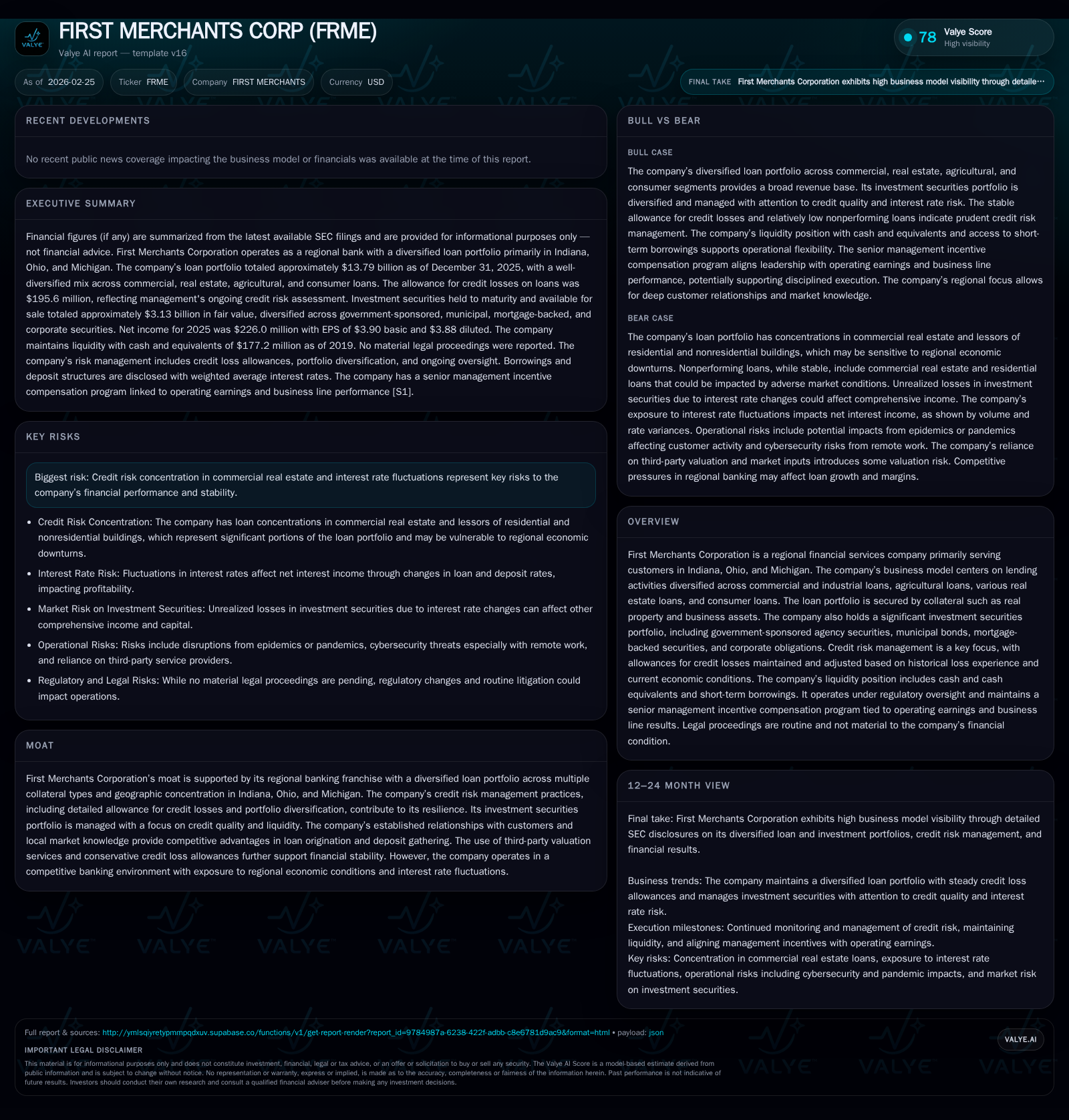
First Merchants Corporation sustained a 12.2% increase in net income in 2025, driven by loan volume growth despite rate pressure on net interest margins. The company’s diverse collateral-backed loan portfolio remains centered in Indiana, Ohio, and Michigan with commercial and industrial loans gaining share. While credit loss provisions rose moderately to reflect emerging risks in commercial real estate, robust capital returns resumed with increased dividends and buybacks. Liquidity management leveraged short-term borrowings with stable costs, underpinning operational cash flow growth. Looking ahead, ongoing monitoring of commercial real estate exposure and interest rate fluctuations will be critical amid evolving regulatory and economic conditions.
First Merchants’ Historical Profitability and Drivers of Net Interest Income
First Merchants Corporation reported solid financial performance for fiscal year 2025, delivering net income of $226 million—a healthy increase of approximately 12.2% compared to $201 million in 2024 [F1]. This uptick contrasts the flat-to-negative impact often seen in regional banks when navigating rising interest rate environments or challenging credit cycles.
The company’s net interest income dynamics illustrate this complexity: loan volumes expanded contributing roughly $31 million in tax-equivalent basis interest income, but this was more than offset by an unfavorable $53 million rate variance primarily reflecting compressive yield curves and competitive funding pressures [S1][S27]. Interest expense benefitted from rate declines on deposits showing a combined $38 million net improvement driven mostly by money market accounts despite some headwinds in other deposit categories.
Detailed net interest income (fully taxable equivalent) volume vs rate shifts underscore how First Merchants is leveraging volume expansion amid tightening spreads:
Historical performance (annual)
| FY | Net ($mm) | CFO ($mm) | Net YoY |
|---|---|---|---|
| 2025 | 226 | 284 | +12.2% |
| 2024 | 201 | 266 | -10.0% |
| 2023 | 224 | 259 | +0.8% |
| 2022 | 222 | 268 |
Note: Omitted columns lack sufficient annual XBRL coverage in the provided tags (need ≥2 annual points): Rev, OpInc, Capex, FCF. Source: SEC companyfacts cache [F1].
Capital returns and efficiency (annual)
| FY | Div ($mm) | Buybacks ($mm) | ROE% |
|---|---|---|---|
| 2025 | 83 | 47 | 9.2 |
| 2024 | 82 | 56 | 8.7 |
| 2023 | 80 | 0 | 10.0 |
| 2022 | 73 | 0 | 10.9 |
Source: SEC companyfacts cache [F1].
Note: Buyback data unavailable prior to FY2024; Operating Income/Revenue figures not provided in available tags [F1]
Detailed Loan Portfolio Composition and Evolution Since 2021
First Merchants’ lending model is distinctly characterized by a diversified mix of collateral-secured loans concentrated principally across Indiana, Ohio, and Michigan [S20]. The total loan portfolio grew notably by approximately $937 million from the end of FY2024 to reach about $13.8 billion as of December 31, 2025.
Commercial and Industrial (C&I) loans accounted for the largest component at $4.48 billion or roughly one-third (32.4%) of total loans—up from $4.11 billion (32%) the prior year—signaling intensification toward higher yielding commercial credits [S20][S22]. Agricultural loans remained stable at about $283 million (2.1%).
Within real estate categories, which collectively represent over half the portfolio by value, non-owner occupied commercial real estate loans stood at approximately $2.3 billion (17%) with owner-occupied CRE another sizable segment totaling roughly $1.24 billion (9%). Residential mortgage loans constituted about $2.42 billion or approaching one-fifth (17.5%), supported by home equity lines aggregating over $700 million (5%). The construction loan bucket contracted modestly but still represented close to $805 million (6%) [S22].
Loan maturities show substantial longer-term duration especially within residential mortgages, where over two-thirds mature beyond five years—supporting franchise stability but also concentration risk assessment [S20].
Investment Securities Management Amid Yield Curve Volatility
The investment securities portfolio remains a critical element of First Merchants’ asset composition, comprising high-quality government-sponsored agency securities, municipal bonds, mortgage-backed securities, and corporate obligations [S4][S14]. The amortized cost stood at nearly $1.57 billion for available-for-sale securities at end-2025 with fair value adjustments demonstrating significant unrealized losses reflecting widespread interest rate increases.
Despite unrealized losses exceeding $168 million primarily due to duration exposure amid volatile yield curves, management reported no impairment allowances for credit losses as losses were market-driven rather than credit-related [S17][S18]. Portfolio valuation employs third-party market inputs classified under Level 1 and Level 2 hierarchy levels with discounted cash flow models used selectively for Level 3 instruments providing valuation rigor [S4].
Yield moderations were evident: U.S government-sponsored mortgage-backed securities averaged a taxable equivalent yield near ~2%, while state and municipal bonds averaged approximately ~3%, supporting steady albeit compressed investment returns [S19].
Operating Cash Flow Trends and Underlying Economic Factors
Cash flow from operations demonstrated consistent strength with an approximate year-over-year increase of about $18 million (+6.5%), reaching nearly $284 million in FY2025 [F1]. This operational cash generation points to resilient core earnings quality insulated somewhat from volatility in accounting-based net income or one-time provision movements.
Core deposit growth—though not quantified explicitly—is inferred from cash flow profiles and deposit expense dynamics implying stable funding sources fundamental to balance sheet expansion without reliance on more costly external borrowings.
Capital Structure, Short-Term Borrowings, and Liquidity Management
Strategic liquidity management has been pivotal: total short-term borrowings increased from roughly $523 million at end-2024 to an elevated level near $734 million as of end-2025 [S7]. This includes federal funds purchased ($40 million), repurchase agreements ($104 million), Federal Home Loan Bank advances ($75 million), and subordinated borrowings ($1 million) maturing within one year [S5][S7].
Weighted average cost of these borrowings rose modestly but remains efficient at about 2.8%, indicating effective borrowing cost management despite general monetary tightening climates [S5]. The mix prioritizes secured funding via government-sponsored enterprise obligations underlying repo agreements ensuring liquidity buffers meet regulatory and operational standards.
Equity capital increased substantially in line with earnings retention plus issuance outcomes; stockholders’ equity grew more than $160 million year-over-year reaching nearly $2.47 billion [F1].
Shareholder Returns: Dividends, Buybacks, and ROE Profile
First Merchants maintained disciplined capital returns throughout FY2025 with dividends paid increasing marginally to approximately $82.9 million compared to about $81.6 million the prior year [F1][S3]. Dividend per common share was declared at an indicated rate supporting steady yield expectations.
Notably buybacks resumed with repurchases totaling nearly $46.9 million in FY2025 after being nil before FY2024 [F1], signifying confidence in balance sheet health while balancing capital redeployment needs.
Return on Equity stabilized at an estimated level near ~9.2%, computed as annual net income over fiscal year-end stockholders’ equity, illustrating reasonable profitability given current macroeconomic challenges [F1]. The payout ratio demonstrates conservative but consistent distribution policies compatible with strong allowance coverage for potential credit losses.
Forward-Looking Considerations: Credit Risk Exposure and Regulatory Environment
Credit risk remains the paramount challenge given First Merchants’ notable exposure to commercial real estate lending sectors which together exceed one-quarter (~27%) of the total loan book when combining owner-occupied and non-owner occupied segments [S12][S20]. Within these portfolios two industry concentrations—Lessors of Residential Buildings (11.4% total loans) and Lessors of Nonresidential Buildings (10%)—exceed key concentration thresholds requiring ongoing risk monitoring per regulatory guidance [S12].
Allowance for Credit Losses on loans increased slightly by about $2.8 million during FY2025 ending at nearly $195.6 million representing robust reserves aligned with current expected credit loss (CECL) methodology incorporating forward-looking economic scenarios including pandemic-related uncertainties noted among risk factors [S12][S21][S8]. Net charge-offs moderated significantly from previous peaks indicating improving portfolio performance albeit early signs show shifting delinquency patterns especially within residential nonaccrual balances rising modestly offsetting declines elsewhere [S13][S21].
Additionally, regulatory environment retains focus on operational resilience amidst cybersecurity threats heightened by pandemic-related remote work exposures as well as compliance vigilance over liquidity coverage ratios and stress testing frameworks applicable for regional banks like First Merchants [S15][S8]. Legal exposures remain minimal with no material litigation affecting financial condition or guidance disclosures as confirmed in filings [S8].
Key Milestones and Market Risks to Monitor in Coming Years
Going forward stakeholders should closely watch quarterly filings for shifts in:
- Loan portfolio compositions particularly CRE concentrations relative to borrower industry codes,
- Changes or tiering within allowance for credit losses reflecting evolving macroeconomic forecasts,
- Short-term borrowing levels given dynamic funding cost environments,
- Capital return policies balancing shareholder demands against prudent reserve build-up,
- Regulatory updates impacting liquidity coverage ratios or stress scenario assumptions,
- And any emerging operational risks tied to cybersecurity or pandemic-economic recovery trajectories.
Analysts note that while explicit guidance on future milestones is absent currently—given no direct forecast disclosure—these factors represent key barometers shaping First Merchants' earnings sustainability through anticipated cyclical phases.
Disclaimer: This report is based solely on public SEC filings dated through February 25, 2026, company facts data extracts as cited ([F1],[S#]), and does not constitute investment advice or recommendations.
Disclaimer: This is research-only, informational analysis and not investment advice. It may include AI-generated interpretation and general industry context. Always verify important details using primary sources.

Comments