
Camber Energy Advances Patented Clean Tech Amid Critical Liquidity Challenges
Latest quarterly report highlights technological progress but reveals pressing financial constraints, shaping near-term commercialization prospects.
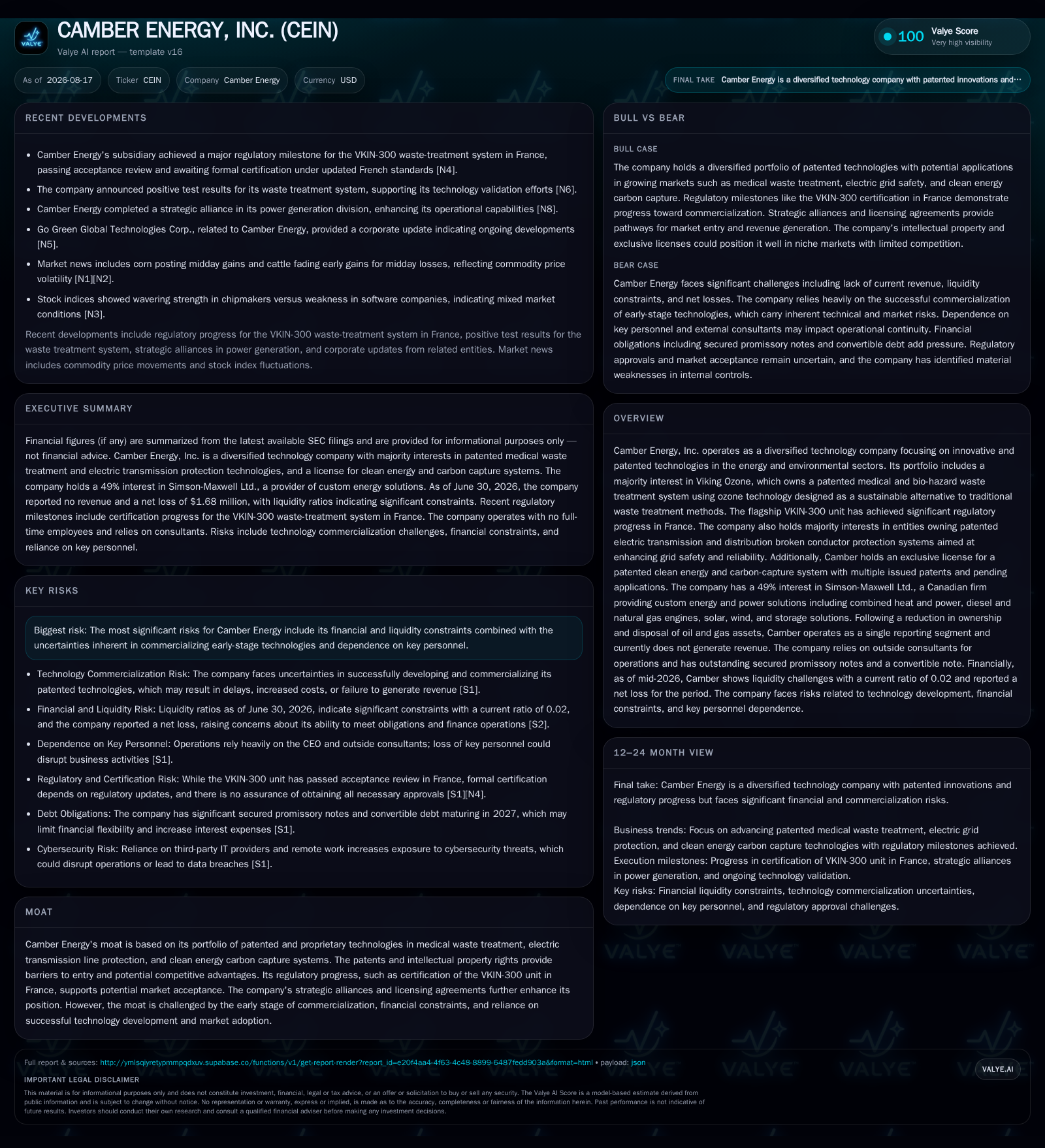
Camber Energy, Inc. continues to develop a diversified portfolio of patented technologies spanning medical waste treatment, electric transmission protection, and carbon capture systems. Recent regulatory milestones, notably in France for its VKIN-300 bio-hazard treatment unit, bolster the prospects of technology adoption. However, the company's financial position remains strained with a current ratio near 0.02 and significant liabilities, underscoring liquidity risks that could impede commercial scaling. Strategic alliances and intellectual property rights constitute Camber’s main competitive moat amid commercialization uncertainties typical of early-stage clean tech ventures.
Recent Operating Update
Camber Energy's latest quarterly filing dated August 13, 2026, reaffirms the company’s continued focus on developing innovative technologies in energy and environmental sectors [S2]. The quarter reported no material change in risk factors from its previous filings but exposed mounting liquidity challenges given current assets of approximately $1.46 million versus current liabilities north of $64 million as of June 30, 2026 [F1].
Further context comes from a June 4, 2026, event filing disclosing the strategic amalgamation of Simson-Maxwell Ltd., a Canadian entity in which Camber holds a significant minority interest (49%), into T&T Power Group Inc., marking a consolidation move within its custom energy solutions segment [S3]. Simson-Maxwell specializes in clean-tech energy systems including combined heat and power (CHP), industrial engines compliant with stringent tier 4 emissions standards, solar, wind components, and electrical control equipment such as switchgear and paralleling gear [S1]. This restructuring could signal attempts to streamline operations or leverage scale synergies.
The Viking Preferred Shares underline substantial redemption obligations with redemption privileges commencing March 31, 2028 at approximately CDN$7.75 million (USD $5.6 million) escalating to CDN$8.52 million under deferred payment options; these shares hold senior liquidation preference over common stock potentially crystallizing future liquidity demands [S3]. Monthly payment provisions of around USD $11,000 add incremental fixed outflows that will need careful management.
Business Model Analysis
Camber operates principally as an IP-driven technology developer diversified across energy innovation niches: patented ozone-based bio-hazard waste treatment systems (majority through Viking Ozone), electric transmission line broken conductor protection technologies (via Viking Sentinel/Protection), and an exclusive license for advanced clean energy carbon-capture technologies concentrated geographically in Canada and select U.S. states [S1].
Revenue generation mechanics rely heavily on technology licensing, sale or deployment of proprietary equipment such as the VKIN-300 medical waste treatment unit designed for sustainable disinfection ideally replacing conventional incineration or chemical processes [S1]. The reuse aspect — enabling treated waste classification as renewable fuel suitable for waste-to-energy facilities — introduces compelling green credentials appealing to regulatory authorities and environmentally conscious stakeholders.
The company's minority stake in Simson-Maxwell complements these IP assets by providing end-market exposure through customized turnkey clean energy systems integrating renewables and emissions-compliant engines [S1]. This creates diversified revenue opportunities beyond pure technology licensing into services and equipment sales within industrial and commercial client segments
However, actual revenue remains minimal thus far ($6.23 million most recently reported) with operating losses exceeding $7.9 million indicative of early-stage commercialization phases where R&D intensity outpaces monetization [F1]. The business model depends critically on achieving regulatory certifications (as evidenced by recent progress with French authorities) and subsequent customer adoption supporting meaningful licensing fees or equipment sales volume.
Industry Structure and Competitive Position
Operating at the intersection of diversified energy technology development and environmental solutions places Camber amid several distinct yet adjacent peer groups: clean technology developers like Bloom Energy focusing on solid-state fuel cells; electric transmission equipment giants such as ABB or Siemens; bio-hazard waste specialists akin to Stericycle; plus carbon capture firms like Carbon Clean Solutions.
Camber’s competitive moat primarily arises from its patent portfolio spanning multiple proprietary technologies — particularly the U.S. Utility Patent No. 11,565,289 for its ozone-based medical waste system — combined with geographical exclusivity on certain licenses enhancing barriers to entry [S1]. The recent milestone wherein the VKIN-300 unit passed compliance review under one of the world’s strictest French standards (NFX 30-503) signifies a potent validation moment that could ease broader European market entry once certification is formally granted contingent on regulatory decree updates [S1].
Nonetheless, these advantages are balanced against substantial commercialization challenges: being a relatively small player lacking scale compared to industrial incumbents limits bargaining power with large utilities or waste management firms accustomed to established vendors. Moreover, regulatory delays pose non-trivial risks as certifications underpin market acceptance.
Growth Drivers
Several macro trends support long-term demand for Camber’s core offerings:
- Increasing global environmental regulations pushing medical facilities towards sustainable bio-hazardous waste treatment alternatives that reduce toxic emissions.
- Rising emphasis on grid reliability and safety necessitating advanced monitoring/protection solutions like broken conductor detection minimizing outages—areas served by Camber’s patented transmission technologies.
- Expanding government incentives targeting clean energy adoption including carbon capture projects aligned with decarbonization targets in North America.
- Growing volume of regulated medical waste worldwide fostering demand for effective treatment units qualifying as renewable fuel sources to feed circular economy models.
- Strategic partnerships such as the Simson-Maxwell amalgamation broadening market reach into integrated commercial energy installations.
Achieving tangible milestones such as certification completions, pilot deployments reaching scale, growing royalty/licensing income streams, or new alliance formations would serve as clear indicators validating these growth vectors.
Risks and Growth Constraints
Key vulnerabilities tempering outlook include:
- Acute financial strain highlighted by extremely poor short-term liquidity posing existential threat absent capital infusions; inability to sustain R&D investments risks stalling critical product advancements [F1],[S2].
- Prolonged regulatory approval timelines creating uncertainty about when or if technologies will secure necessary market authorizations especially outside initial jurisdictions.
- Commercialization risk wherein fully developed patents may prove uncompetitive due to inferior performance or cost dynamics relative to mature incumbent solutions.
- Dependence on a small team for specialized technical expertise heightens operational risk should key personnel depart given limited bench strength reported historically.
- Potential intellectual property infringement claims from competitors that could incur costly litigation or impede freedom to operate although no active disputes currently disclosed [S1].
- Redemption obligations on preferred shares represent looming cash flow drains that may constrain reinvestment capacity or force asset sales.
These constraints underscore the importance of orderly financial management alongside rapid execution against regulatory goals and partner negotiations.
What to Watch Next
Monitoring key upcoming developments will clarify Camber’s trajectory:
- Formal issuance of French VKIN-300 certification following anticipated decree amendments—this triggers meaningful commercial ramp-up potential across European markets.
- Progress in commercial deployment of broken conductor protection systems capturing utility customers seeking grid reliability enhancements.
- Expansion of licensing deals or joint ventures leveraging the company’s patented carbon capture technologies within Canada or select U.S. states internationally protected under exclusivity agreements.
- Operating cash flow trends in subsequent quarters revealing whether liquidity pressures are easing or intensifying relative to prior reporting cycles.
- Any refinancing actions addressing Viking Preferred Shares’ sizable redemption payments becoming due starting March 2028.
- Milestones around new patent grants or applications reinforcing IP moats against emerging competitors.
Closer scrutiny of these milestones can validate both operational execution capability and financial sustainability moving forward.
Financial Profile Discussion
Camber Energy's financial profile reflects typical characteristics of early-stage diversified technology developers heavily invested in R&D with limited current revenue generation capacity [F1]. As of June 30, 2026, the company reported current assets totaling roughly $1.46 million contrasted starkly by current liabilities exceeding $64 million [F1].
Total debt stood at approximately $5.07 million mid-2023 adjusted for net debt position around $3.9 million after accounting for cash balances from late 2022 serving as rough liquidity cushions [F1],[S3]. Notably, redemption provisions related to Viking Preferred Shares introduce further contingent liabilities scheduled from March 31, 2028 onward requiring payments upward of USD $5.6 million over varied timelines plus accrued dividends creating sizable future cash demands [S3].
Efficient management of costs alongside timely achievement of certification and licensing milestones will be critical for transitioning toward breakeven operations accompanied by scalable revenue streams derived from royalties or equipment sales underpinned by validated proprietary technologies.
Disclaimer: This is research-only, informational analysis and not investment advice. It may include AI-generated interpretation and general industry context. Always verify important details using primary sources.

Comments