
Century Aluminum’s Earnings Rebound Amid Power Cost Challenges
Century Aluminum achieved a significant operating income turnaround in 2025 while managing volatile power costs through integrated assets and strategic contracts.
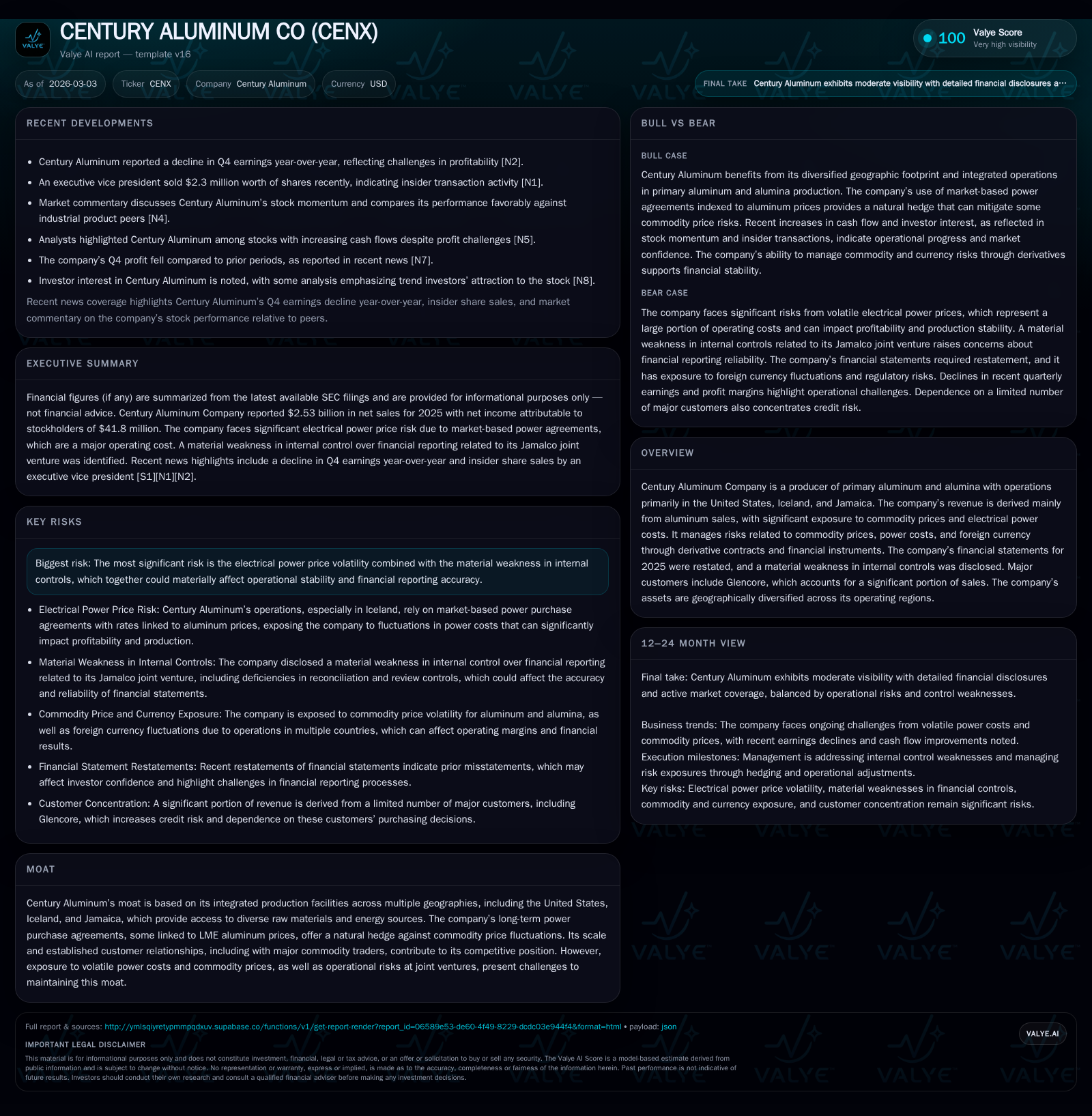
Century Aluminum reversed prior losses to record a 30.2% increase in operating income to $158.1 million in 2025, backed by its diversified production footprint and long-term power supply agreements. Despite the net income declining by 87.6% due to restatements related to joint venture accounting and material control weaknesses, operational cash flow surged by 852%, reflecting improved earnings quality. The company faces ongoing risks from electrical power price volatility and commodity cycles but is investing heavily in sustainability and restart projects while maintaining disciplined capital structure management.
Financial Turnaround in 2025: From Losses to Positive Operating Income
Century Aluminum navigated a challenging macro backdrop to deliver a pronounced earnings turnaround in fiscal year 2025. The company recorded operating income of $158.1 million, up 30.2% versus the prior year [F1], recovering robustly from a negative -$150.2 million operating loss reported in 2022 [F1]. This improvement unfolded during a top-line contraction of -10.7%, reflective of slower aluminum demand and price weakness persisting through parts of the year [F1]. Net income results were more nuanced; while positive at $41.8 million, this figure represents a steep decline of -87.6% from prior year levels [F1] primarily due to restatement impacts from adopting full consolidation of its Jamalco joint venture and corrections related to internal control deficiencies flagged in filings [S1][S3][S20]. Notwithstanding these accounting challenges, cash flow from operations demonstrated striking resilience, climbing over eightfold (+852%) to $185 million on strengthened earnings quality and working capital improvements [F1]. Capital expenditures increased moderately (+21.7%) to $100.2 million as the company invested in maintenance and growth initiatives [F1][S1].
Historical performance (annual)
| FY | Net ($mm) | CFO ($mm) | OpInc ($mm) | Capex ($mm) | Net YoY |
|---|---|---|---|---|---|
| 2025 | 42 | 185 | 158 | 100 | -87.6% |
| 2024 | 337 | -25 | 121 | 82 | +881.4% |
| 2023 | -43 | 106 | 32 | 95 | -205.7% |
| 2022 | -14 | 26 | -150 | 86 |
Source: SEC companyfacts cache [F1].
Capital returns and efficiency (annual)
| FY | FCF ($mm) | ROE% |
|---|---|---|
| 2025 | 85 | 5.2 |
| 2024 | -107 | 48.5 |
| 2023 | 11 | -12.1 |
| 2022 | -60 | -3.5 |
Source: SEC companyfacts cache [F1].
Note: 'NA' for revenue values reflects unavailable comparable data after restatements; percentage changes reflect latest year-over-year figures where available.
Operational Drivers Behind Recent Performance Improvements
Century Aluminum's operational foundation is anchored by integrated primary aluminum production facilities spread across the United States (including Mt. Holly and Hawesville), Iceland (Grundartangi), and Jamaica (Jamalco). This geographic diversification enables access to varied raw material supplies—bauxite mining and alumina refining in Jamaica complement smelting operations elsewhere—and most critically, different energy grids characterized by distinctive generation mixes [S1]. Grundartangi benefits substantially from hydroelectric and geothermal sourced power under long-term purchase agreements with terms extending through mid-2030s, providing some insulation from fossil fuel-induced price volatility typical within traditional grids [S1]. These contracts often incorporate pricing components tied directly or indirectly to London Metal Exchange (LME) aluminum prices, constitutionally aligning energy costs with metal realizations—a salient natural hedge absent in run-of-mine competitors.
Operational parameters such as 'pot stability' are especially sensitive to fluctuations in energy availability and quality; interruptions or spikes can precipitate cell deterioration or halt production altogether [S1]. Across key sites—Sebree, Mt. Holly, Grundartangi—the aggregate annual megawatt load exceeds roughly 11.6 million MWh under full capacity scenarios [S1], underscoring power as one of the dominant cost inputs.
Capital Expenditures Focused on Sustainability and Restart Projects
Capital expenditure outlays maintained an upward trajectory in fiscal year 2025 at $100.2 million compared with $82.3 million in the prior year (+21.7%) [F1][S1]. Notable allocations include approximately $60-$70 million earmarked for repairing infrastructure damage at Iceland's Grundartangi facility—costs partly offset by anticipated insurance recoveries—as well as around $45 million invested toward restarting Mount Holly operations paused in previous years due to economic conditions [S1]. Additional funds targeted upgrades at the Jamalco alumina plant ($25 million), emphasizing both efficiency improvements and compliance with evolving environmental standards.
These capex efforts align tightly with Century's sustainability agenda focused on reducing emissions intensity while securing operational reliability essential for maintaining 'pot stability.' Continued investment in modernizing energy-intensive processes signals management’s intent to sharpen cost competitiveness despite external headwinds [S1].
Power Supply Agreements and Their Impact on Cost Structures
Power procurement arrangements constitute one of Century Aluminum’s pivotal competitive levers but also embed substantial risk exposure given their variable cost nature linked partially to LME aluminum prices [S1]. Grundartangi benefits from three principal suppliers—HS Orka, Landsvirkjun, and Orkuveita Reykjavíkur—with agreements staggered between fixed rates plus variable LME-linked components through expirations ranging from 2026 up to potentially extended periods until circa 2036 [S1].
An illustrative sensitivity analysis highlights that every $1 per MWh shift corresponds approximately to a nearly $16 million annual expense variance company-wide, signaling outsized margin impact potential given total expected consumption exceeding eleven million MWh annually across facilities [S1]. For example, Sebree (3.37M MWh), Mt Holly (3.50M MWh), and Grundartangi (~4.75M MWh) contribute materially respective shares of this load.
Given grid dynamics, transmission limitations, fuel price fluctuations (natural gas, coal), weather extremes affecting renewables output, or tightened regulatory regimes could cause abrupt cost pressures or operational curtailments impacting potline availability directly [S1]. In response, Century employs financial derivatives periodically designed to hedge downside power price risks though such measures generally cannot fully neutralize inherent market volatility.
Commodity Price Exposure and Risk Mitigation Strategies
Revenue derives predominantly from direct aluminum sales; thus exposure to commodity price cyclicality is structurally significant [S1][N5]. Century manages certain input cost volatilities—including bauxite/alumina feedstock pricing embedded partly via long-term contracts—and foreign currency risks resulting from operations denominated variously in Icelandic krona (ISK), Euro, Jamaican dollars among others [S12][N5]. Currency fluctuations affect labor costs, maintenance expenses, local tax liabilities as well as deposits held regionally.
Derivatives are actively deployed against these risks including forward contracts covering exchange rate exposures as well as commodity swaps designed specifically around LME benchmarks prevalent industry-wide [S1][S12]. While these hedges offer mitigative relief during periods of sharp price movements for inputs or currencies correlated closely with aluminum prices or geopolitical developments, Century’s exposure remains sensitive because its margins hinge on tightly coupled variable cost streams.
Thus the company's integrated asset footprint combined with partially indexed power agreements creates a partial ‘natural hedge’ posture; however operational vigilance is essential given residual unhedged elements exist.
Balance Sheet Strength, Liquidity, and Debt Profile Analysis
Century Aluminum's capital structure reveals enhanced liquidity positioning complemented by prudent leverage management during ongoing recovery phases [S4–S10][F1]. As of December 31, 2025 current assets stood at approximately $1.03 billion versus current liabilities totaling roughly $524 million yielding a current ratio near a healthy ~1.97x based on raw XBRL extracts [F1]. This buffer supports working capital needs amid volatile input costs.
Significant debt adjustments occurred throughout the period including redemption of higher coupon notes totaling more than $260 million during mid-2025 linked largely to improving cash flows enabling refinancing efforts at lower cost structures [S5][S11]. The issuance of senior secured notes aggregating $400 million maturing mid-2032 furthers funding flexibility while maintaining senior secured status collateralized by principally domestic subsidiaries’ assets [S16][S17].
Revolving credit facilities remain undrawn currently but commitments totaling several hundred millions remain accessible providing additional liquidity cushions if required especially for capex or operational contingencies [S4][S10]. Covenants embedded within these credit agreements impose customary restrictions on dividends, acquisitions/higher indebtedness issuance which constrain free deployment yet safeguard creditor confidence [S4][S5][S7][S18].
Returns and Cash Flow: What the Numbers Reveal About Shareholder Value
Centuries' trailing return metrics reflect incremental restoration following tumultuous prior years: normalized Return On Equity (ROE) calculates approximately at modest 5.2%, derived simply from net income ($41.8 million) over average equity base ($805 million) for latest fiscal period per reported figures [F1]. Free cash flow approximates around $85 million calculated by subtracting capex [$100M] from operating cash flow [$185M], reinforcing improved internal cash generation capacity supporting deleveraging or shareholder distributions potential over medium term absent covenant limits [F1][S21].
Despite having an authorized repurchase program valued up to $130 million originally established nearly a decade ago,the company has not executed material buybacks during recent years largely reflecting capital preservation priorities amid cyclical uncertainty alongside spending commitments on sustainability/restart projects detailed above — managed buybacks remain discretionary should liquidity improve further [F1][S21]. Dividend payments are similarly restrained given credit facility limitations acknowledging priority rerouted towards strengthening operational foundations.
Future Outlook: Growth Constraints and Emerging Opportunities
Looking ahead into calendar year 2026 and beyond, Century Aluminum confronts layered constraints tied chiefly to volatile electrical power costs which remain a significant variable overhead element amplified especially in market-based supply regions subject to intermittent supply/demand imbalances within wholesale markets [N5][S12][N1]. Sustained energy price hikes beyond LME-linked escalators may erode margin buffers rapidly requiring enhanced compensation via operational efficiencies or downstream premium sales opportunities.
Operational risk clusters also focus on the Jamalco joint venture where restatement adjustments revealed historical material weaknesses suggesting persistent vigilance required concerning financial reporting integrity alongside continuing efforts underway regarding governance improvements announced recently [S3][N9].
Growth prospects reside principally around reactivation of Mt Holly smelting capacities representing incremental tonnage infusion circa mid-decade timeframe contingent upon successful restart investments already progressing per disclosed capex plans alongside continuous optimization drives at existing core sites including Grundartangi refurbishment expected reimbursed partially through insurance proceeds thus lowering net investment abstraction pressures – each project incrementally adds scale leverage critical for longer-term competitiveness within an industry increasingly pressured by ESG-oriented stakeholders seeking sustainable aluminum supply chains [N5][N10][N13].
Watchpoints: Key Metrics and Developments for Investors
Investors monitoring Century Aluminum should focus attentively on several near-to-medium term catalysts including quarterly earnings trends relative to consensus estimates particularly evaluating whether operational turnaround momentum sustains amidst fluctuating metal markets evidenced early Q4/25 results underperforming expectations per reports [N1][N9]. Equally important will be disciplined execution against elevated capex budgets targeting repair/restoration projects with follow-through impacts on operational uptime plus verifying progress addressing internal controls highlighted transparency concerns per recent SEC filings advising restatements coupled with public disclosures signaling remedial actions underway but incomplete currently [S3][N4].
Further liquidity/maturity profile shifts such as refinancing activity or possible covenant renegotiations will shed light on capital flexibility meanwhile insider selling activity — exemplified recently by EVP stock dispositions valued at multiples millions — warrants scrutiny vis-à-vis confidence signals embedded therein [N4][N13]. Ongoing power market developments influencing energy contract negotiations or spot market disruptions represent systemic sector-native risk dimensions underscoring importance for pointed technological/process innovations addressing pot stability reliability crucial not only for Century but broadly reflective across primary aluminum producers reliant on multi-terawatt-hour consumption patterns.[S25]
This report synthesizes publicly available financial statements filed through March 3, 2026 with select corroborating news sources without expressing investment recommendations or forecasts beyond documented data points or explicit cited guidance.
Disclaimer: This is research-only, informational analysis and not investment advice. It may include AI-generated interpretation and general industry context. Always verify important details using primary sources.

Comments