
Central Puerto Broadens Energy Footprint with Hydrocarbon Acquisition
April 2026 marks a strategic milestone for Central Puerto as it acquires Patagonia Energy, diversifying beyond power generation.
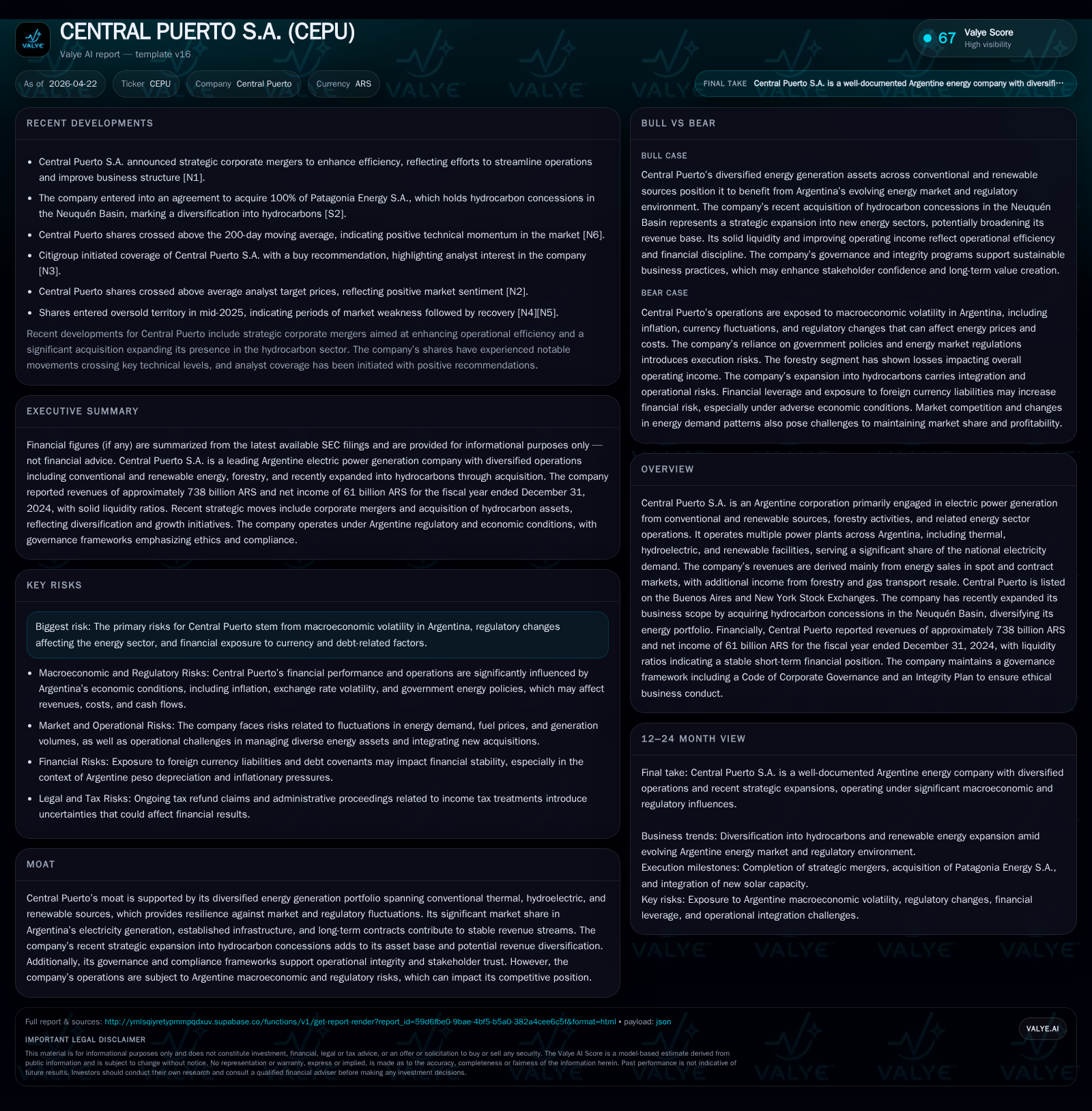
Central Puerto S.A. announced in April 2026 a transformative acquisition of Patagonia Energy S.A., adding hydrocarbon concessions to its portfolio and marking a deliberate shift towards energy diversification. This acquisition complements the company’s established base in thermal, hydroelectric, and renewable power generation within Argentina's dynamic and often volatile energy sector. Against the backdrop of recovering economic activity and tariff reforms, Central Puerto aims to strengthen its competitive position while mitigating concentration risks inherent in its traditional electricity generation business. However, growth remains constrained by Argentina’s macroeconomic volatility and regulatory uncertainties that influence pricing frameworks and capital deployment.
Key Operating Update: Hydrocarbon Asset Acquisition Signals Strategic Shift
In April 2026, Central Puerto S.A. executed an agreement to acquire 100% of Patagonia Energy S.A., which holds a hydrocarbon concession in the crucial Neuquén Basin [S2]. This transaction is explicitly framed by management as consistent with the company’s medium- to long-term growth strategy aimed at broadening its footprint in Argentina’s energy sector. The acquisition brings notable diversification benefits by adding upstream hydrocarbons capabilities to Central Puerto’s otherwise primarily power-generation-focused portfolio. This extends the company's asset base into fossil fuels’ upstream segment—allowing potential revenue stabilization against electricity market cyclicality or regulatory shifts. Completion depends on customary precedent conditions [S2].
This is a fundamental strategic pivot that complements Central Puerto’s existing thermal plants using gas as fuel by incorporating upstream resource control—an integration seldom seen among Argentina’s leading electricity generators. The move should enable improved risk management via broader commodity exposure while offering operational synergies over time.
Central Puerto’s Integrated Business Model: From Power Generation to Energy Diversification
Historically, Central Puerto generates revenue through a combination of electric power sales from conventional thermal plants fueled largely by natural gas, complemented by hydroelectric facilities and growing renewable assets such as solar and wind farms [S1][F1]. Electricity sales comprise both spot market transactions managed through CAMMESA (Argentina’s wholesale electricity market operator) and long-term contracts regulated through varying tariff adjustment frameworks. Additional income streams include forestry operations and resale of gas transportation capacity.
The company benefits from tariff regimes embedded with periodic adjustments aimed at cost recovery reflecting inflationary pressures—a critical factor given Argentina's high CPI levels [S1]. Operational efficiency initiatives have improved cost-to-revenue ratios in recent years, bolstering gross margins despite volatile fuel costs and currency swings [S1]. Importantly, this underlying business model relies on substantial installed capacity predominantly gas-fired complemented by renewable plants contributing increasing load factors.
Adding upstream hydrocarbon concessions potentially enhances vertical integration—allowing Central Puerto some control over fuel supply security and cost dynamics. Such integration is not only rare domestically but also positions Central Puerto competitively against rivals reliant solely on third-party fuel sourcing.
Navigating Argentina’s Energy Sector: Competitive Landscape and Regulatory Dynamics
Central Puerto competes among a set of integrated incumbents controlling Argentina's bulk power generation assets across thermal, hydroelectric, nuclear, and renewables [S1]. Market pricing mechanisms remain sensitive to macroeconomic conditions including inflation exceeding 30% annually (2025) and Peso depreciation exceeding 40% year-over-year [S1]. Tariff adjustments are enacted through government resolutions but face political risk; delays in cost pass-through translate to margin compression.
Fuel supply costs particularly for natural gas are influenced by local production volumes, infrastructure bottlenecks, and policy decisions affecting subsidies or export controls [S1]. These complexities create oscillating input costs impacting short- to medium-term operational economics. Exchange rate volatility adds another layer since most debt is denominated in U.S. dollars while revenues are Pesodenominated or partially dollar-linked through contracts [S1].
Industry competitors vary from integrated utilities with full fuel-to-power chains to smaller niche producers depending heavily on spot market prices. Tariff reform efforts undertaken since early 2025 seek more sustainable pricing reflecting operating costs but must balance social affordability mandates.
Growth Drivers: Expanding Asset Base, Renewables, and Market Demand in Focus
Economic data indicate Argentine GDP grew +4.4% in 2025 after stagnation during previous years [S1], supporting higher electricity consumption linked to industrial activity recovery. Private consumption constituted roughly 70% of GDP sustaining steady demand growth for power services.
On the supply side, Central Puerto continues investing heavily in renewable capacity expansions including the San Carlos solar farm development alongside ongoing projects converting thermal plants (Brigadier Lopez combined cycle conversion), enhancing efficiency and greener output. Capital expenditures increased notably in 2025 reflecting these priorities [S1].
Tariff regime recalibrations underpin improved revenue quality supporting further reinvestment capacity relative to historical levels [S1]. Inclusion of hydrocarbons upstream assets opens avenues for operational synergies possibly smoothing fuel input cost profiles through vertical integration.
Collectively these drivers suggest structural growth in production capability aligned with projections for sustained Argentine industrial expansion combined with favorable policy impetus towards clean energy transitions.
Constraints on Expansion: Macroeconomic Volatility and Regulatory Exposure
Despite positive momentum, significant headwinds stem from Argentina’s chronic macroeconomic volatility marked by elevated inflation (~31.5% CPI increase in 2025), severe Peso depreciation (end-2025 exchange rate >1400 ARS/USD), restricting predictability of revenue streams denominated in local currency versus foreign-dollar indexed debt obligations [S1][S3].
Regulatory uncertainty persists within tariff setting procedures subject to political discretion impacting timing or magnitude of price adjustments resulting in intermittent margin pressure [S1]. Changes in subsidy schemes or natural gas allocation policies could materially affect input costs altering plant profitability.
Management formalizes comprehensive risk assessments reviewing strategic-operational-financial aspects feeding into annual budgetary frameworks ensuring mitigation strategies align with these exposures [S3]. Currency hedging options remain limited under Argentine conditions increasing residual FX risks on cash flows denominated across currencies.
Debt covenant constraints around leverage ratios impose limits on aggressive borrowing especially given most loans bear floating interest rates tied to global benchmarks like SOFR replacing LIBOR [S3][S5]. Capital expenditure deployment therefore requires careful financing calibration balancing growth needs versus financial flexibility.
Governance and Risk Management Framework as an Operational Pillar
Central Puerto maintains robust governance under a professional board actively involved in strategy oversight emphasizing sustainability principles anchored in ethics codes updated periodically [S3]. The Board prescribes clear succession planning processes securing leadership continuity minimizing execution disruptions [S3].
Risk management processes include layered analyses quantifying probability-weighted impacts across sectors—strategic risks include regulatory shifts or domestic economic instability; operational risks cover plant availability fluctuations; financial risks focus on FX exposure plus interest rate variability; compliance risks address evolving legal landscapes impacting energy production licensing or environmental norms [S3].
This governance discipline supports investor confidence notwithstanding Argentina’s elevated country risk profile enhancing credibility amid emerging market complexities.
What to Watch: Transaction Completion, Integration Milestones, Market Signals
Key near-term catalysts revolve around the finalization of Patagonia Energy acquisition fulfilling regulatory approvals typical for hydrocarbon asset transfers within Argentina [S2][N1]. Subsequent integration stages will warrant scrutiny regarding realized synergies—particularly whether upstream asset control effectively stabilizes fuel input costs benefitting electricity generation margins.
Monitoring CAMMESA settlement dynamics remains crucial given their history influencing cash flow timing critical for operational liquidity while tracking government announcements on tariff adjustments or subsidy frameworks will signal direction for revenue predictability.
Capital expenditure execution—especially renewable expansions—and any updates on regulatory reforms impacting pricing mechanisms constitute further performance indicators measurable through quarterly disclosures [N1][S2].
Financials Overview: Revenue Growth, Earnings Dynamics, and Capital Structure
Central Puerto recorded robust revenue escalation with FY2024 reported top-line reaching approximately Ps.738 billion representing a dramatic +135% year-over-year jump from prior periods [F1]. This surge partly reflects adjusted tariff frameworks alongside expanded operational scale including renewables additions.
However, net income declined by roughly -58% during the same period settling at Ps.61 billion illustrating margin pressure stemming chiefly from cost escalations related to imported components sensitivity to exchange rates plus refinancing charges incurred on dollar-denominated debt [F1][S1].
Return on equity remains modest at about 3.3%, highlighting capital-intensive nature of energy infrastructure balanced against prevailing economic headwinds constraining profitability ratios [F1]. Liquidity indicators stay stable with a current ratio near 1.48 providing a buffer for short-term obligations supported by solid cash equivalents holdings.
The company actively pursues share repurchase programs authorized up to US$20 million targeting treasury stock reduction signifying management's positive valuation outlook despite external uncertainties [S4][F1].
Long-term debt largely denominated in U.S. dollars underscores exposure to currency movements though loan covenants align with conservative leverage thresholds ensuring compliance ([S5], [S6], [S9]). Recent capital raise agreements with international financial institutions such as IFC fortify balance sheet enabling planned expansion activities including battery storage investments paired with renewable projects enhancing future competitiveness ([S5]).
Historical performance (annual)
| FY | Rev ($bn) | Net ($bn) | Rev YoY | Net YoY |
|---|---|---|---|---|
| 2024 | 738.2 | 61.3 | +135.4% | -58.0% |
| 2023 | 313.6 | 146.0 | +209.3% | +665.1% |
| 2022 | 101.4 | 19.1 | +77.6% | +3044.8% |
| 2021 | 57.1 | -0.6 |
Source: SEC companyfacts cache [F1].
Capital returns and efficiency (annual)
| FY | ROE% |
|---|---|
| 2024 | 3.3 |
| 2023 | 17.0 |
| 2022 | 7.3 |
| 2021 | -0.5 |
Source: SEC companyfacts cache [F1]. |
| Capital Structure & Liquidity Snapshot |
|---|
| Cash & Equivalents (Dec 2024): Ps.3.8 billion |
| Current Assets (Dec 2024): Ps.554 billion |
| Current Liabilities (Dec 2024): Ps.375 billion |
| Debt Mainly USD-Denominated (>98%) |
| Leverage Ratios Maintained Within Covenants |
| Share Repurchase Programs Active up to US$20 million Authorized |
Overall financial positioning reflects resiliency amid challenging Argentine macro conditions enabling continued investment alongside measured capital returns.
This analysis synthesizes SEC filings dated up to April 22, 2026 ([S1]-[S29]), latest quarterly disclosures ([S2], [S3]), news reports ([N1]), and companyfacts data ([F1]). It reflects documented corporate actions without speculative forecasts or investment recommendations.
Disclaimer: This is research-only, informational analysis and not investment advice. It may include AI-generated interpretation and general industry context. Always verify important details using primary sources.

Comments