
Wright Investors Service Holdings: Transitioning from Shell to Strategic Operator
The company currently operates as a cash-rich shell, focusing on capital preservation and strategic alternatives to transform into an active financial services operator.
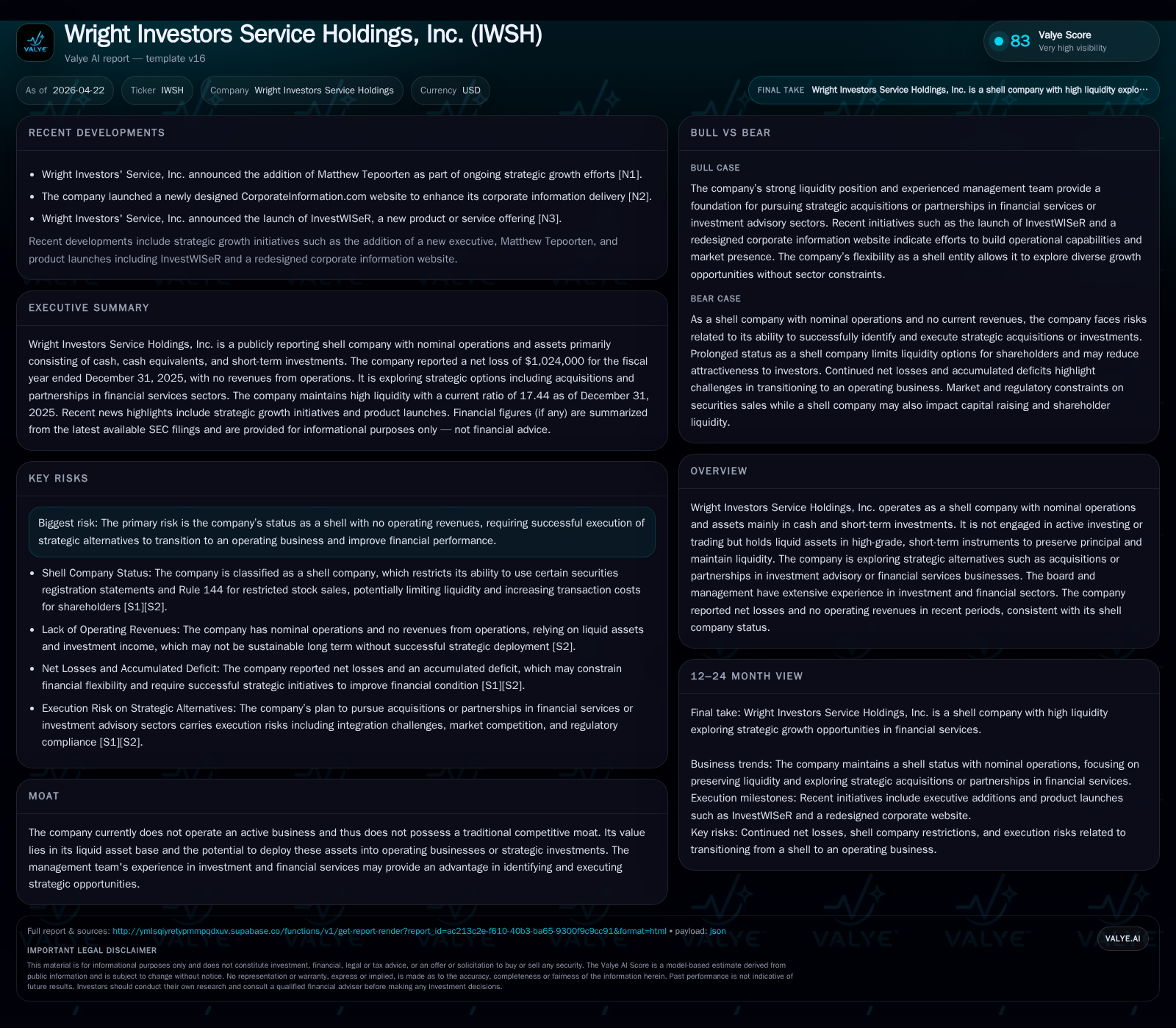
Wright Investors Service Holdings, Inc. remains a shell company with nominal operations primarily holding cash and short-term investments. Its recent activity centers on a large share repurchase authorization indicating a focus on capital return amid no current operating revenues. The management is actively exploring acquisitions or partnerships in investment advisory and financial services sectors to evolve beyond its shell status. While it faces execution risks and lacks operating income, the company’s liquidity and experienced board provide optionality for future growth.
Latest Operating Developments Highlight Capital Return and Investment Review
Wright Investors Service Holdings’ latest quarterly filing dated November 14, 2025 [S2] reveals no active share repurchases during the period ended September 30, 2025; however, it reiterates a board authorization to repurchase up to five million shares of common stock through open market or private transactions. To date, approximately 2.23 million shares have been repurchased under this program with about 2.77 million shares still available for buyback. This sizeable capital return initiative is notable given the company’s lack of operating activities and suggests an effort by management to enhance shareholder value by reducing equity float amid limited growth avenues.
Simultaneously, the company continues to hold its liquid assets primarily in mutual funds classified as available-for-sale securities and short-term Treasury Bills. The filings discuss prudent credit loss assessments concerning these holdings but report no impairment allowances as of September 30, 2025. This cautious stance aligns with the company’s strategy of principal preservation rather than active trading or investing.
Overview of Company’s Non-Operating Shell Status and Business Model
IWSH operates essentially as a shell company with nominal operations centered on maintaining cash equivalents and short-term investments [S1], . It does not engage in active securities trading or asset management activities and reports no revenues related to investment services. The persistent net losses are explained by ongoing administrative expenses exceeding minimal investment income generated from low-yield Treasury and mutual fund holdings.
The absence of recurring operating revenues underscores that Wright Investors’ primary value proposition lies in its liquid balance sheet position coupled with the potential to deploy capital strategically. This framework presents both opportunity and inherent risk: without transformation into an operating entity generating sustainable revenues or returns beyond interest income, the company’s valuation remains dependent on successful alternative uses of its cash resources.
Strategic Alternatives under Consideration: Acquisition and Partnerships
Management has disclosed intentions to explore a range of strategic options aimed at transforming Wright Investors from a passive shell into an active operator within the financial services sphere [S6]. These alternatives include potential acquisitions of investment advisory firms or other financial service businesses as well as forming partnerships or joint ventures.
Given the management team's collective experience in the investment sector , these strategic pursuits represent critical levers for creating value beyond mere capital return programs. However, execution risk remains high as any such transaction must generate sufficient scale to overcome initial overhead burdens while penetrating competitive markets.
Competitive Position and Industry Context for Potential Investments
While IWSH currently holds no direct competitive footprint due to inactivity, the targeted sectors—investment advisory and financial services—are structurally challenging environments dominated by firms leveraging scale economies, regulatory expertise, strong distribution channels, or technology-driven client servicing platforms.
Within investment advisory industries, key competitive moats often arise from brand reputation, asset under management (AUM) stickiness driven by client trust and high switching costs, regulatory compliance capabilities, and operational leverage enabling profitable client scaling. An entrant like IWSH would face hurdles such as establishing credibility without an operating track record and competing against incumbents boasting established AUM-linked fee streams.
Regulatory demands also impose barriers including registration requirements with bodies like SEC or FINRA as well as adherence to fiduciary standards that add complexity to new entrants’ cost structures.
Drivers and Constraints for Growth and Transformation
The underlying driver for IWSH’s prospective growth centers on the successful execution of strategic alternatives transitioning it away from dormant status toward an operating business model capturing recurring revenues from advisory fees or associated financial services [S1], . This growth trajectory is inherently structural if acquisitions can create meaningful AUM scale or carve out niche advisory segments.
However, growth constraints loom large due to several factors: continuing net losses driven by fixed administrative expenses erode liquidity; uncertainty around identifying suitable acquisition targets delays revenue realization; and competition may limit pricing power or deal terms achievable by an inexperienced operator. Moreover, preserving shareholder value while executing these transformations requires balancing timely asset deployment against dilutive funding needs or excessive risk taking.
Upcoming Milestones and Key Catalysts to Monitor
Critical indicators reflecting progress will be public disclosures regarding completed acquisitions or partnership agreements signaling material shifts into operating businesses. Further share repurchase activity may demonstrate board confidence in intrinsic equity value absent strategic deployment.
Additionally, watch for updates on liquidity levels—especially cash versus liabilities—as shrinking reserves could pressure either accelerated dealmaking or push alternative capital allocation measures such as dividends or return of capital [S2], [S3]. Any revision in guidance addressing future corporate direction will also be pivotal for assessing execution momentum.
Financial Summary: Capital Structure, Repurchases, and Liquidity
As of year-end December 31, 2025 [F1], Wright Investors reported $33K in cash and cash equivalents alongside $1.378 million in current assets total against relatively low current liabilities of $79K — yielding a robust current ratio near 17.4x indicative of strong near-term liquidity buffers despite operational inactivity.
The company sustained an operating loss approximating $1.096 million in FY2025 reflecting ongoing administrative overheads exceeding minimal interest income — trends consistent since prior years albeit slightly improved compared to FY2024 (-$1.079M).
Net income followed similar patterns registering a loss near $1.024 million reflective mainly of lack of revenue-generating activities offset partially by investment income decline at lower yield environments.
Since early efforts have focused on returning capital through share buybacks (2.23+ million shares repurchased against a 5 million share plan), this financial discipline complements its conservative approach but leaves substantial optionality untapped pending successful deal execution.
Historical performance (annual)
| FY | Net ($) | CFO ($) | OpInc ($) | Net YoY |
|---|---|---|---|---|
| 2025 | -1024000 | -1054000 | -1096000 | -11.3% |
| 2024 | -920000 | -938000 | -1079000 | +8.5% |
| 2023 | -1006000 | -965000 | -1172000 | +16.7% |
| 2022 | -1207000 | -1160000 | -1228000 |
Source: SEC companyfacts cache [F1].
Capital returns and efficiency (annual)
| FY | ROE% |
|---|---|
| 2025 | -78.3 |
| 2024 | -39.5 |
| 2023 | -30.6 |
| 2022 | -28.1 |
Source: SEC companyfacts cache [F1].
Revenue data is not applicable given shell status.
The capital structure shows zero long-term debt obligations along with no preferred stock issued which helps maintain flexibility for future financing should acquisition opportunities arise.
Disclaimer: This analysis does not constitute investment advice or recommendations but aims to provide an informed overview based on publicly available SEC filings and industry understanding relevant as of April 22, 2026.
Disclaimer: This is research-only, informational analysis and not investment advice. It may include AI-generated interpretation and general industry context. Always verify important details using primary sources.

Comments