
Clean Energy Technologies Expands Board Amid Regulatory Compliance and Financial Restructuring
Recent governance changes and financial updates highlight operational challenges and strategic positioning in renewable energy.
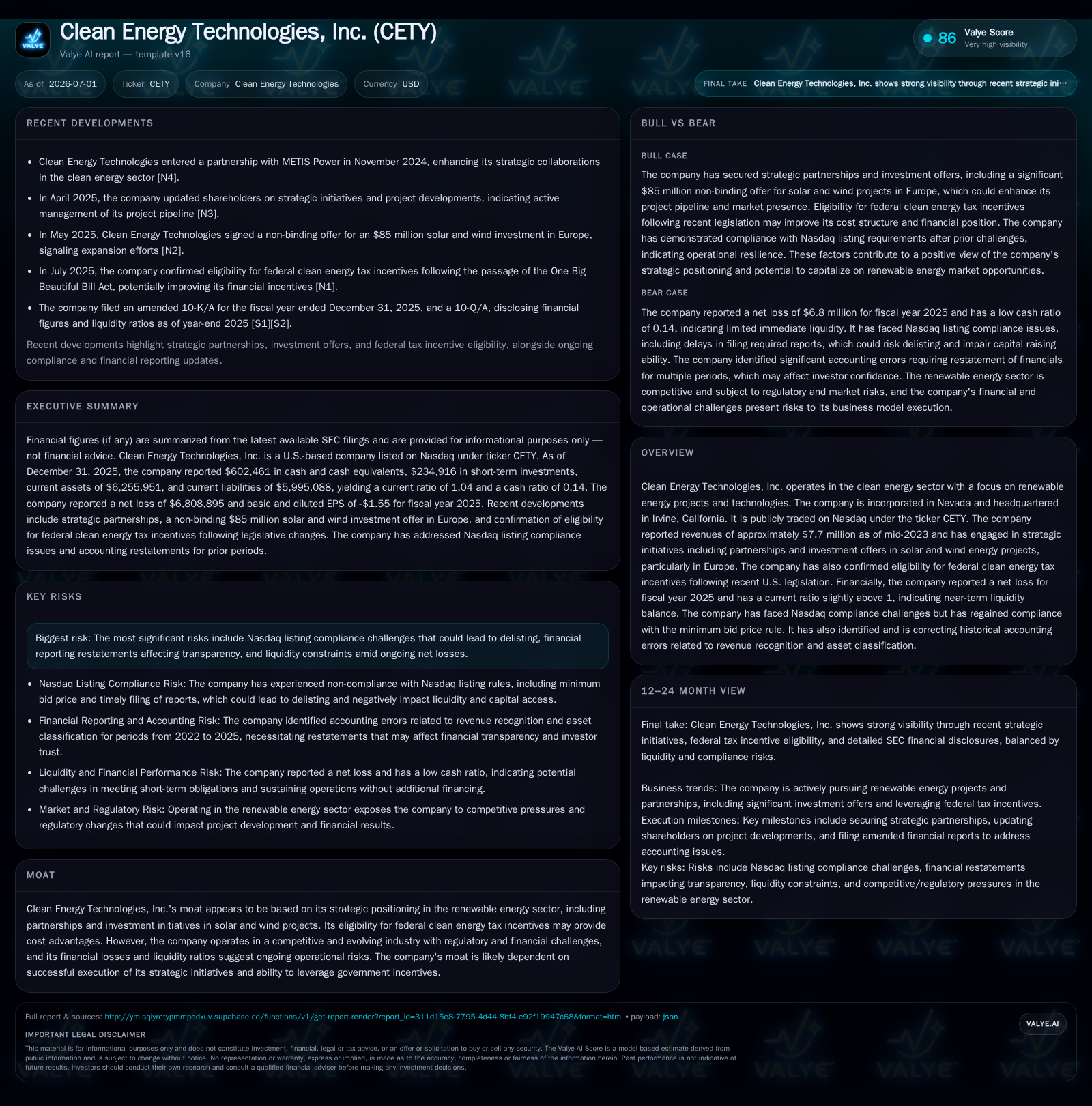
Clean Energy Technologies, Inc. (CETY) recently appointed two new directors to its Board, signaling a push to strengthen governance as it navigates ongoing regulatory compliance challenges related to Nasdaq listing requirements. The company operates in renewable energy project development and technology deployment, focusing on solar and wind projects with European partnerships and eligibility for U.S. federal clean energy tax incentives. Despite strategic initiatives, CETY continues to face substantial net losses and near-term liquidity constraints, reflected in a modest current ratio of 1.04 as of year-end 2025. Execution of its project pipeline and regulatory compliance remain critical watchpoints for the company's path forward.
Recent Operating Update
On June 21, 2026, Clean Energy Technologies appointed Ruoxin (Skyler) Wang and Zhang Zhixiang to its Board of Directors [S3]. This move likely responds to the heightened emphasis on strengthening corporate governance during ongoing Nasdaq listing compliance challenges. The company has been addressing delayed periodic SEC filings, including restatements of historical financials dating back to 2022 due to previous misclassifications of receivables and revenue timing issues [S13]. Such restatements reflect prior balance sheet inaccuracies but purportedly do not affect core operational performance.
The latest filings also document capital raising through convertible promissory notes with Pacific Pier Capital II LP in April 2026 ($406,000 principal) along with continuing securities purchase agreements earlier in the year [S20], [S18], [S25]. These financial moves underscore CETY's need for liquidity to fund business development and pay service providers but carry shareholder approval conditions tied to Nasdaq rules limiting share issuances without vote [S20]. Moreover, ongoing notices from Nasdaq as recent as May 2026 highlight risks that failure to file timely quarterly reports could trigger delisting proceedings if the company does not cure filing deficiencies promptly [S26].
Business Model Overview
Clean Energy Technologies operates principally within renewable energy sectors focused on solar and wind projects, primarily through project development initiatives, technology provision, and potentially ownership or revenue-sharing models tied to installed assets or PPAs [S1]. The company’s strategy includes leveraging federal clean energy tax incentives under recent U.S. legislation which can provide significant cost offsets enhancing project economics. Additionally, its engagements in Europe for solar and wind projects position CETY within a competitive international market where policy support is strong but regulatory complexities vary.
Revenue generation is intermittent and dependent on successful completion and grid integration of projects alongside securing long-term contracts or PPAs with utilities or corporate buyers. Since the company reported only about $957,000 in revenue as far back as 2017 without recent disclosed top-line figures [F1], the model remains pre-scale with meaningful revenues contingent on pipeline conversion.
Given the capital-intensive nature of renewable asset development—requiring substantial upfront capex before steady operating cash flows—companies like CETY typically rely heavily on external financing including equity offers, convertible debt instruments, or strategic partnerships. Operating expenses largely scale with project development activities rather than immediate asset operation.
Industry Structure and Competitive Context
The clean energy technology industry encompasses numerous players from developers of utility-scale solar/wind farms (e.g., NextEra Energy), technology innovators in solar modules (e.g., First Solar), wind turbine manufacturers (e.g., Vestas), to independent power producers managing portfolios (e.g., Brookfield Renewable). Within this value chain spectrum, CETY appears positioned between project developer/technology provider roles without significant asset ownership scale.
Competitive differentiation typically hinges on securing prime project sites with favorable resource profiles (high irradiance or wind speeds), winning government permits amid environmental scrutiny, cost-efficient installation leveraging advanced technologies, plus access to stable long-term PPAs ensuring predictable revenues. Equally vital is maintaining regulatory compliance—particularly listing requirements—since reputational transparency can influence investor confidence during capital raises critical for growth.
CETY’s eligibility for federal clean energy tax incentives provides a cost advantage relative to less-established peers but does not insulate it from intense competition or sectoral risks such as subsidy phase-outs or geopolitical tensions affecting European projects.
Growth Drivers
Key growth vectors include scaling the installed renewable capacity measured by megawatts (MW) brought online under development contracts or joint ventures. Enhancing capacity factors through technological improvements or optimized site selection improves output (MWh) increasing revenue potential under PPAs.
Expanding the project pipeline geographically diversifies regulatory risk profiles while tapping emerging markets where renewables gain urgency due to local decarbonization targets. Strategic partnerships facilitating co-investment reduce capital strain while accelerating execution timelines.
Federal clean energy tax incentives materially improve return thresholds lowering effective cost per megawatt installed. Furthermore, advances in grid integration technologies augment operational uptime enabling higher saleable energy volumes.
The company’s past financial restatements dampen report reliability perceptions potentially complicating future capital raises.
Capital intensity combined with negative operating margins (net loss $6.8M reported for fiscal year ended December 31, 2025) strains cash flows while forcing dependency on convertible debt that dilutes shareholders upon conversion [F1]
Execution risks include potential delays or cost overruns inherent in complex renewable projects subject to permitting obstacles or supply chain disruptions for equipment like turbines or panels. Regulatory shifts jeopardizing subsidies represent external uncertainty. Technology underperformance risks lowered capacity factors which compress margins.
International ventures expose CETY to geopolitical volatility affecting cash repatriation timing or foreign currency fluctuations impacting reported results.
What To Watch Next
Investors should track upcoming quarterly SEC filings for evidence of improved filing discipline signaling resolution of past deficiencies. Announcements regarding new project awards in Europe or elsewhere will spotlight tangible progress toward revenue scaling.
Capital structure changes via new financings or note conversions impact share count dilution risks requiring shareholder votes given Nasdaq trading rules limitations.
Operational metrics such as increased installed capacity measured in MWs connected to the grid, lengthened PPA terms secured indicating stable future cash flows, or demonstrated use of federal tax incentives will be significant demand-side markers confirming the effectiveness of growth strategies.
Any updates on Nasdaq's acceptance of compliance plans will critically determine market access stability affecting financing cost structure going forward.
Financial Profile Discussion
As per the latest available financial snapshot as of December 31, 2025, Clean Energy Technologies showed modest liquidity with current assets at approximately $6.26 million against current liabilities near $6 million resulting in a current ratio of about 1.04 indicative of marginal short-term liquidity coverage [F1]. Cash reserves stood just above $600K while total debt burdened the company with roughly $1.2 million resulting in net debt around $600K reflecting ongoing leverage reliance.
Recent issuance of convertible notes accompanied by equity subscriptions has provided essential working capital inflows but could raise dilution pressures impacting earnings per share improvement timelines if revenue ramp does not accelerate accordingly [S20], [S25]. Maintaining balanced liquidity while progressing towards positive operating cash flow will be pivotal for sustainable capitalization amid competitive pressures.
This analysis synthesizes publicly available SEC documents up to July 2026 without offering investment research views but aims to present an informed understanding of Clean Energy Technologies’ operational position relative to industry dynamics and sector KPIs.
Disclaimer: This is research-only, informational analysis and not investment advice. It may include AI-generated interpretation and general industry context. Always verify important details using primary sources.

Comments