
Goldenwell Biotech's Licensing Horizon and R&D Readiness Shape Next Steps
The impending expiry of a key license and completion of product development milestones position Goldenwell Biotech at a critical juncture with implications for growth and risk.
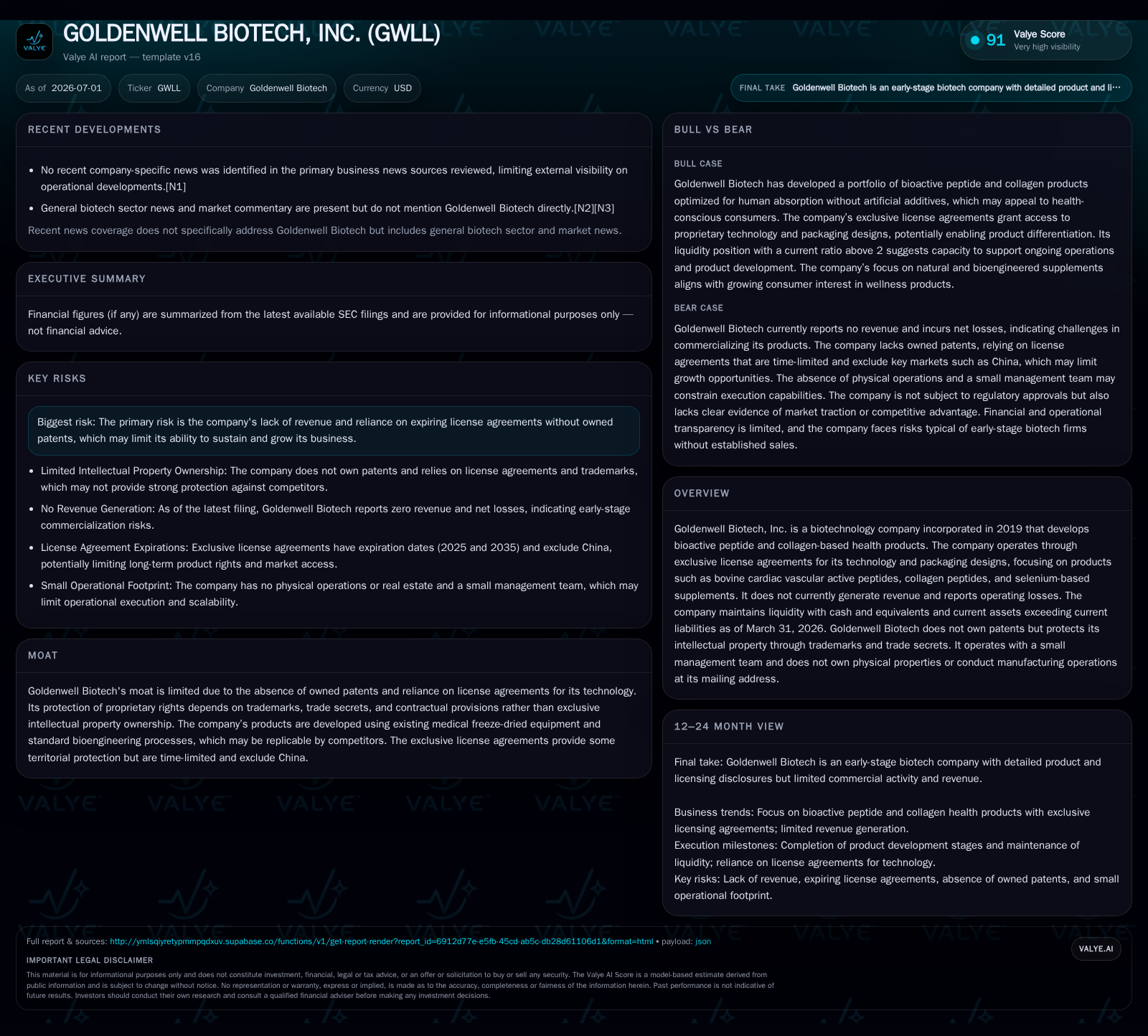
Goldenwell Biotech operates predominantly through exclusive license agreements rather than owning patents, with its primary Australian Trefoil license expiring in November 2025. The company has completed formulation and quality control of five bioactive peptide and collagen-based products, signaling readiness for commercialization pending regulatory clarity. Despite these operational advances, Goldenwell faces significant risks stemming from its limited intellectual property protection, dependency on license renewals, absence of manufacturing assets, and ongoing operating losses. Its financial resources provide only a limited runway to sustain operations absent revenue generation or new funding. Monitoring license renewal outcomes and progress toward market launch will be critical to assessing Goldenwell’s viability beyond this pivotal phase.
Recent Operating Update: License Expiry Approaches Amid No Renewal Disclosure
Goldenwell Biotech’s latest quarterly filing highlights a critical near-term challenge: the imminent expiration of its Australian Trefoil Health Technologies Pty Ltd exclusive license on November 15, 2025 [S2], [S6]. This license underpins flagship products including Sugar Master and DNA Repair and covers all territories except China. The absence of disclosed renewal negotiations or contingency plans in the July 2026 report underscores a material operational risk. Losing this license could disrupt product continuity or necessitate costly reformulation efforts. Meanwhile, the second exclusive license from Ji Lin JZY Biotech Inc., controlled by the CEO, extends through January 11, 2035 but similarly excludes China [S1], [S6], limiting geographic reach.
Business Model and Industry Positioning: Licensing-Centric with No Owned Patents
Goldenwell’s business model centers on licensing patented technologies rather than owning them outright. This approach allows access to proprietary bioactive peptide and collagen technologies without direct patent ownership [S1], [S6]. Instead, the company relies on trademarks, trade secrets, confidentiality clauses, and contractual exclusivity embedded within these licenses to protect its intellectual property [S1], [S13].
While this model reduces upfront R&D capital outlay typical of patent-owning biotech firms, it also limits competitive moats. Without owned patents covering core processes like freeze-drying or enzymatic extraction, Goldenwell remains vulnerable to replication by competitors once licenses expire or if contractual exclusivity is compromised. This distinguishes it from peers such as Ligand Pharmaceuticals that supplement licensing with robust patent portfolios.
Product Development Progress: Completed Formulations Ready for Commercialization Pending Market Entry
Operational disclosures confirm that Goldenwell has advanced five proprietary products—including bovine cardiac vascular active peptides and collagen peptides—through comprehensive R&D phases encompassing raw materials selection, formulation development, lab testing, and quality assurance/quality control (QA/QC) studies [S1], [S7], [S13], [S21], [S22]. These products employ medical freeze-dried equipment optimized for molecular integrity and human absorption.
Manufacturing Strategy: Fully Outsourced Production with Operational Scalability Constraints
Goldenwell operates an asset-light manufacturing model without owned facilities; production is outsourced utilizing existing freeze-dried processing equipment available from third-party manufacturers [S1], [S7]. This reduces capital expenditure but creates dependencies on external partners for consistent quality assurance—a critical factor in biotech product acceptance.
The small management team comprising three non-employee officers further indicates limited internal operational scale-up capacity absent additional investment or hiring [S6]. While common among early-stage biotechs pre-commercialization, this structure requires effective coordination with manufacturing partners to maintain standards.
Growth Drivers: Licensing Renewal and Market Demand for Peptide Supplements
Future growth depends heavily on renewing or replacing the Australian Trefoil license to preserve access to foundational technologies [S1], [S7]. Geographic expansion opportunities beyond licensed territories (notably China) remain untapped due to existing license exclusions.
Market trends favoring natural bioactive peptides and collagen supplements offer a favorable backdrop. Goldenwell’s use of low-temperature lyophilization techniques supports product purity—a competitive advantage in consumer health segments focused on ingredient integrity. Strategic partnerships or collaborations could accelerate commercialization but have not been disclosed.
Risks and Watchpoints: License Dependency, Weak IP Moat, Financial Constraints
The expiring Australian Trefoil license presents a material risk; failure to renew would necessitate disruptive reformulation or could halt sales. The absence of owned patents exacerbates vulnerability to competitor replication post-license expiry [S1], [S2].
Regulatory ambiguity regarding product classifications may pose latent risks if future authorities impose stricter requirements affecting market access timing.
Near-Term Catalysts: License Renewal Clarity and Commercialization Initiatives
Investors should closely monitor any developments related to the Australian Trefoil license renewal ahead of its November 2025 expiration. Clear communication on renewal terms or alternative strategies will be pivotal in mitigating operational disruption risks [S2], [S3].
Additional attention should focus on evidence of regulatory feedback impacting launch timelines alongside marketing initiatives tied to the five developed products. Operating expense trends will reveal management’s ability to balance burn rate while pursuing partnerships or funding.
Notably, May 2026 filings disclosed restatements correcting previous revenue recognition errors reflecting efforts toward improved financial reporting transparency [S3]
This analysis synthesizes Goldenwell Biotech’s July 2026 disclosures focusing on its dependence on exclusive licensing arrangements approaching critical expirations alongside solid R&D progress across bioactive peptide/collagen products. The company’s asset-light manufacturing model combined with an IP strategy lacking owned patents underscores inherent competitive challenges amid evolving market opportunities for natural peptide supplements.
Investors should prioritize monitoring licensing developments alongside commercialization progress within regulatory frameworks.
Disclaimer: This document is an analytical overview based on publicly available filings as of July 2026 intended solely for informational purposes without constituting investment advice.
Disclaimer: This is research-only, informational analysis and not investment advice. It may include AI-generated interpretation and general industry context. Always verify important details using primary sources.

Comments