
Cartesian Growth Corp III Targets Mid-2026 Business Combination in High-Growth SPAC Race
Cartesian Growth Corp III advances toward closing its first business combination, leveraging private equity expertise amid sector timing pressures.
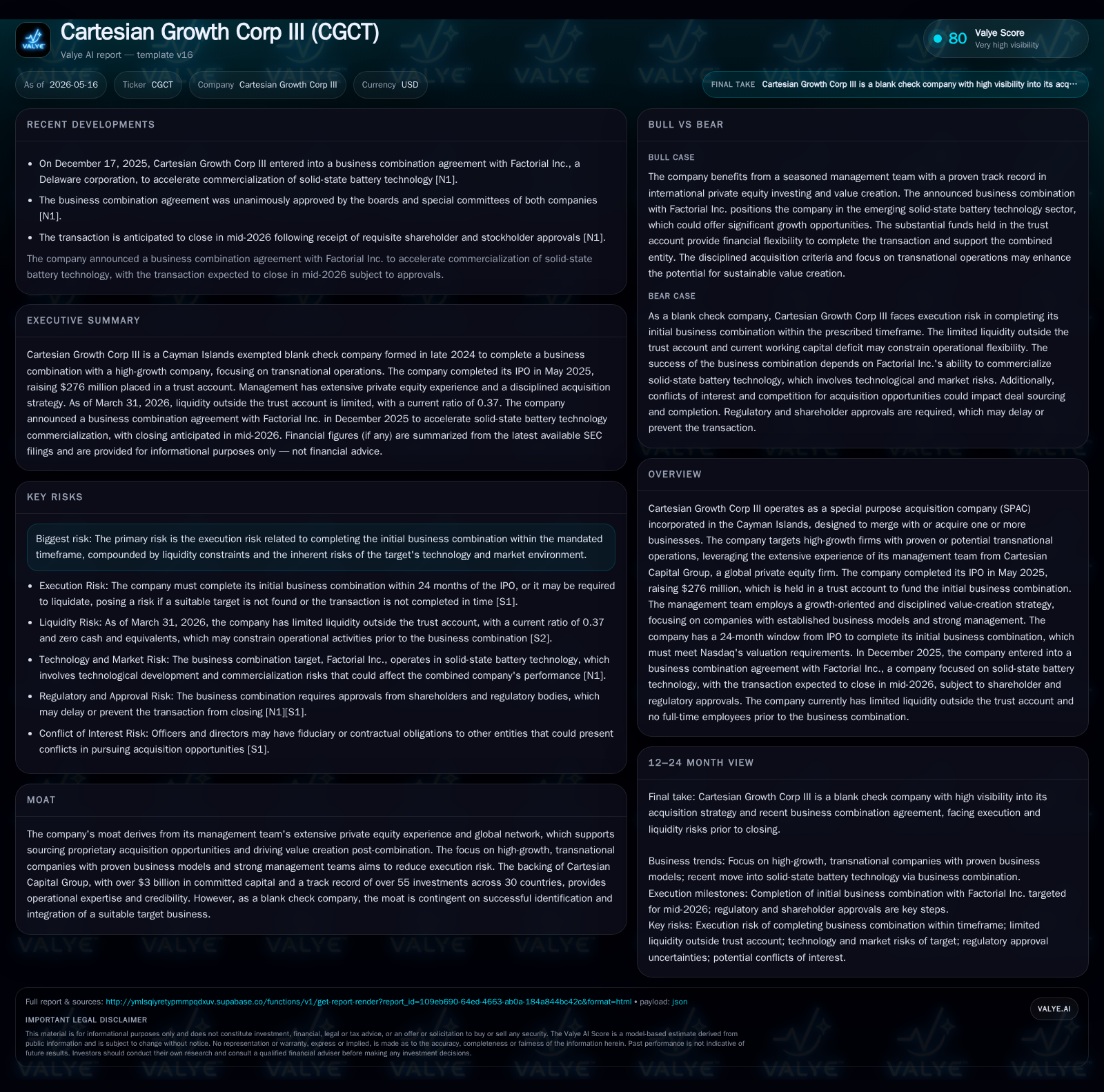
As of May 15, 2026, Cartesian Growth Corp III (CGCT) is progressing steadily toward its initial business combination with Factorial Inc., expected to close mid-2026. The February 2026 MOU on strategic manufacturing collaboration underlines growth potential for the target. CGCT’s model as a Cayman-based SPAC focusing on high-growth transnational companies benefits from experienced sponsors but faces typical execution risks tied to deal timelines and liquidity constraints pre-close.
Latest Quarterly Progress Signals Imminent Business Combination
Cartesian Growth Corp III’s (CGCT) latest 10-Q filing dated May 15, 2026 [S2] reveals that it remains on track toward completing its initial business combination with Factorial Inc., a Delaware-incorporated firm specializing in solid-state battery technology. This transaction builds upon the December 17, 2025 Business Combination Agreement [S1], unanimously approved by independent boards of each party. The anticipated closing is positioned for mid-2026 pending receipt of requisite CGCT shareholder approvals, Factorial stockholder consent, and satisfaction of customary closing conditions.
The company itself continues to operate without generating any revenues or engaging in operational activities aside from preparatory efforts for this merger. Its financial activities primarily involve managing interest income accrued on funds held in the trust account established at IPO [S1]. While no direct revenues exist yet, the combination agreement with Factorial moves CGCT beyond the pure shell stage toward forming an operational public entity—critical at this juncture amid competitive pressures and deadline-driven necessity within the SPAC space.
A recent event filing from May 11, 2026 [S3] also reiterates no offers or sales of securities have transpired outside regulated processes, reinforcing regulatory compliance standards ahead of transaction consummation.
Business Model and Management Experience Drive Acquisition Strategy
CGCT is a Cayman Islands exempted company created explicitly as a special purpose acquisition company (SPAC) focused on acquiring or merging with businesses possessing high growth potential and transnational footprints [S1]. Its strategic edge stems from sponsorship by Cartesian Capital Group LLC, a global private equity firm managing over $3 billion in committed capital since 2006 with more than 55 investments across approximately 30 countries [S1]. This backing provides CGCT access to proprietary deal flow channels and operational expertise aimed at value creation after closing.
The $276 million gross proceeds raised during its May 5, 2025 IPO — fully placed into a trust account — represent its finance weaponry for acquisition funding [S1]. Sponsor alignment is encouraged through private placement warrants exercisable post-merger, incentivizing close coordination to achieve deal success.
As a blank check vehicle, CGCT has yet to initiate operations independently; its revenue generation will only commence post-business combination when Factorial becomes part of its corporate structure [S1]. This underscores that current value accrues mostly from management credibility and prospective merger success rather than ongoing cash flow.
Competitive Dynamics in the SPAC Sector and Target Industry Landscape
The blank check ecosystem remains highly competitive amid fluctuating investor appetite and regulatory scrutiny. CGCT adheres to Nasdaq’s critical deal valuation rule mandating that initial business combinations must represent at least 80% of the trust assets' fair market value upon agreement signing [S25]. Such requirements narrow viable targets and escalate pressure to complete within a narrow window — CGCT has until approximately May 2027 (24 months post-IPO) to close its first merger or face liquidation risks [S25].
Competition among SPAC sponsors intensifies rivalry for high-caliber targets like Factorial that can credibly scale internationally and meet institutional investor expectations. Proprietary source channels derived from Cartesian Capital Group's extensive network provide some differentiation but do not fully mitigate inherent bidding risks or market cycles affecting valuations.
Moreover, internal governance mandates including approval by independent directors add layers to ensure transaction fairness but may also protract negotiation timelines [S25]. Regulatory burdens including forthcoming Sarbanes-Oxley internal control requirements effective after FY2026 further increase compliance costs for the combined entity [S6].
Key Growth Drivers Post-Business Combination
Though CGCT itself is a capital vehicle pre-merger, factoring in Breakout target Factorial reveals structural expansion potential driving underlying growth. Factorial is positioned as a leader in advanced solid-state battery technology with ambitions crystallized through its February 2026 Memorandum of Understanding (MOU) with South Korean battery equipment provider Philenergy Co., Ltd. — intended to accelerate manufacturing scale-up of Factorial's Solstice™ platform [S8].
This cross-border manufacturing collaboration points both towards industrial demand for next-generation batteries critical in electric vehicles and energy storage sectors as well as operational synergies that Cartesian believes it can unlock through private equity-style governance enhancements post-combination [S8], [S1].
Post-close growth trajectories hinge on expanding transnational operations leveraging Cartesian’s relationships across North America, Europe, Asia-Pacific, and South America markets where energy transition tech shows strong momentum [S1]. Failure would trigger liquidation obligations potentially unfavorable to shareholders [S25].
Liquidity constraints are evident: CGCT reports zero cash & equivalents outside its trust vehicle at quarter end March 31, 2026 but holds about $276 million secured within the trust account earmarked strictly for consummating the business combination [F1], [S1]. Operational expenses are financed by limited working capital; reported current assets stand at roughly $509k against current liabilities around $1.39 million producing a low current ratio near 0.37 typical for blank check shells prior to operating entity formation [F1]. Total debt approximates $227k primarily comprising sponsor loans or similar commitments expensed pre-close [F1].
Notably, no revenues mitigate cash flow coverage pre-merger amplifying reliance on sponsor financial support or efficient cost management until closing occurs [S1], [F1]. Possible integration obstacles post-business combination include aligning disparate organizational processes under public reporting requirements such as Sarbanes-Oxley internal controls becoming applicable after FY2026 filings begin [S6], which could also extend timelines and increase compliance costs.
Finally, target-specific market risks persist given the volatile technology cycle inherent in emerging battery platforms where competitive leaps or regulatory shifts can materially alter prospects post-merger.
Upcoming Milestones and Shareholder Approval Process
Critical near-term events center around dissemination of proxy statement/prospectus materials necessary for public shareholder voting on the proposed business combination with Factorial. Successful solicitation will enable final board ratifications across both entities followed by satisfying remaining closing conditions such as financial audits reconciled under GAAP or IFRS as applicable [S26], [S7].
The proxy issuance marks a pivotal catalyst offering investors an explicit opportunity to approve or reject the merger proposal. Approval likelihood depends heavily on communicated strategic vision tied to Factorial’s manufacturing partnerships, expected future performance projections articulated via forward-looking disclosures, as well as broader market sentiment toward SPAC-backed combinations in clean technology sectors at this time.
Regulatory filings during Q2–Q3 calendar period signaling formal approval status will be closely monitored by stakeholders before the targeted mid-2026 close date.
Current Financial Position and Capital Structure Outlook
Reviewing CGCT’s most recent balance sheet snapshot underscores a classic pre-combination SPAC financial profile:
| Metric | Value (USD) | Period End |
|---|---|---|
| Cash & Equivalents | 0 | |
| 2026-03-31 | ||
| Total Debt | 227,374 | |
| 2025-03-31 | ||
| Current Assets | 509,350 | |
| 2026-03-31 | ||
| Current Liabilities | 1,387,305 | |
| 2026-03-31 |
[F1]
The effective absence of liquid cash reflects segmentation between trust account holdings reserved exclusively for funding the acquisition versus operating cash held outside.
These metrics affirm dependency on completing the business combination promptly; operational scale realization via Factorial integration will transition CGCT into generating ongoing operating cash flows necessary to sustain balance sheet health going forward.
The trajectory of Cartesian Growth Corp III rests predominantly on successfully consummating its business combination with Factorial within planned timing parameters while navigating stringent regulatory requirements and executing shareholder engagement strategies effectively. The management team's experienced background via Cartesian Capital Group provides meaningful proprietary advantages yet does not eliminate macro sector risks nor precise execution challenges inherent in contemporary SPAC market dynamics.
Disclaimer: This analysis does not constitute investment advice or recommendations but aims to provide an informed overview based on publicly available regulatory filings through May 15–16, 2026.
Disclaimer: This is research-only, informational analysis and not investment advice. It may include AI-generated interpretation and general industry context. Always verify important details using primary sources.

Comments