
City Holding’s Regional Community Bank Model Balances Loan Growth and Capital Return amid Credit Risks
City Holding Co leverages strong regional market penetration and diversified loan portfolio to drive steady financial performance while navigating credit and interest rate risks.
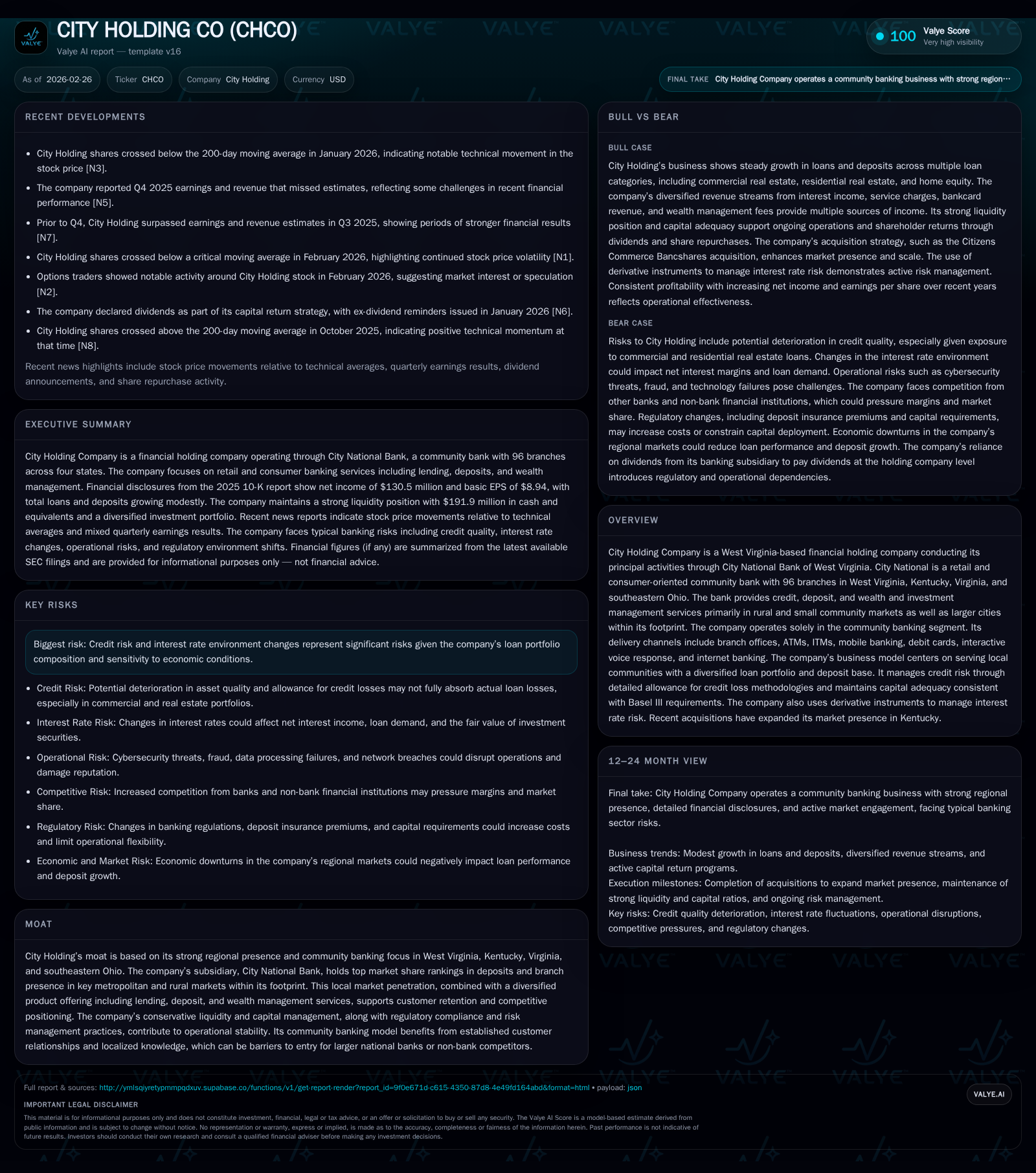
City Holding Company (CHCO) operates through City National Bank, with a focus on community banking in West Virginia, Kentucky, Virginia, and southeastern Ohio. Historical financial results show steady earnings growth driven by loan portfolio expansion and deposit base diversification. With robust capital ratios and disciplined risk management, the company supports solid dividend payments and share repurchases. Future growth could be challenged by credit risk pressures and interest rate environment changes. Key monitoring points include credit loss allowances, loan demand trends, and regulatory developments.
Company Overview
City Holding Company (CHCO), headquartered in Charleston, West Virginia, is a financial holding company conducting its business principally through City National Bank of West Virginia. The bank operates a network of 96 branches predominantly serving West Virginia along with Kentucky, Virginia, and southeastern Ohio. City National focuses keenly on retail consumer banking within rural and small community markets as well as select larger metropolitan areas such as Charleston (WV) and Lexington (KY). Its diversified product offerings span lending, deposits, wealth management, and investment services delivered via branches supplemented by ATMs, interactive teller machines (ITMs), mobile banking applications, debit cards, voice response systems, and internet banking platforms [S1].
City Holding runs a one-segment operation—community banking—with a business philosophy centered on fostering long-term local relationships supported by deep regional knowledge. This localized approach enables it to maintain top market share rankings in both deposits and branch presence across multiple core geographic MSAs [S1], underpinning customer loyalty which serves as a moat against larger national competitors.
Historical Performance
Financials for the full year ended December 31, 2025 illustrate consistent growth momentum following several years of expansion. Net income rose 11.4% to $130.5 million from $117.1 million the previous year [F1]. This increase was fueled primarily by approximately 5.4% loan portfolio growth to $4.51 billion at year-end 2025 versus prior year levels [S23], alongside stable net interest income generation reflecting careful balance sheet management.
The company's deposit base remained solid with deposits funding nearly 79% of total assets—higher than peer averages—with a notable weighting towards noninterest-bearing demand accounts and savings deposits accounting for approximately 60% of total assets, aiding liquidity and lowering expensive funding needs [S18]. Capital levels were strong with Common Equity Tier 1 (CET1) capital ratios for the holding company measured at 16.9%, significantly above regulatory minimums designed under Basel III frameworks ensuring financial stability [S20].
Operating cash flows reflected effective quality earnings-generation capacity totaling $131 million in 2025 with low capital expenditure needs ($2.9 million), primarily dedicated to branch maintenance and IT upgrades appropriate for a community bank focused on digital adoption within its footprint [F1].
Financial Summary Table
Historical performance (annual)
| FY | Net ($mm) | CFO ($mm) | Capex ($mm) | Net YoY |
|---|---|---|---|---|
| 2025 | 130 | 131 | 3 | +11.4% |
| 2024 | 117 | 132 | 3 | +2.4% |
| 2023 | 114 | 138 | 3 | +272.9% |
| 2022 | 31 | 116 | 2 |
Source: SEC companyfacts cache [F1].
Capital returns and efficiency (annual)
| FY | Div ($mm) | Buybacks ($mm) | FCF ($mm) |
|---|---|---|---|
| 2025 | 47 | 46 | 128 |
| 2024 | 43 | 18 | 129 |
| 2023 | 40 | 60 | 135 |
| 2022 | 37 | 26 | 114 |
Source: SEC companyfacts cache [F1].
*Note: Significant increase from the COVID-19 impacted year to 2023.
Future Growth Prospects
Growth going forward will likely continue to hinge on several factors intrinsic to City Holding's community banking model:
- Loan Portfolio Expansion: Continued moderate expansion in commercial real estate lending remains pivotal given it represents the largest category (~$1.87 billion). Focused underwriting discipline balancing fixed versus variable rates mitigates some interest rate risks embedded in these loans [S21][S23].
- Deposit Growth & Mix: Maintaining or growing core deposit balances through expanded branch presence or digital channels will affect the company's liquidity profile positively, especially as over half of deposits are transaction or savings accounts.
- Wealth Management Services: Cross-selling opportunities leveraging trusted local relationships may yield fee income growth.
- Risk Management: Tight monitoring of credit loss provisioning aligned with CECL methodologies will be crucial given macroeconomic uncertainties affecting rural economies within their footprint [S11][S21].
Constraints arise mainly from credit-risk concentrations linked to economic cycles impacting hotel, multi-family housing segments, or commercial real estate downturns along with competition from both large banks and emerging fintech entities adapting to shifting consumer behaviors [S2]. Interest rate fluctuations also pose margin pressure risks due to sensitivity in loan repricing lagging deposit cost adjustments.
Forecasts / Milestones / Expectations
While explicit forward guidance was not provided in recent filings or news releases up to early 2026, observers should monitor several indicators:
- Quarterly net charge-offs relative to allowance for credit losses indicating asset quality trends.
- Deposit betas reflecting funding cost sensitivity amid rising or falling rate environments.
- Dividend declarations aligned with capital preservation norms set by regulators.
- Share repurchase activity signaling confidence levels from management regarding stock valuation [N1][N2][S13].
A presentation by CFO David L. Bumgarner at the January 2026 Janney CEO Forum reaffirmed ongoing commitment to disciplined growth balanced against conservative risk parameters but did not specify quantitative targets [S3].
Returns / Capital Allocation Policy
Approximately quantified returns demonstrate attractive profitability metrics; implied return on equity (ROE) stands near 16% based on reported annual net income over average equity capital levels ($130 million / $810 million approx.) – reflective of efficient capital use among regional banks [F1].
Cash generated from operations remains robust ($131 million), supporting ample free cash flow after minimal capex commitments ($2.9 million). These resources fund recurring shareholder returns via dividends totaling $47 million alongside active buyback programs amounting to $45 million executed under an open-ended plan authorized since early 2024 aimed at enhancing EPS accretion through controlled reduction of shares outstanding [F1][S13][N7].
Capital management closely aligns with regulatory frameworks under Basel III ensuring buffers that eschew dividend constraints while preserving flexibility for opportunistic capital deployment strategies.[S20]
Industry Context Analysis
Community banks such as City Holding currently navigate an environment characterized by:
- Increased regulatory scrutiny demanding elevated capital adequacy measurements while restraining aggressive risk-taking.
- Consumer preference shifts accelerating digital channel adoption pushing traditional bricks-and-mortar dependent banks towards IT investments.
- Competitive dynamics intensified by fintech lenders encroaching into niche lending segments although often lacking local relationship depth. This combination drives many regionally focused institutions to emphasize operational efficiency alongside customer intimacy as differentiators enabling resilience amid macroeconomic headwinds.
Conclusion
City Holding Company presents a solid case study of a successful regional bank with entrenched market presence leveraged by diversified products targeting underserved rural communities complemented by strategic urban nodes within its tri-state footprint. Its financial robustness is supported by prudent underwriting practices evidenced through thoughtful allowance for credit losses assessments under CECL standards coupled with ample liquidity buffers exceeding industry peers’ norms. Future performance hinges critically on managing evolving credit risks associated with economic variabilities affecting localized sectors while continuing its commitment towards balanced capital returns including consistent dividends and share buybacks that underpin shareholder value creation without compromising regulatory compliance or operational soundness.
This analysis is based solely on data available from publicly filed SEC documents dated up to February 25, 2026, supplemented by recent Nasdaq news articles cited accordingly.
It is intended for informational purposes only without any recommendation regarding investment decisions.*
Disclaimer: This is research-only, informational analysis and not investment advice. It may include AI-generated interpretation and general industry context. Always verify important details using primary sources.

Comments