
Climb Global Solutions Expands Revenue With Rising Customer Concentration and Competitive Pressures
The company leverages a scalable IT distribution model to capture market growth while managing risks from customer and vendor concentration.
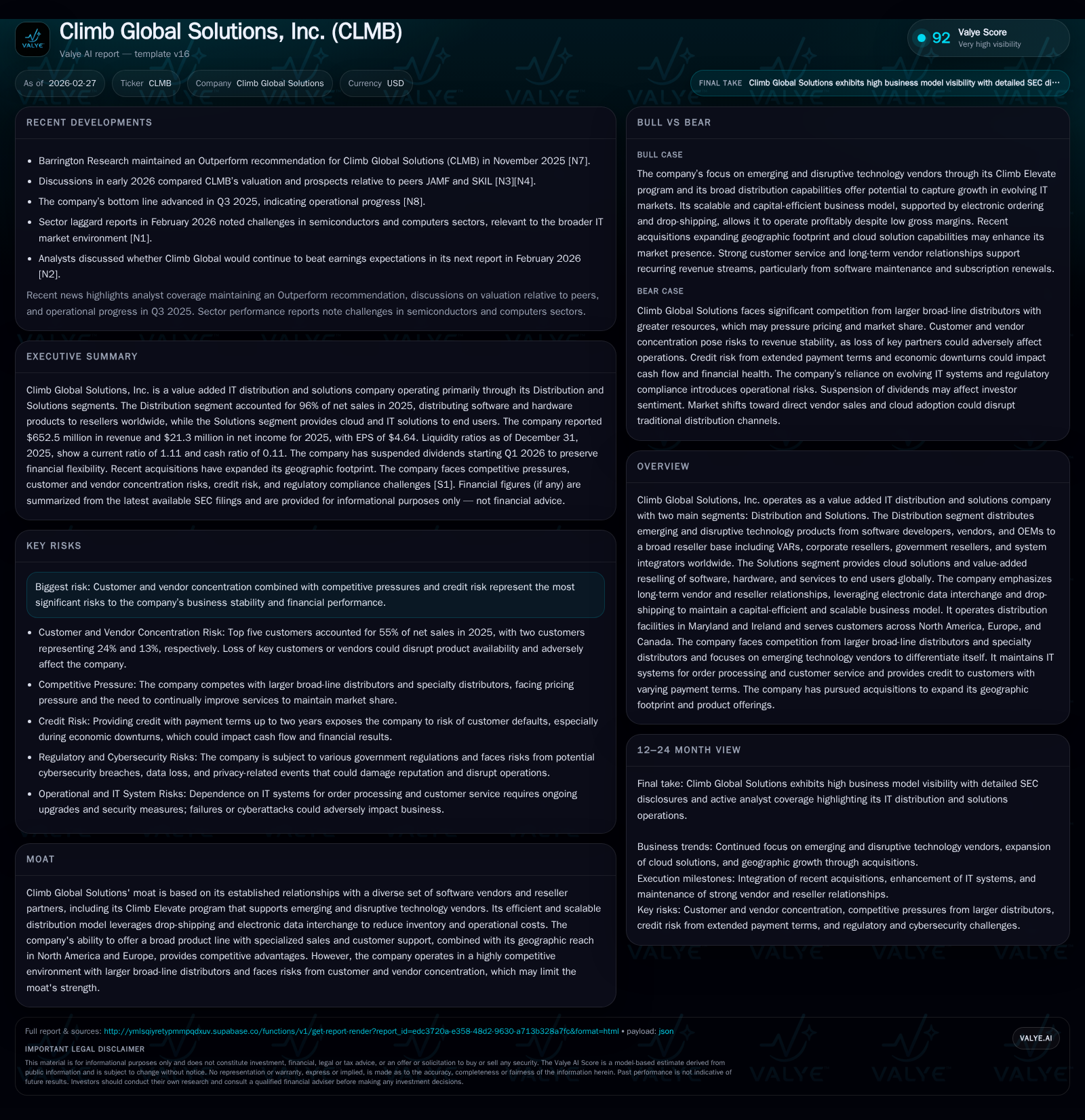
Climb Global Solutions, Inc. has exhibited a strong revenue surge reaching $652.5 million in 2025, driven by expanded software product offerings and acquisitions. The firm's core value-added IT distribution business remains capital-efficient through extensive use of drop-shipping and electronic data interchange, enabling profitability amidst low gross margins. Future growth depends on continued vendor diversification, cloud services expansion, and integration of specialty solutions, although competitive pressure and high customer concentration present ongoing challenges. The company maintains solid returns on equity and free cash flow generation despite a notable decline in operating cash flow in 2025.
Company Profile and Business Model
Climb Global Solutions, Inc. (CLMB), incorporated in Delaware since 1982 and listed on NASDAQ, is a value-added IT distributor that specializes in emerging and disruptive technology product distribution along with providing cloud-based solutions through its two main segments: Distribution (Climb Channel Solutions) and Solutions (Grey Matter). The company operates with distribution hubs in Maryland (USA) and Dublin (Ireland), servicing broad reseller bases—including VARs, corporate resellers, government entities, system integrators, direct marketers, and national IT superstores—across North America, Europe (notably the United Kingdom), and Canada [S1][S4][S8].
The Distribution business predominantly sells third-party software licenses, subscription-based products, service agreements, networking/security/storage hardware (often drop shipped directly by vendors), enabling a capital-light model characterized by low gross margin percentages but overall profitability through scale and operational efficiency [S1][S5][S15]. Climb's Solutions segment offers cloud services plus the reselling of hardware/software directly to end users globally; although it comprises roughly 4% of net sales it generated about 13% of consolidated gross profit in 2025—a reflection of higher-margin specialty products focused on cloud support capabilities acquired via recent purchases such as Data Solutions Holdings Limited and Douglas Stewart Software & Services LLC [S6][S16][S23].
Historical Financial Performance
Over recent years Climb has steadily scaled its top-line largely through acquisitions combined with organic growth within its vendor-reseller network. Revenue rose sharply from $465.6 million in FY2024 to $652.5 million in FY2025—an increase exceeding 40%—driven mainly by expanded sales volume within the Distribution segment alongside steady advances in the emerging cloud solutions market served by the Solutions business [F1]. Operating income improved moderately with a gain of about 4.3% to $29.2 million reflecting margin compression pressure offset by greater scale efficiencies and cost controls. Net income also advanced nearly 15% year-over-year to $21.3 million despite competitive pricing dynamics [F1]. Operating cash flow decelerated notably from $33.7 million down to $16.6 million due primarily to working capital fluctuations—a pattern sometimes observed when rapid revenue growth requires higher receivables or inventory advances [F1].
Historical performance (annual)
| FY | Rev ($mm) | Net ($mm) | CFO ($mm) | OpInc ($mm) | Rev YoY | Net YoY |
|---|---|---|---|---|---|---|
| 2025 | 653 | 21 | 17 | 29 | +40.1% | +14.6% |
| 2024 | 466 | 19 | 34 | 28 | +51.0% | |
| 2023 | 12 | 42 | 16 | -1.4% | ||
| 2022 | 12 | 5 | 17 |
Source: SEC companyfacts cache [F1].
Capital returns and efficiency (annual)
| FY | Div ($mm) | Buybacks ($mm) | ROE% |
|---|---|---|---|
| 2025 | 3 | 2 | 18.3 |
| 2024 | 3 | 2 | 20.5 |
| 2023 | 2 | 16.5 | |
| 2022 | 1 | 20.6 |
Source: SEC companyfacts cache [F1].
Note: Revenue values for years prior to FY2024 are largely omitted due to partial data.
Growth Drivers and Industry Positioning
Climb's historical revenue growth demonstrates successful scaling of an efficient capital-light distribution model supported by long-term vendor relationships augmented through its proprietary Climb Elevate program targeting emerging/disruptive software vendors outside traditional line cards [S22][S14]. The company's embrace of cloud computing trends has transitioned into building infrastructure for licensing facilitation, technical support services for SaaS/cloud products including Microsoft suites predominantly within North America, UK, and Europe markets—a strategic move designed to diversify revenues into higher margin categories amid thinning traditional margins [S12][S22].
Acquisitions remain central to geographic expansion strategy evident with purchases extending penetration into UK/Ireland software distribution ecosystems along with specialized verticals like North American K-12 educational software channels [S16][S23]. This indicates management’s aim at blending inorganic growth with structural shifts towards cloud/integrated services.
Customer diversification within reseller categories is a stated priority as well: while large Direct Market Reseller (DMR) customers accounted for nearly half of sales combined with value added resellers improving their contribution share steadily; increasing larger VAR accounts generating more than $1 million annually highlight ongoing efforts toward broadening customer exposure reducing volatile reliance on any single buyer group [S4][S14].
Nonetheless, the market remains intensely competitive dominated by global broadline distributors such as Arrow Electronics, TD Synnex, and Ingram Micro possessing deeper resources—requiring Climb to emphasize flexible specialized offerings coupled with superior seller-vendor alignment as part of its value proposition [S11][S19].
Risks Limiting Growth Prospects
A significant risk factor remains high customer concentration wherein two largest customers comprised approximately 37% of total net sales during FY2025—with the top five customers contributing over half—entailing substantial sensitivity if key relationships unwind or contract abruptly impacting topline volumes decisively [S4][S6][S9]. Vendor concentration exhibits improvement recently with no single vendor surpassing a double-digit percentage threshold, but still representing around third of total purchase volume among top five suppliers raising supply chain dependency risks [S14][S15][S22].
Industry price competition intensifies margin compression given thin gross billings margins intrinsic to distribution businesses compounded by market consolidations alongside potential direct vendor-to-end-user channel shifts presenting downside exposure [S13][S17][S19]. Additionally, credit risk arises from sizeable accounts receivable financing arrangements that include generous extended payment terms typically spanning up to two years for some clients heightening vulnerability during economic downturns or client liquidity issues [S17].
Information technology security also plays a vital role since disruptions or data/security breaches could impair operational continuity further affecting client trust levels impacting revenue performance [S27]. Regulatory compliance costs across multiple jurisdictions add complexity especially around privacy laws which vary globally raising compliance burdens potentially increasing operating costs over time [S25][S26].
Capital Allocation and Returns
Return on equity stood at an estimated ~18%, underscoring reasonable efficiency given competitive pressures faced . Capital expenditures have been historically nominal relative to firm size emphasizing the asset-light approach consistent with digital product licensing focus whereas dividends aggregated slightly above $3 million for FY2025 maintaining steady payout patterns alongside incremental buyback activity at around $2 million demonstrating moderate shareholder return policy balancing reinvestment needs against cash flow realities [F1]. Free cash flow approximated near $16.5 million reflecting positive operating cash inflows after diminishing capex outlays despite lower CFO metrics year-over-year likely tied to working capital investment reflective of growth dynamics rather than durable decline [F1].
Debt levels appear manageable—the term loan balance was minimal (~$0.2 million)—and no revolving credit borrowings outstanding as FY-end indicating conservative leverage tending not to inhibit strategic agility though certain covenant constraints require monitoring amid changing interest rate environments [S24].
Outlook Considerations and Milestones To Watch
While explicit forward guidance is unavailable publicly per filings reviewed, key indicators will revolve around continued revenue diversification between Distribution and higher-margin Solutions streams particularly via cloud/service enables adoption rates evolving market penetrations among VARs expanding beyond direct market resellers near-term; extent of future acquisition deals enhancing footprint or technological capabilities will be material catalysts [N1], alongside competitiveness within core product category pricing trends shaping gross margin sustainability.
Operational metrics such as order fulfillment cycle speeds facilitated by EDI automation tools plus improvements in supporting international regulatory compliance posture remain critical internal milestones impacting scalability geometry going forward [S11][S27]. Finally monitoring customer/vender concentration trends quarterly will indicate risk exposure adjustments relevant for longer term stability assessments.
Sector-Native Analysis
In the IT value-added distribution space, incumbents who can integrate fast-moving SaaS/cloud product lines while maintaining lean inventory models aided by drop shipping hold advantage against large broadline distributors burdened with legacy inventory costs—a dynamic CLMB exemplifies effectively though at smaller scale requiring careful vendor selection agility amidst rapid technology shifts largely driven by cybersecurity demand postures reflected across their line card including Fortinet, Sophos, Trend Micro deployments noted [F1 indirect evidence; S16 lineup footnotes implied via vendors listed].
Moreover recent consolidation waves often leave mid-tier distributors challenged needing specialization strategies such as CLMB’s Climb Elevate platform aligning emerging vendors early lifecycle stages eventually feeding sustainable recurring revenue streams key amid commoditizing legacy software markets.
Conclusion
Climb Global Solutions presents a compelling case study of a niche IT distributor adept at leveraging modern supply chain models coupled with targeted acquisitions fostering geographic and product expansion amid rising competitive pressures and concentrated customer/vendor composition risks. Its financials reflect robust topline acceleration sustained profitability metrics alongside prudent capital deployment though vigilance around credit risk management and margin erosion will remain paramount as the company pursues digital transformation-led growth pathways.
This report utilizes solely public domain filings dated through February 27, 2026 ([F1],[N#],[S#]) without forecasting or investment advice.
Disclaimer: This is research-only, informational analysis and not investment advice. It may include AI-generated interpretation and general industry context. Always verify important details using primary sources.

Comments