
Commerce.com’s Financial Turnaround and Platform Evolution
An analysis of Commerce.com's narrowing losses alongside strategic operational and technological advances driving its business repositioning.
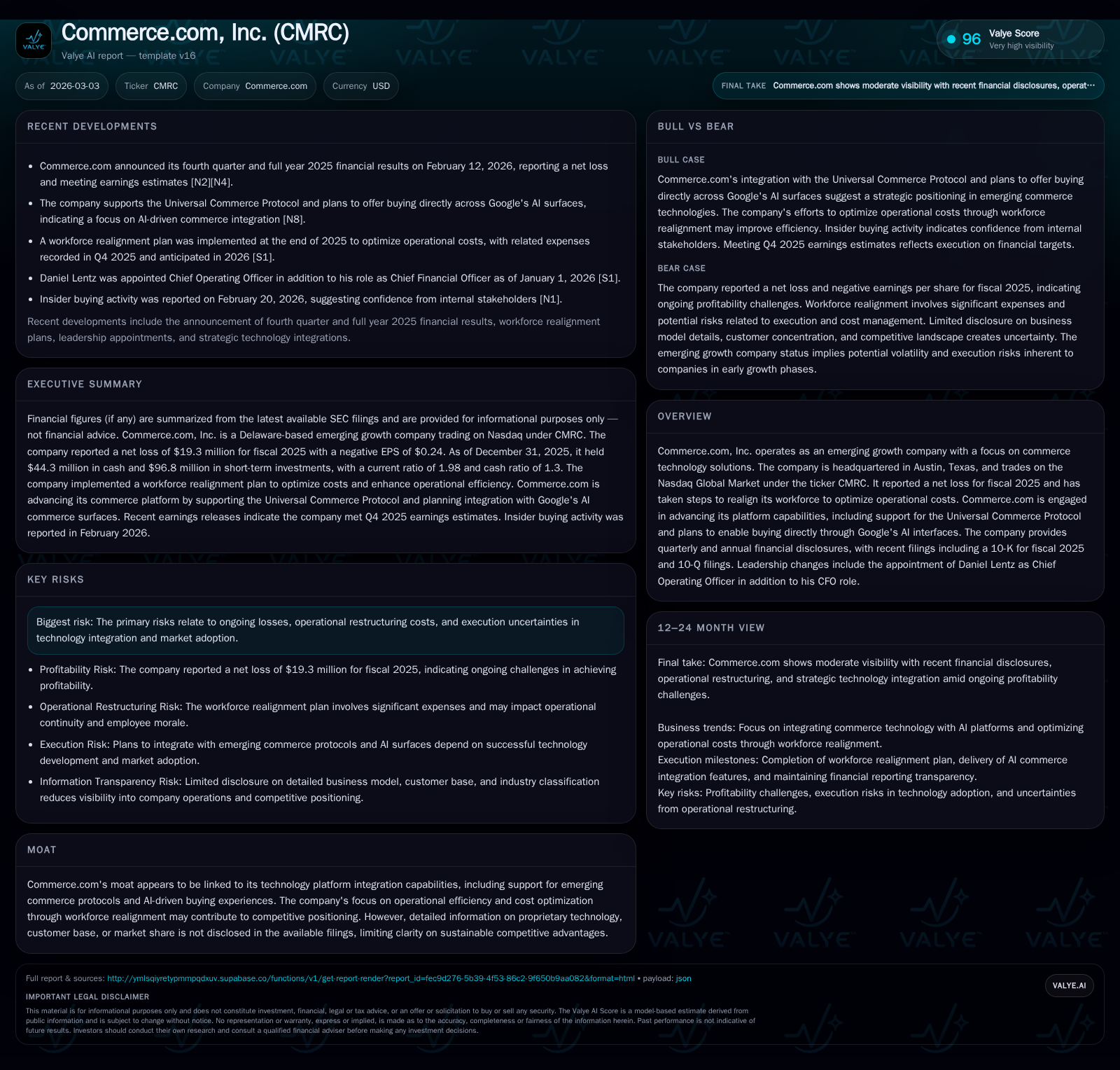
Commerce.com has demonstrated a marked reduction in net losses and improved operating cash flow over the past four fiscal years, signaling progress in its financial turnaround efforts. The company’s December 2025 workforce realignment aims to further optimize costs and drive profitability. Concurrently, Commerce.com is advancing its platform with support for the Universal Commerce Protocol and AI buying integration via Google interfaces, enhancing interoperability and transaction automation capabilities. Leadership consolidation with CFO Daniel Lentz taking on COO responsibilities seeks to align operations tightly with financial management as the company navigates execution risks and adoption challenges inherent to emerging technology deployments.
Revenue and Profit Performance: Progress Through Persistent Losses
Since FY2022, Commerce.com has made substantial strides in reducing its sizable net losses. The company's net income deficit shrank from -$139.9 million in FY2022 to -$19.3 million in FY2025—an approximate 86% improvement over three years [F1]. Operating income followed a similar trend with losses narrowing from -$140.6 million to -$16.2 million over the same period. Notably, between FY2024 and FY2025 alone, operating income improved by over 61%, signaling meaningful operational progress despite remaining unprofitable.
Operating cash flow (CFO) has been equally telling: after experiencing substantial negative outflows of -$89.3 million and -$24.2 million in FY2022 and FY2023 respectively, Commerce.com reversed this trend with positive CFOs of $26.3 million and $25.5 million for FY2024 and FY2025 [F1]. This rebound suggests improving core business efficiencies amid revenue generation efforts.
These figures illustrate an underlying business transitioning from heavy loss absorption toward operational stabilization albeit still challenged by structural costs.
Historical performance (annual)
| FY | Net ($mm) | CFO ($mm) | OpInc ($mm) | Capex ($mm) | Net YoY |
|---|---|---|---|---|---|
| 2025 | -19 | 25 | -16 | 9 | +28.4% |
| 2024 | -27 | 26 | -42 | 4 | +58.2% |
| 2023 | -65 | -24 | -72 | +53.8% | |
| 2022 | -140 | -89 | -141 |
Source: SEC companyfacts cache [F1].
Capital returns and efficiency (annual)
| FY | FCF ($mm) | ROE% |
|---|---|---|
| 2025 | 17 | -49.1 |
| 2024 | 23 | -81.0 |
| 2023 | -253.3 | |
| 2022 | -306.4 |
Source: SEC companyfacts cache [F1].
Table displays annual results showing steady reduction in losses and recovery of operating cash flow adjusted for capital expenditures [F1].
Operational Realignment: Cost Optimization and Workforce Restructuring
To accelerate its path toward profitability and sustain positive cash generation trends observed in FY2024–25, Commerce.com announced a strategic workforce realignment plan enacted at the close of fiscal 2025 [S11][S17]. This plan involves resizing personnel levels aligned with the company's revised cost structure to improve efficiency across operations.
The fourth quarter of fiscal year 2025 saw immediate charges related to this initiative amounting to approximately $7.4 million primarily comprising severance benefits and professional fees. Anticipated additional restructuring expenses total about $6.5 million through fiscal year 2026.
From a cash flow perspective, management expects the program's incremental impact on operating cash flows to reach $3.4 million during Q1 2026 with a total of approximately $12.2 million for the full year—reflecting planned cost savings vis-à-vis upfront expense commitment.
While such restructuring involves inherent execution risk regarding talent retention and business continuity disruptions—as indicated in regulatory filings—management gauges these steps necessary for long-term value creation [S17].
Technological Advancements: Embracing Universal Commerce Protocol and AI Integration
Commerce.com's platform evolution strategy centers on multi-protocol commerce interoperability designed to future-proof transaction capabilities across diverse digital ecosystems [N3]. Specifically notable is the native support for the Universal Commerce Protocol which facilitates seamless standardized commerce data exchange across platforms—a critical infrastructure for scaling omni-channel retail experiences.
Complementing protocol support is advancement toward AI-enabled transaction automation exemplified by plans to integrate buying directly through Google's artificial intelligence interfaces—a forward-looking move aimed at embedding commerce directly within conversational AI frameworks.
These initiatives position Commerce.com's platform for enhanced scalability by delivering frictionless user experiences backed by data-driven intelligence and trust-enabling protocols common among responsive SaaS commerce offerings.
Leadership Consolidation: Impact of CFO Daniel Lentz Assuming COO Responsibilities
Effective January 1, 2026, CFO Daniel Lentz was appointed Chief Operating Officer while maintaining his finance leadership role—a dual function intended to synchronize operational execution tightly under financial stewardship [S17].
This 'dual-hatting' approach aligns with emerging growth technology firms' approaches where governance structures emphasize lean senior leadership teams coordinating cross-functional priorities closely.
Potential benefits include sharper alignment between financial planning/control functions with daily operational oversight allowing for nimble decision making throughout ongoing restructuring phases and innovation deployments.
Risks lie mainly in capacity stretch for one executive balancing wide-ranging responsibilities during complex transformation periods but absence of compensation adjustments suggests confidence in current management bandwidth.
Capital Deployment: Cash Flow Dynamics, Investment in Capex, and Returns Analysis
Fiscal year 2025 capex more than doubled (+131%) relative to prior year reaching approximately $8.6 million indicative of intensified investments underpinning platform development initiatives discussed earlier [F1]. Despite growth-oriented spending pressure free cash flow remains solid positive at an estimated $16.9 million (CFO minus capex), underpinning liquidity resilience during transition.
However returns measured via ROE remain negative at roughly -49%, reflecting lingering net loss legacy even as equity base expanded modestly given accumulated deficits reduced but not reversed during this recovery timeline [F1].
No dividends or share repurchase programs have been reported since at least FY2020 indicating capital preservation focus consistent with emerging growth stage dynamics prioritizing reinvestment over shareholder distributions presently [F1][S12][S14].
Forward Outlook: Growth Prospects and Market Adoption Risks
Commerce.com remains classified as an emerging growth company highlighting extant uncertainties despite progress achieved thus far .[N2][N3] Company disclosures cite risks surrounding ongoing investment return timing given restructuring expenses along with challenges integrating cutting-edge universal commerce protocols within market acceptance timelines.
The platform's differentiation hinges heavily on successful market uptake of multi-protocol interoperability combined with innovative AI transaction automation features that promise efficiency gains but require scale deployment amid competitive SaaS commerce environments fueled by rapid innovation cycles.
Such innovation trajectories bear execution hazards manifest in technology adoption lags or suboptimal integration complexities potentially muting near-term revenue expansion prospects relative to internal strategic ambitions documented by management forward statements [S4].[N3]
What to Monitor: Milestones, Financial Metrics, and Execution Indicators
Valye analysis underscores several critical metrics going forward including:
- Improvement trajectories in operating margins following restructuring completion benchmarks;
- Market traction signals for newly embedded AI-commerce functionalities particularly Google interface-enabled transactions;
- Insider purchasing activity (noted insider buys recently reported) as potential confidence barometers impacting share sentiment dynamics [N6];
- Quarterly liquidity metrics including operating cash flow stability against guidance forecasts outlined during earnings calls [N2].
Close scrutiny of quarterly earnings releases juxtaposed with management commentary will be pivotal for assessing if the current financial turnaround momentum translates into sustainable profitability pathways within evolving commerce technology landscapes.
Disclaimer: This report is based solely on publicly available information provided through official SEC filings ([S#]), recent news releases ([N#]), and validated XBRL data ([F1]). It does not constitute investment advice or recommendations but aims to provide an informed analytical view grounded strictly on disclosed facts without speculative projections.
Disclaimer: This is research-only, informational analysis and not investment advice. It may include AI-generated interpretation and general industry context. Always verify important details using primary sources.

Comments