
CMS Energy’s Second-Quarter 2026 Update Highlights Regulatory Advances and Clean Energy Expansion
CMS Energy advances its regulatory framework and renewables integration while maintaining a strong financial profile in Q2 2026.
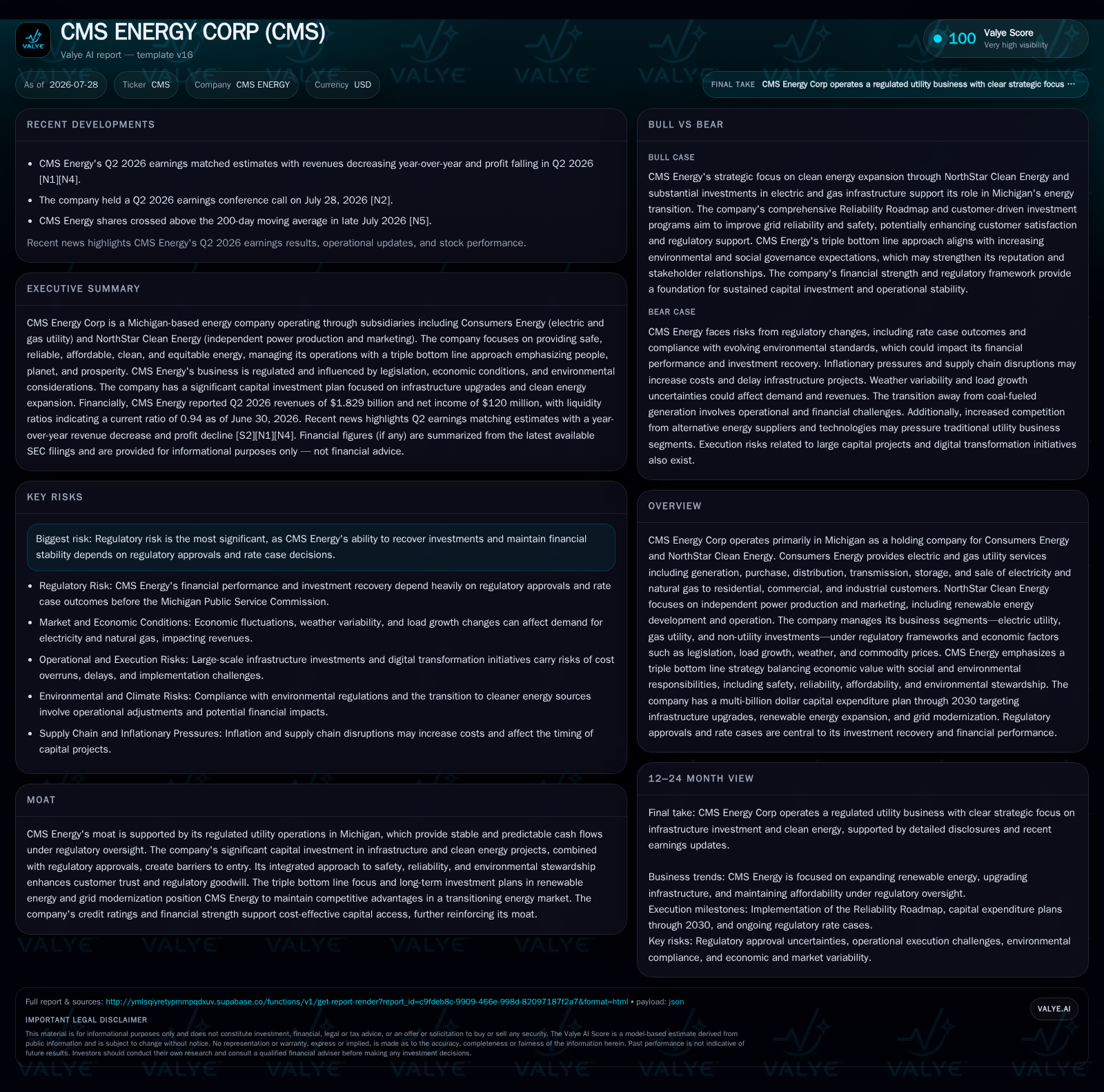
In its latest quarterly filing, CMS Energy detailed enhanced incentives for energy efficiency and renewable power purchase agreements, alongside new statewide energy storage standards and expanded distributed generation limits in Michigan. The company’s regulated utility business continues to underpin stable cash flows, supported by its integrated resource plan focusing on safety, reliability, affordability, and clean energy targets. Key risks remain regulatory dependency and capital intensity amid the energy transition. CMS Energy’s balanced strategy aligns with industry trends emphasizing grid modernization and sustainability, positioning it well against notable peers within the regulated utilities sector.
Recent Operating Update: Regulatory Progress and Clean Energy Incentives
CMS Energy’s second-quarter 2026 filing highlights significant regulatory advancements that are shaping its operational and capital deployment strategies. The company enhanced incentives for energy efficiency programs and secured improved returns on newly executed clean and renewable power purchase agreements (PPAs), reflecting a strategic shift towards sustainable energy sources within its revenue mix [S2]. Michigan’s Public Service Commission (MPSC) has introduced a new energy storage standard requiring electric utilities to submit implementation plans by 2029 to meet a statewide target of 2,500 MW of energy storage capacity. This mandate is expected to accelerate CMS Energy’s investments in battery storage and grid modernization projects, which are critical to integrating intermittent renewable resources and enhancing system flexibility [S2]. Additionally, the statutory cap on distributed generation resources—such as customer-owned solar installations—has been raised to 10% of the utility’s five-year average peak load, enabling greater behind-the-meter resource integration but also necessitating advanced grid management to maintain reliability and power quality [S2]. These regulatory developments collectively drive CMS Energy’s capital allocation towards clean energy infrastructure and system resilience.
CMS Energy’s Electric Supply Plan, embedded within its Integrated Resource Plan (IRP), aligns with these regulatory changes by emphasizing the delivery of safe, reliable, affordable, clean, and equitable energy to its Michigan customers. The IRP incorporates the company’s Renewable Energy Plan (REP) and outlines a long-term strategy to meet environmental goals while maintaining operational excellence [S2]. The effectiveness of these initiatives will be evaluated through upcoming rate cases before the MPSC and progress toward renewable portfolio standards.
Business Model: Regulated Utility with Integrated Renewable Investments
CMS Energy operates primarily through Consumers Energy Company, a vertically integrated electric and natural gas utility serving residential, commercial, and industrial customers across Michigan, and NorthStar Clean Energy, which focuses on independent renewable power generation [S1][S14]. The regulated utility business generates revenue through rate-regulated tariffs approved by the MPSC, which allow recovery of prudent infrastructure investments plus an authorized return on equity (ROE). Key operational drivers include electricity sales volume (MWh), natural gas throughput, peak load demand (MW), and customer growth, all influenced by economic activity, weather patterns, and electrification trends.
Consumers Energy’s electric utility segment manages generation assets (both owned and contracted), transmission infrastructure connecting bulk power supplies, distribution networks delivering electricity to end-users, and retail sales operations [S1][S14]. The natural gas segment oversees procurement contracts, pipeline transmission, storage facilities, and distribution to customers. NorthStar Clean Energy complements this regulated business by developing renewable projects such as wind and solar farms, securing revenues through long-term PPAs outside the regulated rate base, thus diversifying CMS Energy’s cash flow sources [S1][S14].
This hybrid business model balances the stability of regulated utility cash flows—anchored in a defined regulated rate base subject to commission oversight—with growth opportunities from renewable energy projects operating under market or contract-based revenue structures. CMS Energy’s ongoing digital transformation initiatives, branded as the “CE Way,” focus on operational efficiency, safety, cost control, and employee engagement, which collectively support capital productivity and service quality.
Industry Structure and Competitive Position
CMS Energy’s regulated utility operations benefit from Michigan’s regulatory framework, which provides a stable earnings base through cost recovery mechanisms and an authorized ROE. This regulatory environment creates a moat by imposing high capital expenditure requirements for infrastructure maintenance and modernization, alongside stringent compliance demands. Unlike independent power producers exposed to merchant price volatility, CMS Energy enjoys predictable tariff returns subject to periodic rate cases overseen by the MPSC.
The company’s strategic emphasis on renewable energy development through NorthStar Clean Energy aligns with broader industry trends seen at peers such as Duke Energy and NextEra Energy, which combine regulated utility operations with substantial renewable portfolios to advance decarbonization goals. However, CMS Energy’s geographic concentration in Michigan exposes it to state-specific policies on distributed generation limits and energy storage mandates, which differ from peers operating across multiple states or regions. This concentration offers focused regulatory engagement opportunities but also risk if state policies evolve unfavorably.
Operational reliability remains a critical competitive factor, with CMS Energy monitoring system average interruption duration index (SAIDI) and system average interruption frequency index (SAIFI) to assess grid performance. The company invests continuously in grid hardening, automation, and digital metering to enhance these reliability metrics amid increasing penetration of distributed energy resources.
Growth Drivers: Clean Energy Integration and Load Expansion
CMS Energy’s growth outlook is supported by several structural drivers. The expansion of distributed generation limits to 10% of peak load and the state-mandated energy storage targets create direct capital deployment opportunities in behind-the-meter solar and utility-scale battery storage projects [S2]. These investments address intermittency challenges associated with renewable generation and improve grid flexibility.
Electrification trends, particularly in electric vehicle (EV) adoption and building electrification for heating, are expected to drive incremental load growth, creating volume-based revenue opportunities [S14]. Michigan’s economic dynamics support commercial and industrial demand expansion, while residential customer growth contributes to steady baseline consumption
Grid modernization efforts, including advanced metering infrastructure and demand response programs, enhance peak load management and system efficiency. NorthStar Clean Energy’s pipeline of wind and solar projects backed by long-term PPAs contributes to renewable capacity additions, improving carbon footprint metrics and diversifying revenue streams beyond regulated tariffs [S1][S14]. The company’s ability to secure PPAs with favorable return profiles will be a key performance indicator for margin sustainability.
Risks: Regulatory Uncertainty and Capital Intensity
Regulatory risk remains a primary concern for CMS Energy, as rate case outcomes directly affect cost recovery levels and authorized ROE, which underpin earnings stability. Unfavorable or delayed regulatory decisions could compress margins or increase capital funding requirements. The integration of distributed generation resources within statutory caps presents grid management challenges that may require costly mitigation measures.
The capital-intensive nature of maintaining and upgrading transmission and distribution infrastructure, alongside financing renewable energy and storage projects, introduces execution risks related to project timing and cost overruns. Commodity price volatility impacts fuel procurement costs, although pass-through mechanisms largely mitigate margin exposure, potentially causing cash flow timing mismatches.
Technological disruptions from emerging distributed energy resources or demand-side management innovations could erode traditional utility revenue models if not effectively incorporated into CMS Energy’s business strategy. Additionally, weather extremes and cybersecurity threats pose operational risks requiring ongoing mitigation.
What to Watch Next
Key upcoming developments to monitor include rate case filings before the MPSC that will establish cost recovery frameworks for new renewable investments and grid upgrades outlined in CMS Energy’s IRP. Progress on Michigan’s energy storage mandate, including utility filings detailing implementation plans, will indicate operational readiness and capital deployment pace.
Tracking NorthStar Clean Energy’s renewable capacity additions and contract awards with attractive return profiles will provide insight into non-utility segment growth. Operational reliability metrics such as SAIDI and SAIFI will reflect infrastructure health amid increasing distributed resource integration.
Capital expenditure execution and adjusted earnings results, including non-GAAP reconciliations disclosed in quarterly reports, will serve as indicators of disciplined project management and financial performance. Legislative or regulatory changes affecting tariffs, renewable standards, or distributed generation caps warrant close attention due to their potential financial impact.
Financial Profile Discussion
As of June 30, 2026, CMS Energy held $241 million in cash and equivalents against current liabilities of approximately $3.06 billion, resulting in a current ratio near 0.94, consistent with typical working capital management in the utility sector [F1]. Total debt was approximately $18.94 billion at year-end 2025, with net debt around $18.7 billion after accounting for cash reserves [F1]. This capital structure supports CMS Energy’s ability to fund ongoing infrastructure maintenance and renewable energy investments while managing leverage prudently.
The company’s financial discipline, combined with digital transformation initiatives, aims to sustain margins despite inflationary pressures on materials and labor costs associated with infrastructure projects currently underway [S2][S3]. CMS Energy’s stable regulated cash flows underpin its credit profile and capacity to invest in clean energy and grid modernization aligned with evolving regulatory mandates.
Disclaimer: This analysis is based solely on publicly available documents including recent SEC filings for CMS Energy Corp., supplemented by industry knowledge specific to the regulated electric and gas utilities sector. It does not constitute investment advice or research views but aims to provide a fact-based synthesis incorporating operating updates with contextual interpretation rooted in sector expertise.
Disclaimer: This is research-only, informational analysis and not investment advice. It may include AI-generated interpretation and general industry context. Always verify important details using primary sources.

Comments