
DTE Energy Confirms 2026 Outlook with Balanced Growth in Regulated and Renewable Segments
Q2 2026 results reinforce DTE Energy’s steady earnings outlook supported by rate base growth and renewable investment amid regulatory challenges.
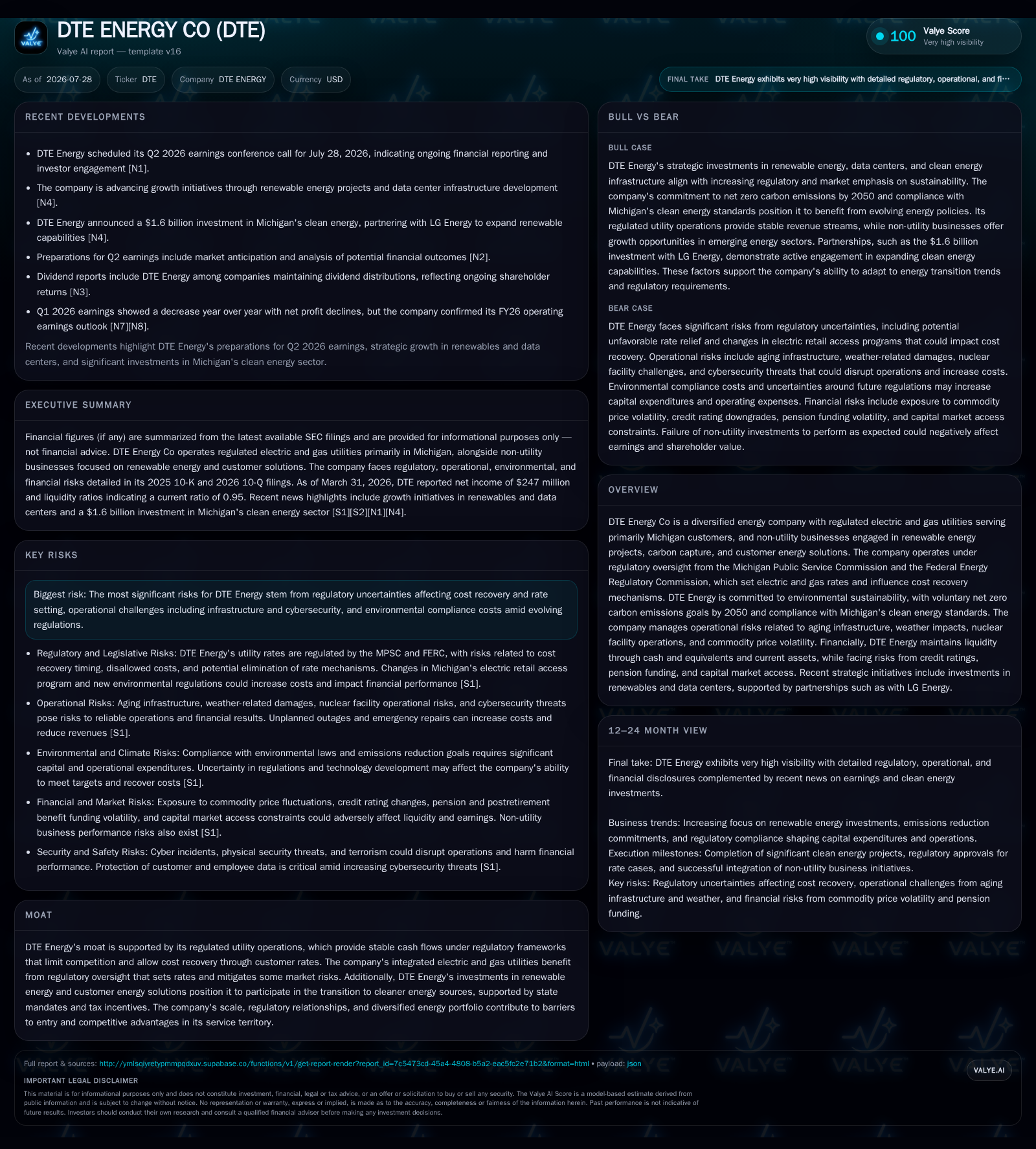
DTE Energy’s Q2 2026 filings reaffirm a stable operating earnings trajectory driven primarily by expansions of its regulated electric and gas utilities under Michigan Public Service Commission oversight, complemented by strategic renewable energy projects. The company balances capital allocation between traditional infrastructure modernization and clean energy investments as it pursues net zero carbon emissions by 2050. Regulatory uncertainties, especially related to cost recovery and retail access migration limits, remain key risks to monitor. Financially, DTE maintains liquidity and manageable leverage appropriate for the capital-intensive utility sector.
Q2 Operating Update Reinforces Earnings Stability
In its Q2 2026 filing dated July 28, DTE Energy reiterated its full-year operating earnings guidance without significant revision despite ongoing regulatory and environmental headwinds [S2][S3]. This reaffirms a business model anchored in the predictability of regulated utility cash flows overseen by the Michigan Public Service Commission (MPSC). While this framework provides stability, the company acknowledges potential risks from regulatory delays or disallowances in recovering costs embedded within customer rates. Complementing utility earnings are contributions from renewable energy investments that align with broader decarbonization trends [N1].
Integrated Utility Business Model: Regulated Returns Underpin Revenue Quality
DTE primarily serves Michigan customers through its regulated electric and natural gas utilities. Revenue is largely derived from rates approved by the MPSC and Federal Energy Regulatory Commission (FERC), embedding cost recovery mechanisms that shield earnings from commodity price volatility and competitive pressures [S1]. This regulated model ensures that prudent capital investments translate into an expanding rate base generating incremental returns under established regulatory return on equity (ROE) frameworks.
The company allocates capital to maintain grid reliability via infrastructure upgrades while investing in renewable energy projects such as wind, solar, battery storage, and carbon capture technology projects. These align with Michigan's clean energy mandates and DTE's voluntary commitment to achieve net zero carbon emissions by 2050 [S1]
Regulatory Environment: Rate Base Growth Dependent on MPSC Decisions
The MPSC plays a critical role in approving rates that reflect capital expenditures necessary for modernization and compliance. Regulatory outcomes dictate the timing and extent of cost recovery; unfavorable rulings or delays could compress margins or defer cash flows from investments made in grid transformation or renewables expansion [S1][S28]
Michigan’s hybrid retail electricity market caps retail access migration at 10%, limiting exposure to alternative suppliers but introducing legislative risk if this cap changes. Such shifts could alter customer composition or capacity requirements unexpectedly [S28][S29]. Effective cost recovery through rates remains essential to maintaining credit quality.
Managing Aging Infrastructure Amid Rising Compliance Costs
The ratio of capital expenditures to depreciation indicates whether spending is primarily growth-focused or maintenance-driven. Sustaining operational reliability—measured through system average interruption duration index (SAIDI) metrics—is critical but can strain margins if regulatory mechanisms lag behind rising costs.
Renewable Investments Drive Portfolio Diversification
Beyond core utility operations, DTE steadily expands renewable energy capacity backed by state tax credits and federal incentives [S1][N1]. Projects include wind farms, solar arrays, battery storage integration, and carbon capture technologies designed to mitigate emissions from legacy fossil-fuel assets
This strategic diversification enhances sustainability credentials while generating revenue less exposed to fuel price swings inherent in conventional generation. Renewable capacity growth serves as an important forward-looking indicator for earnings contributions outside traditional regulated returns.
Key Risks: Regulatory Uncertainty and Retail Access Dynamics
Primary risks encompass potential adverse outcomes in future MPSC rate cases affecting cost recovery timing or approval; legislative changes impacting retail access participation caps; evolving environmental regulations imposing additional compliance costs; plus commodity price volatility influencing fuel procurement expenses [S28][N1]
Retail access migration sensitivity illustrates how pricing differentials can influence customer behaviors despite existing caps. Monitoring these evolving dynamics is crucial for assessing earnings durability.
Monitoring Milestones Through Year-End 2026
Investors should track forthcoming MPSC rate case decisions confirming authorized rate base levels; quarterly capital expenditure updates relative to budgets; commissioning schedules for renewable projects; along with operational reliability statistics (e.g., SAIDI/SAIFI) reflecting service quality trends [S2][N2]. Legislative developments affecting retail access programs or environmental policies will also be pivotal.
Financial Profile Discussion: Leverage Supports Capital-Intensive Growth
This leverage level is typical for integrated utilities balancing substantial debt-financed capital investment with stable regulated cash flows that underpin creditworthiness [S2]. Adequate liquidity supports ongoing investments in grid modernization and renewables without immediate refinancing concerns
DTE Energy exemplifies a dual-path strategy combining regulated utility cash flow stability under Michigan PSC governance with proactive expansion into renewables aligned with decarbonization goals. The main challenge remains managing evolving regulatory risks around timely cost recovery amid rising compliance burdens while leveraging clean energy investments as distinct growth avenues within a capital-intensive industry.
Disclaimer: This is research-only, informational analysis and not investment advice. It may include AI-generated interpretation and general industry context. Always verify important details using primary sources.

Comments