
SMJ International’s Export-Led Flooring Business Faces Margin Pressure While Maintaining Strong Liquidity
SMJ International leverages export markets such as India and Japan for growth but encounters margin compression amid competitive pressures and inflation.
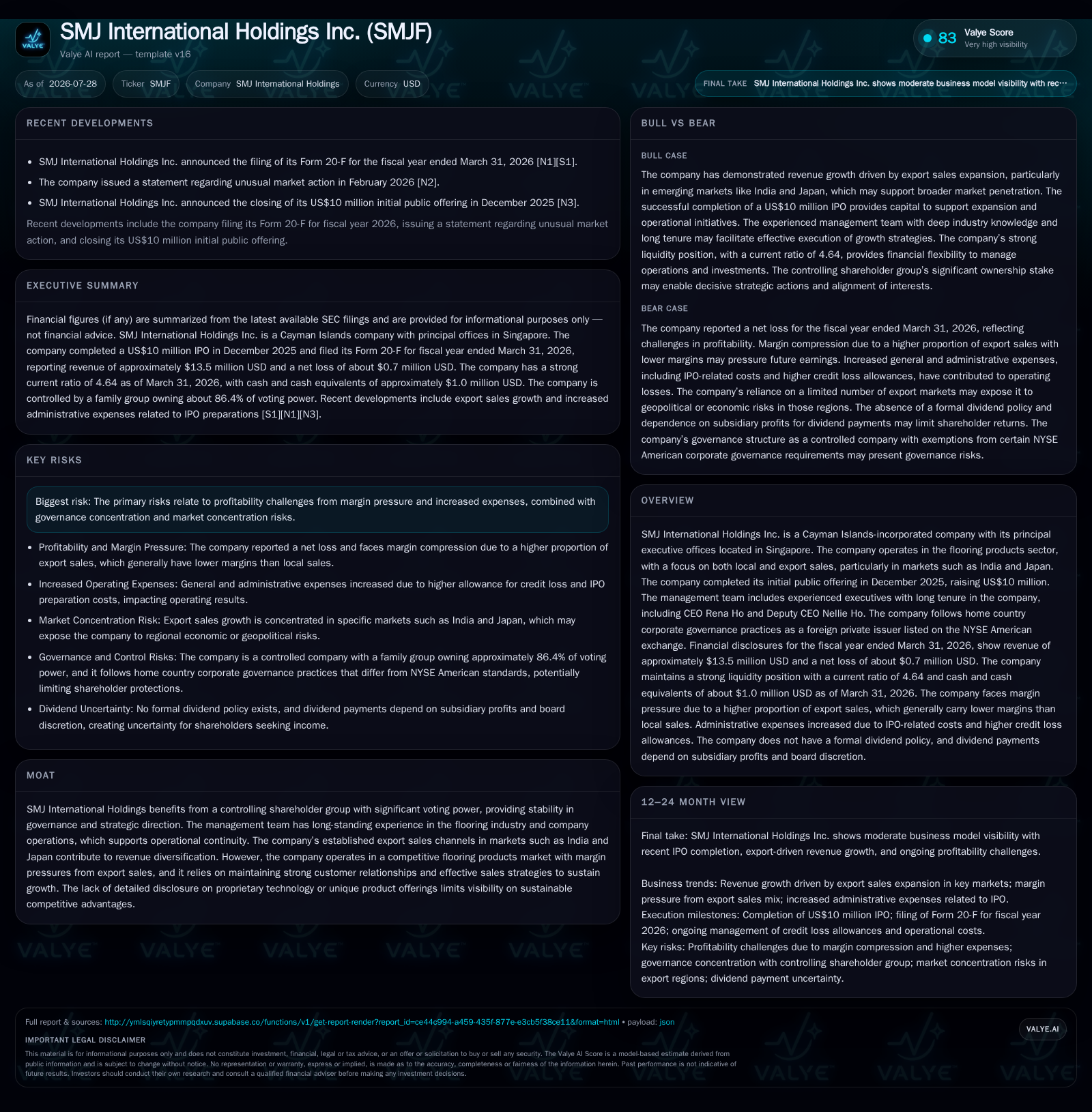
SMJ International Holdings, a publicly listed flooring products company headquartered in Singapore, reported $13.5 million revenue and a net loss of $0.7 million for fiscal 2026, reflecting margin pressure primarily from export sales expansion. The company’s business model balances local and export markets, with established channels across Asia, but remains exposed to typical flooring industry challenges including raw material cost inflation and competitive pricing pressure. Management stability and a strong liquidity position, with a current ratio above 4.6, provide operational resilience. Key risks include governance concentration, operating expense inflation, and dependence on project-based customers.
Recent Operating Update
Business Model Overview
SMJ operates within the midstream segment of the flooring products manufacturing and distribution value chain, focusing on sourcing flooring materials that it sells through wholesalers, retailers, contractors, and project developers primarily in Southeast Asia and export markets like India and Japan. The company’s revenue derives from both local Singapore sales—which tend to yield higher gross margins—and export sales where competitive pricing compresses margins due to logistics costs and local market dynamics [S22][S1]. Sales are predominantly project-based without long-term contracts, causing variability tied to construction or renovation cycles within key customer relationships [S6].
Revenue mechanics hinge on product mix between vinyl, laminate, hardwood or engineered flooring sourced mainly from suppliers across Thailand and China [S24], with export sales denominated partly in US dollars exposing SMJ to foreign exchange risk managed via hedging practices [S25]. Its monetization pattern involves upfront corporate financing supported by trade credit facilities with short maturities typically around four months [S25], necessitating effective working capital management given inventory stocking obligations.
The firm’s customer base includes several major clients accounting for individually more than 10% of revenues or receivables; however, this concentration adds exposure to fluctuations in project awards or scope with those customers [S6]. There is no disclosed proprietary technology or product innovation differentiation; rather SMJ competes on product quality consistency, distribution reach, and customer relationships nurtured through experienced management led by CEO Rena Ho who has longstanding industry tenure [S2].
Industry Context and Competitive Positioning
The flooring products industry faces intense competition driven by evolving consumer preferences toward durability and aesthetics alongside volatility in raw materials like wood and vinyl affecting input costs. Export market exposure introduces complexities via logistics expense volatility, currency risks, regulatory compliance demands, and pricing pressure against local players or alternate import suppliers. Peer benchmarks such as Mohawk Industries or Tarkett illustrate scale-driven margin advantages absent at smaller operators like SMJ.
In this environment, SMJ contends with margin compression as rising export sales which accounted for a growing share during the reporting period carry inherently lower gross margins compared to domestic Singapore sales [S22]. This dynamic is typical industry-wide where freight costs dilute profitability even if expanding volume supports topline growth metrics. Operating expenses saw moderate increases primarily due to inflation-related wage growth and administrative overheads heightened by IPO-related professional fees reflected in fiscal 2026 results [S22][S25].
Supply chain agility is critical given fashion-driven changing customer preferences requiring adaptation in supplier selection each year among a concentrated pool predominantly based in Thailand and China [S24]. SMJ’s management believes willingness to source substitute suppliers mitigates supplier concentration risk though maintaining timely quality-comparable alternatives demands operational focus.
Growth Drivers
Key growth catalysts for SMJ include continued expansion in residential and commercial construction within Southeast Asia and target export markets like India—a high-growth region for infrastructure investment—as well as Japan which represents a stable demand base albeit at maturity levels requiring differentiated service or pricing competitiveness. Renovation activity also supports recurrent demand over new builds.
Strategic use of IPO proceeds has targeted bolstering inventory stocking levels and expanding distribution networks to capture project lead times more effectively while facilitating quicker customer fulfillment cycles which drive revenue growth opportunities [S17]. Incremental investments into sales channel diversification are designed to deepen penetration into export markets where partnerships or acquisitions could enhance product offerings or geographic footprint.
Risks and Constraints
Operating risks center on sustained margin pressure due to raw material cost inflation compounded by overhead cost increases linked to personnel expenses—evidenced by management acknowledging inflation impacts on operating results though not yet material but potentially adverse if revenue growth slows ahead of cost hikes [S1][S25]. Continued reliance on project-based customers creates inherent variability in booking size and timing since long-term contracts are generally absent; thus customer retention rates remain a sensitive KPI.
Governance complexity arises from controlling shareholder concentration providing strategic direction stability but posing minority interest agency issues absent broader shareholder alignment transparency highlighted in disclosures [Valye Moat & Risks]. Currency exposure ties directly to fluctuating procurement costs in foreign currencies versus reporting currency dynamics.
Competitive threats stem from market fragmentation where larger peers benefit from scale economies allowing better sourcing terms plus superior logistics integration which SMJ may find challenging to match competitively without material capability expansions.
What To Watch Next
Critical near-term performance markers include quarterly revenue growth trajectory particularly from export regions India and Japan as indicators of successful penetration beyond domestic base. Monitoring gross margin trends will reveal if operating leverage can offset raw material costs sufficiently or if pricing adjustments prove feasible amid competitor actions.
Working capital efficiency progress measured by inventory turnover ratio improvements will signal supply chain optimizations absorbing higher stocking levels without incurring obsolescence risk. Updates on any strategic acquisitions or channel partnerships funded through IPO proceeds should surface given their stated role in growth plans.
Management’s commentary on inflationary effects scalability vis-à-vis operating expense controls will also be pivotal to projecting sustained profitability improvements.
Conclusion
SMJ International operates as a focused regional player in the competitive flooring products manufacturing and distribution sector carving out revenue growth primarily through expanding exports while maintaining strong liquidity buffers post-IPO funding. The company faces inherent industry risks: margin compression fueled by input cost inflation coupled with project-based customer demand variability limits near-term profitability despite growing top-line figures.
Stable shareholder control combined with an experienced leadership team contributes governance continuity advantageous for executing strategic initiatives like inventory expansion and distribution enhancements. Yet operational execution must navigate supply chain efficiencies, product mix optimization across diverse buyer preferences, and overhead cost management against inflationary conditions.
Investors watching SMJ should closely monitor quarterly revenue compositions across geographic segments alongside gross margin trends signaling pricing power retention or erosion.
Finally, any announcements regarding strategic acquisitions or partnerships funded via IPO proceeds could materially influence growth trajectory beyond organic expansion capabilities currently documented.
Disclaimer: This is research-only, informational analysis and not investment advice. It may include AI-generated interpretation and general industry context. Always verify important details using primary sources.

Comments