
Valmont Industries Strengthens Infrastructure Backlog Amid Agricultural Demand Pressure
Strong Infrastructure segment orders offset softer Agriculture sales as Valmont navigates raw material cost and seasonal cycles in Q2 2026.
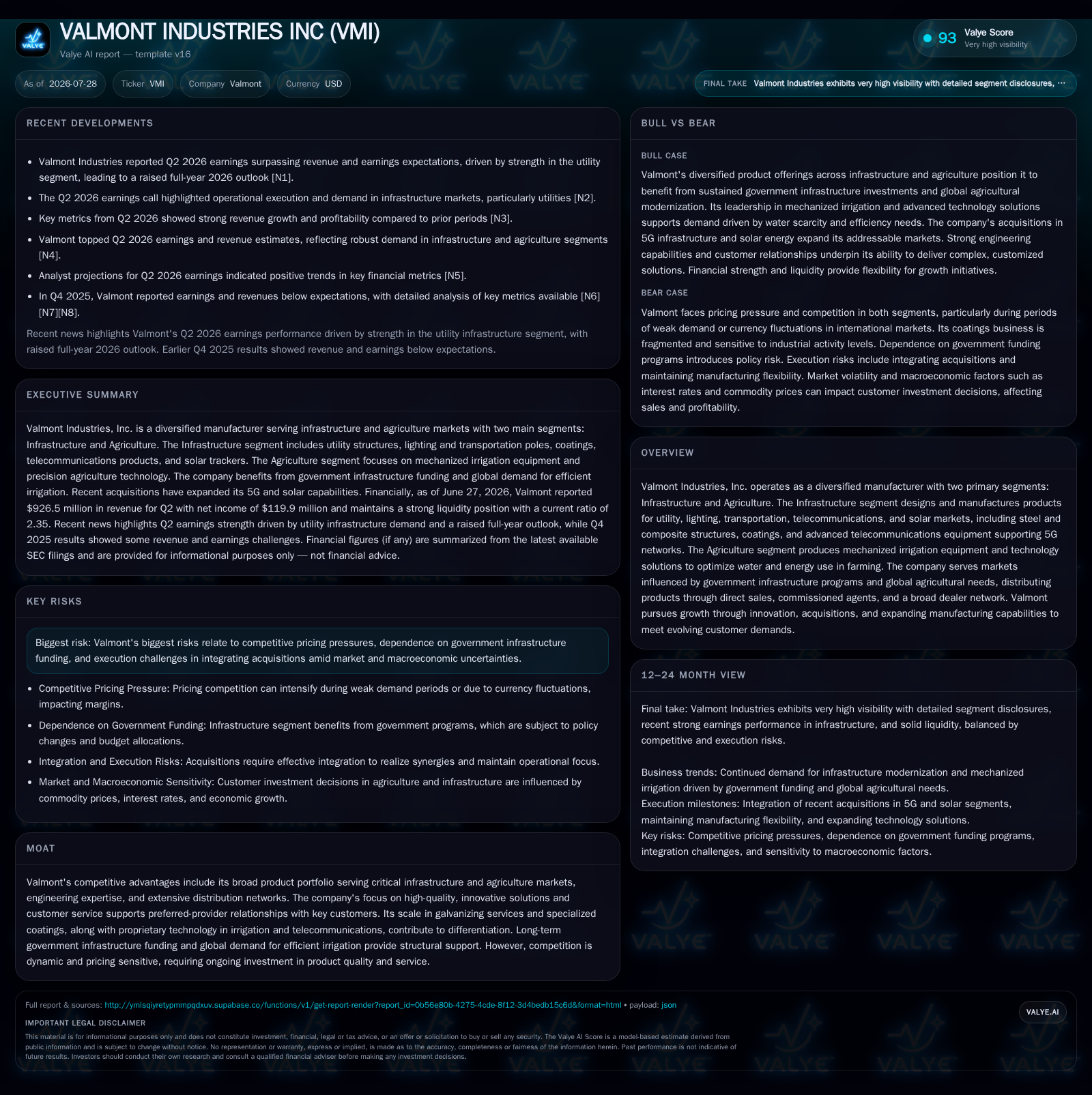
Valmont Industries reported a robust order backlog growth in its Infrastructure segment for Q2 2026, driven by utility and 5G telecom demand, while its Agriculture segment faced continuing headwinds from farm income fluctuations and water policy uncertainty. The company’s diversified manufacturing model spanning engineered steel structures, mechanized irrigation equipment, and coatings services provides resilience despite cyclical end markets and commodity cost volatility. Recent acquisitions deepen its technology portfolio supporting infrastructure modernization and precision agriculture. Valmont’s leverage and liquidity remain manageable, but raw material exposure and competitive bidding pressure require ongoing operational agility.
Recent Operating Update: Infrastructure Orders Support Robust Backlog
Valmont Industries’ Q2 2026 results reveal continued strength in its Infrastructure segment driven primarily by electric utility capital projects and accelerating deployment of 5G telecommunications infrastructure [S2][N1]. The company reported a book-to-bill ratio exceeding one in this segment, indicating that new orders surpass shipments, which bodes well for sustained revenue visibility into subsequent quarters. By contrast, the Agriculture segment faced subdued demand attributable to cyclicality in farm income, increased input costs for growers, regulatory uncertainty about irrigation water use policies in parts of the U.S., as well as variable weather patterns including drought conditions [S1][S10]. This dynamic underscores the dual-natured cyclicality afflicting Valmont’s business model where infrastructure investments are partially spurred by government stimulus programs like IIJA (Infrastructure Investment and Jobs Act), while agricultural spending is directly linked to farmer economics influenced by global commodity prices.
Valmont's Business Model: Diverse Engineered Solutions Across Critical Markets
Valmont operates principally through two segments: Infrastructure and Agriculture. The Infrastructure division designs and manufactures engineered steel structures used predominantly in electrical transmission lines, utility substations, telecommunications towers (notably supporting dense 5G networks), outdoor lighting poles for transportation corridors, commercial lighting applications including sports venues and parking areas, as well as solar energy mounting systems [S1][S16]. These products are large-scale capital equipment sold mainly directly to utilities or developers via a combination of direct sales force and commissioned agents. The company supplements these with coatings services (galvanizing for corrosion protection) tailored to extend asset life — a crucial value-add given the environmental exposures of infrastructure assets.
The Agriculture segment focuses on mechanized irrigation equipment such as center pivot systems under the Valley® brand — designed to optimize water application efficiency across various field sizes globally — along with advanced technology solutions enabling precision agriculture via connected devices that monitor soil moisture and automate irrigation schedules [S1][S18]. Its extensive dealer network spreads across North America (250 dealers) and international markets (400 dealers across six continents), providing customization, installation management including water pumping systems powered by grid electricity or renewable sources like solar panels, plus after-sale service parts distribution.
Revenue derives from product sales (capital equipment units), aftermarket replacement parts (a recurring revenue source with higher margin profile), coatings contract services charged per volume/area treated or part processing throughput, plus software/technology subscriptions/licenses enhancing irrigation system productivity. Pricing strategies must balance competitive bidding dynamics — particularly acute in commoditized steel structure contracts — with differentiated offerings anchored on engineering quality, reliability certifications, durability standards for load-bearing applications under varying environmental stresses (wind loading, ice accumulation), and technological innovation.
Industry Structure and Competitive Position
Operating at the intersection of industrial hardware manufacturing serving critical infrastructure sectors like electric utilities and telecommunications alongside agriculture equipment production situates Valmont within capital-intensive industries whose demand is sensitive to macroeconomic cycles and regulatory environments.
Peers encompass diversified industrial manufacturers such as Lindsay Corporation (irrigation), Ametek (electrical components), Muelle (infrastructure support products), as well as specialized galvanizing firms. Comparative strengths rest on scale advantages in galvanizing network coverage enabling geographic proximity to customers within economically viable freight ranges (~300-500 miles), breadth of product portfolio encompassing both standard offering steel/composite structures plus custom-engineered solutions to meet specific load requirements stated by utility regulators or telecom operators deploying denser base stations incentivized by increasing data consumption trends.
Customer retention benefits from long-term preferred-provider relationships typically renewed every three to five years coupled with investment in dealer education ensuring effective local market penetration supporting sophisticated machine configurations aligned with crop type demands or utility infrastructure specs. Additionally, proprietary patented technologies in irrigation machine design and PIM mitigation systems for signal interference enhance barriers against substitution. Nonetheless, dynamic competition compounded by currency fluctuations influencing import competitiveness requires vigilance over pricing policies.
Growth Drivers: Innovation Meets Macro Tailwinds
Government infrastructure funding remains a critical structural growth driver for Valmont’s fabricated steel structures used in utility transmission upgrades aimed at grid resilience amid climate change impacts such as natural disasters disrupting power supply chains [S1][N1]. Continued rollout of 5G wireless networks mandates new telecommunications towers incorporating ConcealFab acquired technology enhancing network performance by reducing passive intermodulation effects supporting higher frequency bands essential for mmWave deployment [S15].
On the agricultural front, rising global water scarcity necessitates mechanized irrigation solutions improving water use efficiency compared to traditional flood irrigation methods; this drives adoption especially in arid regions leveraging Valmont’s precision agriculture offerings partially powered by renewable energy sources reducing operational costs for farmers [S18]. Incremental acquisitions made recently bolster solar energy project participation helping farmers offset energy input expenses.
Moreover, expanding urbanization accelerates demand for transportation lighting infrastructure—both public (roadway safety lighting) and private commercial developments fueling traffic flow management products including guardrails designed for crash attenuation meeting evolving federal highway administration standards.
Risks & Watchpoints: Raw Materials & Market Cyclicality
Cyclical demand variability remains a pronounced risk given electric utilities’ capital expenditure profiles subject to regulatory approval cycles or economic downturns potentially postponing grid modernization projects impacting order timing [S1][N1]. Similarly, fluctuating farm incomes tied to commodity prices compounded by high input cost inflation may suppress growers’ capital investments into new irrigation equipment for multiple quarters.
Raw material cost pressures represent a persistent margin headwind chiefly involving hot-rolled steel coil prices influenced by global supply-demand imbalances combined with zinc used extensively for galvanizing surfaces protecting steel from corrosion effects plus natural gas consumption expenses required for galvanizing tank heating processes [S1][S6]. While Valmont has structured some cost pass-through agreements embedded in contracts providing partial price recovery capability versus fixed-price commitments susceptible to squeeze margins during volatile spikes.
Further uncertainties stem from legal proceedings related to Brazilian regulatory matters affecting agriculture operations where recent adverse appellate court decisions could entail additional provisions beyond currently accrued reserves; ongoing patent-related guardrail litigation outside U.S. markets poses potential reputational risk possibly affecting demand if regulatory approvals tighten unexpectedly [S8][S7].
What to Watch Next
Key metrics signaling execution momentum include monitoring quarterly changes to order backlog segmented between Infrastructure versus Agriculture; sustained above-par book-to-bill ratios will confirm robust top-line acceleration especially for multi-year utility projects tougher to defer. Capacity utilization rates at galvanizing plants serve as real-time gauges of downstream industrial activity levels supporting coatings revenues.
Innovation pipeline updates particularly rollout speed of digital irrigation control platforms will be an indicator of potential step-change margin expansion opportunity given recurring revenue conversion potential combined with farmer adoption rates. Tracking raw material cost volatility alongside pricing adjustments discerned via average selling prices embedded within public disclosures informs margin sustainability debate.
Operational milestones tied to integration progress post-ConcealFab acquisition including cross-selling effectiveness into existing customer bases support medium-term growth projections along with successful mitigation strategies addressing geopolitical trade policy shifts potentially impacting international sourcing strategies.
Financial Profile Discussion
Valmont maintains a conservative liquidity position evidenced by a current ratio near 2.35 as of June 2026 supported by $139 million cash balances complemented by current assets totaling approximately $1.78 billion against $757 million current liabilities reflecting adequate short-term working capital coverage [F1]. Total debt stood near $796 million at year-end 2025 yielding net debt roughly $657 million after cash offsets requiring prudent leverage oversight amid sizeable capital expenditure needs inherent in manufacturing capacity expansion initiatives [F1][S4].
Operating margins are challenged by elevated raw material inputs; however, gains from operational efficiencies combined with favorable product mix shifts towards higher value-added segments underpin resilient profit generation demonstrated by operating income around $415 million during the latest fiscal year end [F1]. Free cash flow generation is anticipated to sustain investment flexibility essential for pursuing targeted acquisitions complementing organic R&D investments.
In conclusion, Valmont’s diversified manufacturing platform balances exposure across infrastructure modernization imperatives anchored by government funding cycles alongside global agricultural mechanization trends promoting sustainable water usage despite cyclical pressures reflective of broader economic forces. Management’s focus on innovation-driven differentiation coupled with disciplined financial stewardship positions the company prudently amid ongoing raw material challenges and sector-specific competitive dynamics.
This analysis synthesizes publicly available SEC filings up to July 28th 2026 combined with contemporaneous market commentary without providing specific investment research views.
Disclaimer: This is research-only, informational analysis and not investment advice. It may include AI-generated interpretation and general industry context. Always verify important details using primary sources.

Comments