
Boeing Navigates Supply Chain and Program Accounting Challenges Amid Strong Backlog
Boeing’s Q2 2026 update underscores the operational complexities of fulfilling a substantial backlog amid ongoing supply constraints and program accounting pressures, while pension funding remains stable and liquidity solid.
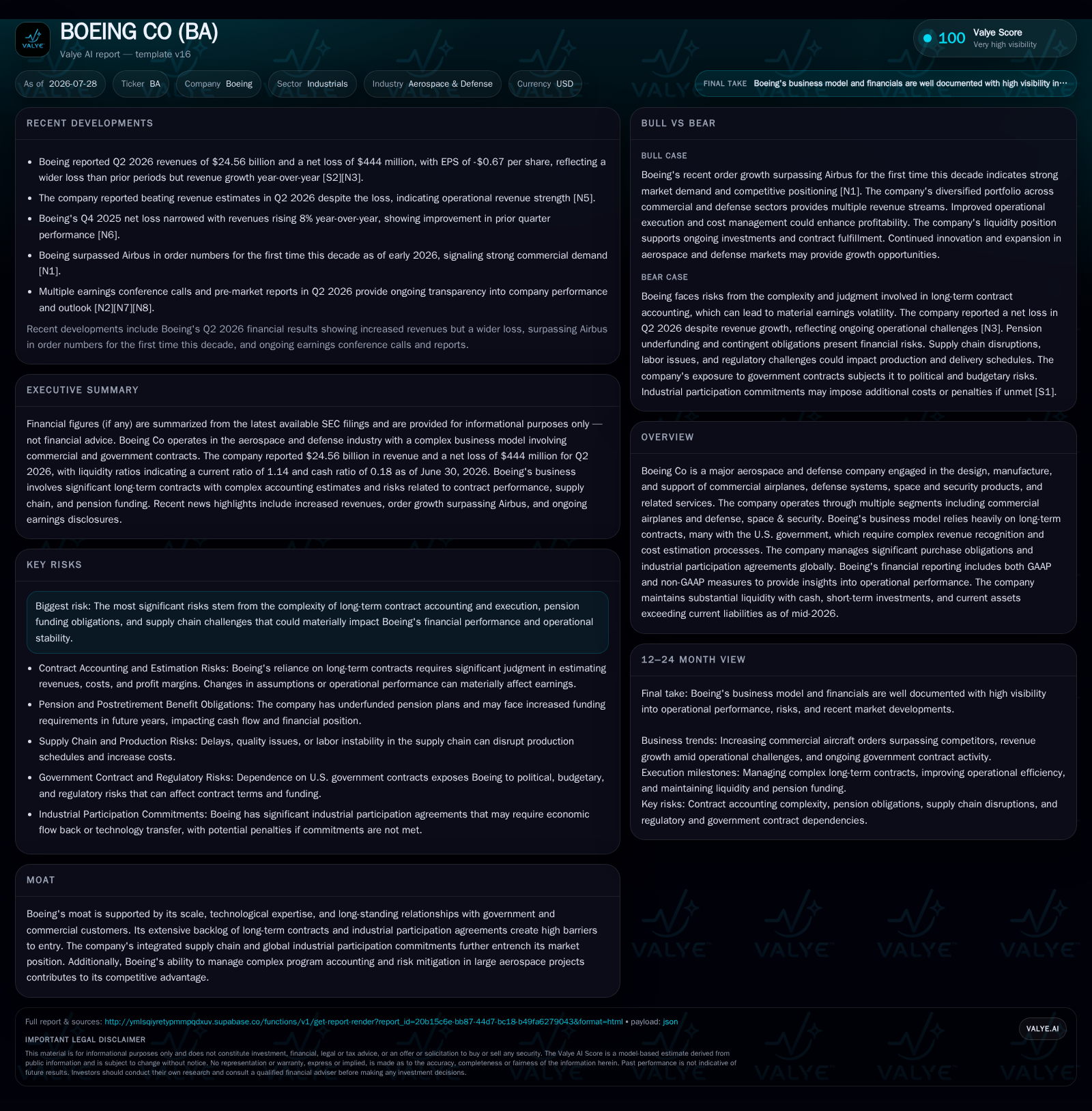
Boeing’s latest quarterly filing shows a robust order backlog supporting revenue visibility but highlights persistent supply chain bottlenecks that temper production ramp-up and delivery performance. Program accounting intricacies contribute to margin volatility typical for aerospace OEMs managing long-term contracts. Pension underfunding is manageable with no significant cash contributions expected in 2026. Industrial participation agreements support global market access but carry execution risks. Commercial segment demand remains cyclical, balanced by steady defense procurement. Boeing’s financial position reflects adequate liquidity with $9.44 billion cash against $44.35 billion debt at Q1 2026, though leverage stays elevated.
Boeing’s Q2 2026 Update Highlights Operational Challenges Amid Strong Backlog
Boeing’s Q2 2026 10-Q filing reveals a substantial order backlog combining commercial aircraft and defense contracts, providing multi-quarter revenue visibility critical for managing production and cash flow [S2]. This backlog reflects a mix of long-term contracts with commercial airlines and government agencies, underpinning Boeing’s role as a leading original equipment manufacturer (OEM) in aerospace and defense. However, the company continues to face operational complexities driven by supply chain constraints and program accounting intricacies that affect margin stability and delivery performance.
Backlog Composition and Revenue Visibility
The backlog at mid-2026 remains robust, encompassing firm orders for commercial jets alongside defense and space systems contracts. Commercial backlog levels are influenced by the cyclicality of global air travel demand, which affects airlines’ capital expenditure plans and delivery schedules [S1]. Defense contracts, often governed by government procurement cycles and modernization initiatives, provide steadier revenue streams with less volatility. Boeing’s revenue recognition follows program accounting principles, requiring revenue to be matched against estimated contract costs over extended production periods. This accounting treatment necessitates disciplined cost estimation and control to protect operating margins amid fluctuating supplier conditions and production challenges [S2].
Supply Chain Constraints Impact Production and Margins
Persistent supply chain disruptions remain a significant bottleneck for Boeing’s production ramp-up plans. Delays in critical component deliveries and raw material shortages extend lead times, complicating production scheduling and limiting the company’s ability to increase output rates as targeted [S2]. These constraints have led to increased costs from expedited logistics and supplier premium charges, exerting downward pressure on margins. Additionally, delayed deliveries affect revenue recognition timing and risk contractual penalties tied to on-time delivery commitments. Effective supply chain management, including supplier coordination and inventory procurement, is therefore a key operational focus to restore production efficiency and margin stability.
Program Accounting and Earnings Volatility
Boeing’s long-term contracts require frequent revisions to cost estimates, which directly impact quarterly earnings through adjustments in contract profitability assessments [S1], [S2]. Variability in program cost forecasts, driven by manufacturing complexities and supplier performance, contributes to earnings volatility typical for aerospace OEMs managing multi-year projects. Contract loss reserves or releases arising from cost overruns or underruns affect operating income margins and cash flow timing. Monitoring contract liabilities and receivables provides insight into future margin trends and potential risks associated with program execution.
Pension Funding Status and Financial Flexibility
As of December 31, 2025, Boeing’s pension plans showed approximately $4.3 billion underfunding on a GAAP basis but were over 90% funded on an ERISA basis, reflecting a relatively stable pension funding position [S1]. This status allows Boeing to avoid significant pension cash contributions in 2026, preserving liquidity for operational needs and capital investments. However, pension obligations remain sensitive to actuarial assumptions such as discount rates and demographic changes, which could affect future funding requirements. Ongoing monitoring of pension plan metrics is important for anticipating potential impacts on cash flow and capital allocation.
Industrial Participation Agreements Facilitate Global Market Access
Boeing’s industrial participation commitments total approximately $16.4 billion through 2034, reflecting obligations to support local economic activity, technology transfer, or skills development in international markets tied to procurement contracts [S1]. These agreements help secure overseas business by embedding Boeing within local supply chains and government frameworks, creating competitive barriers for rivals lacking similar arrangements. While no penalties were incurred in 2025, failure to meet these commitments could result in financial penalties, underscoring execution risk over the long term.
Segment Performance: Commercial Cyclicality Balanced by Defense Stability
The commercial aircraft segment remains subject to cyclical demand patterns driven by global air travel trends, which influence airline fleet renewal and expansion decisions [S1], [S2]. Conversely, the defense segment benefits from more stable government procurement budgets focused on modernization and capability upgrades. This diversification across commercial and defense markets provides Boeing with some resilience against sector-specific downturns, although execution risks and supply chain issues affect both segments.
Sustained R&D Investment Supports Technological Leadership
Boeing continues to invest significantly in research and development aimed at advancing aircraft fuel efficiency, avionics, and expanding space system capabilities [S1]. These investments are critical to maintaining competitive advantages relative to peers such as Airbus in commercial aerospace and addressing disruption from emerging space sector entrants like SpaceX. Innovation in materials, propulsion, and digital systems underpins Boeing’s ability to secure future contracts and expand aftermarket services revenue, which is increasingly important for lifecycle profitability.
Key Operational Milestones and Watchpoints
Near-term operational priorities for Boeing include resolving supply chain bottlenecks to enable production rate increases aligned with backlog targets, improving accuracy in program cost estimation to reduce earnings volatility, and securing new contract awards particularly within defense procurement cycles [S2], [S3]. Monitoring pension funding assumptions and industrial participation execution will also be important to manage financial flexibility and mitigate penalty risks. Key performance indicators to watch include production output rates, on-time delivery percentages, program cost variances, contract win rates, and pension plan funding ratios.
Financial Position: Adequate Liquidity Amid Elevated Leverage
Capital allocation decisions appear balanced between operational execution, strategic investments in innovation, and managing financial obligations in a complex macroeconomic environment.
This analysis synthesizes Boeing’s recent filings with aerospace industry context to provide a detailed view of operational challenges, financial position, and strategic priorities without offering investment advice or forecasts.
Disclaimer: This is research-only, informational analysis and not investment advice. It may include AI-generated interpretation and general industry context. Always verify important details using primary sources.

Comments