
Itron Strengthens Industrial IoT Ecosystem with Advanced Resiliency Segment and Solid Recurring Revenue Trajectory
Itron’s Q2 2026 filing underscores its strategic expansion into resiliency solutions and a stable recurring revenue base amid ongoing industry supply and regulatory complexities.
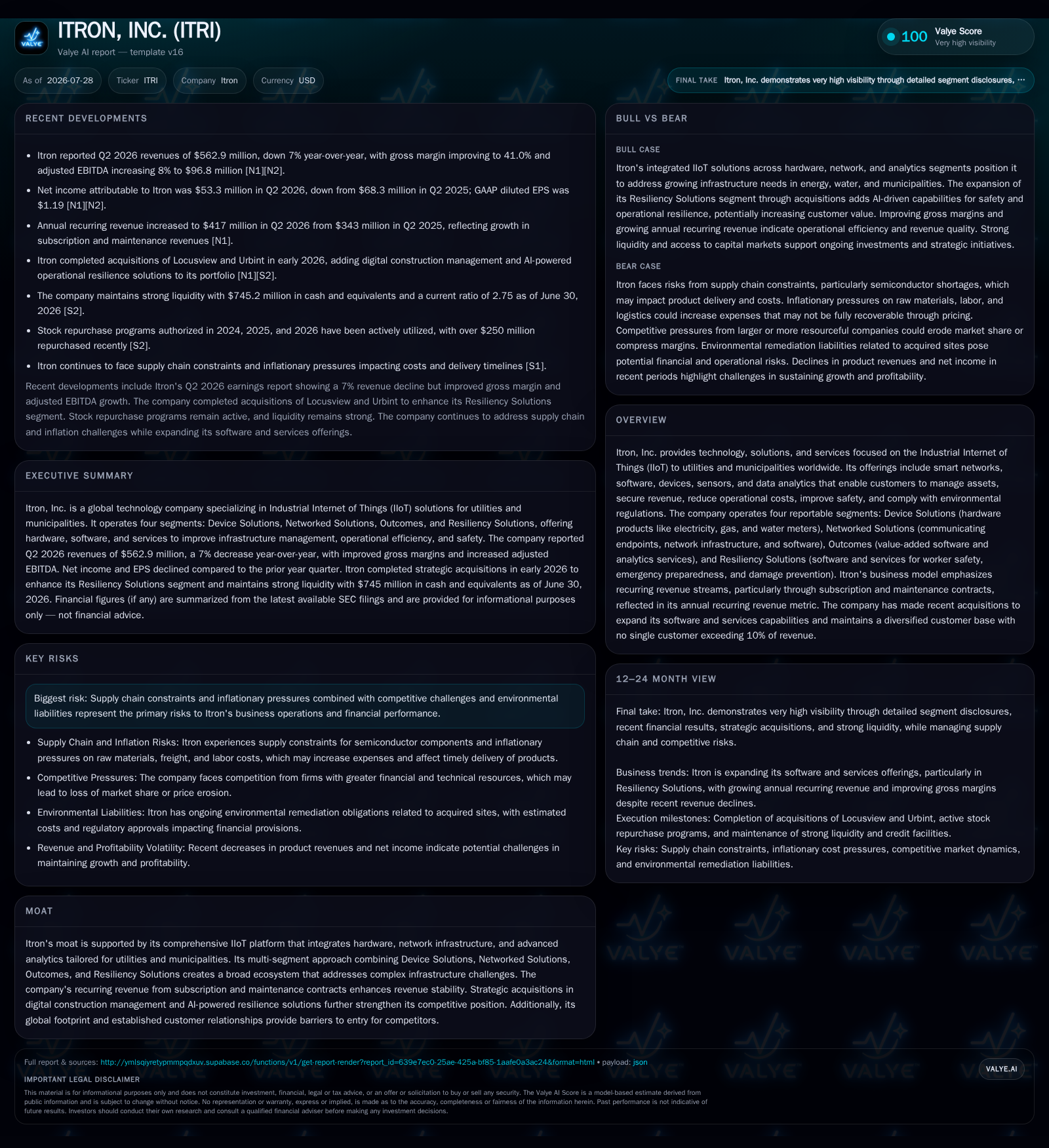
In its latest quarterly filing, Itron launched a new Resiliency Solutions segment addressing emergent utility infrastructure challenges such as operational safety and emergency preparedness. This move complements its established multi-segment IIoT model, which integrates Device Solutions, Networked Solutions, and Outcomes to deliver hardware, network, and AI-powered analytics to utilities worldwide. Recurring revenue streams from software subscriptions and maintenance contracts remain a key stability pillar amidst long sales cycles and supply chain inflation pressures. The company also refreshed its capital structure with an $805 million convertible note issuance in early 2026, enhancing liquidity for growth investments. Risks persist around regulatory delays, cost inflation, and environmental liabilities tied to legacy site cleanups.
Itron Expands Industrial IoT Platform with New Resiliency Solutions Segment and Maintains Robust Recurring Revenue Base
Itron’s Q2 2026 quarterly filing highlights a strategic expansion with the launch of the Resiliency Solutions segment in Q4 2025, reflecting a deliberate broadening of its Industrial Internet of Things (IIoT) ecosystem beyond traditional metering and network infrastructure toward enhanced operational safety, emergency preparedness, and damage prevention within utility infrastructure [S2][S1]. This new segment delivers software and services designed to support utilities’ workforce safety protocols, critical infrastructure protection, and emergency response readiness—areas increasingly prioritized amid heightened regulatory scrutiny and escalating climate-related risks. By integrating resiliency-focused offerings alongside its established Device Solutions, Networked Solutions, and Outcomes segments, Itron aims to deepen its platform’s end-to-end coverage of utility operational domains, potentially increasing cross-selling opportunities and customer stickiness.
The Resiliency Solutions segment aligns with broader industry trends emphasizing investment in resilient infrastructure as utilities and municipalities seek to mitigate risks from natural disasters and cyber threats. This strategic move positions Itron to address growing demand for solutions that enhance system reliability and operational continuity, complementing its hardware-centric device portfolio and network infrastructure with advanced software-driven resiliency capabilities.
Recurring Revenue Streams Provide Stability Amid Hardware Sales Volatility
Recurring revenues derived from subscription-based software licenses and maintenance contracts remain a critical pillar underpinning Itron’s financial stability within its multi-segment business model. While the company does not disclose explicit recurring revenue percentages, management commentary underscores the strategic emphasis on expanding software-as-a-service (SaaS) style offerings, particularly within the Outcomes segment, which delivers AI-enabled analytics and value-added services that extend beyond one-time hardware sales [S2][S1]
These recurring contracts typically feature high renewal rates, supported by the complexity and integration depth of Itron’s IIoT platforms, which create switching costs for utilities managing critical grid assets. This dynamic fosters durable customer relationships and recurring billing streams, which help smooth revenue fluctuations caused by the inherently long and irregular sales cycles for hardware products such as smart meters and communicating endpoints.
Core Hardware and Network Infrastructure Drive Integrated Solutions Sales
Itron’s Device Solutions segment continues to generate the bulk of hardware revenue through sales of electricity, gas, and water meters, including both standard standalone endpoints and communicating smart meters designed to operate within or outside Itron’s end-to-end solutions [S1]. Complementing this is the Networked Solutions segment, which provides comprehensive smart grid communication infrastructure encompassing network design services, headend management software, modules, sensors, distribution automation communications, smart lighting controls, and grid edge devices. Together, these segments enable utilities to deploy scalable, interoperable IIoT networks that support automated meter reading (AMR), advanced metering infrastructure (AMI), distributed energy resource management (DERM), and smart city applications.
Hardware unit shipments, particularly of smart meters and communicating endpoints, remain key operating KPIs, although supply chain constraints—especially in raw materials like copper, aluminum, and semiconductors—pose ongoing challenges affecting production lead times and cost structures [S1]. Itron’s supplier diversification and supply resiliency initiatives aim to mitigate these pressures amid inflationary cost environments.
Regulatory and Market Dynamics Shape Long Sales Cycles and Order Backlog Volatility
The utility IIoT market benefits from structural tailwinds driven by government incentives and regulatory mandates promoting smart grid modernization, energy efficiency, and environmental compliance globally. However, these drivers coexist with prolonged and unpredictable sales cycles characteristic of regulated utility procurement processes [S1]. Utilities typically undergo multi-year budgeting, formal requests for proposals (RFPs), technical evaluations, and regulatory reviews before awarding contracts, resulting in significant quarter-to-quarter fluctuations in order backlog—a key near-term demand indicator
Itron’s backlog dynamics reflect this environment, with committed but undelivered orders varying as utilities’ capital spending and regulatory approvals evolve. Monitoring backlog trends alongside bookings provides insight into demand momentum and potential revenue recognition timing.
Outcomes Segment Leverages AI and Advanced Analytics to Enhance Utility Asset Management
The Outcomes segment represents Itron’s software-driven value proposition, employing artificial intelligence (AI), machine learning (ML), statistical modeling, and distributed computing to convert raw utility data into actionable insights [S1][S2]. This segment supports utilities in optimizing asset management, reducing non-technical losses such as theft and metering inaccuracies, enabling predictive maintenance, improving leak detection, and ensuring regulatory compliance.
By embedding sticky SaaS-style applications within its IIoT platform, Itron enhances recurring revenue potential and customer ROI, differentiating itself from peers focused primarily on hardware. The continuous innovation in AI/ML capabilities within Outcomes strengthens Itron’s competitive positioning in the evolving utility analytics market.
Strengthened Liquidity Through Convertible Note Issuance Supports Growth and Innovation
In February 2026, Itron completed an $805 million convertible note issuance maturing in March 2032, structured without regular interest payments, thereby minimizing near-term cash interest obligations while enhancing capital flexibility [S2]. This financing bolsters Itron’s liquidity position, supporting investments in R&D, acquisitions, and expansion of the Resiliency Solutions segment and AI-driven analytics capabilities.
As of June 30, 2026, Itron reported $745 million in cash and equivalents against $1.61 billion in total debt, yielding a net debt position of approximately $865 million and a current ratio of 2.75x, reflecting a solid liquidity profile to support ongoing growth initiatives [F1]
Persistent Risks Include Inflationary Pressures, Regulatory Uncertainty, and Environmental Liabilities
Itron faces ongoing risks from inflationary cost pressures, notably in metals such as copper and aluminum used in meter manufacturing, as well as semiconductor component price volatility. These factors challenge gross margin maintenance, especially given limited pricing flexibility with utility customers sensitive to capital budgets [S1]
Regulatory uncertainties, including potential delays or changes in smart grid-related spending mandates, may impact order intake and project timing, contributing to revenue volatility [S1]. Additionally, environmental remediation liabilities from legacy industrial sites acquired through past transactions represent contingent risks. For example, remediation plans approved by Italian authorities entail cleanup costs subject to variability, although indemnification agreements mitigate direct financial exposure
Customer Procurement Behavior and Backlog Trends as Key Operational Indicators
Utility procurement behavior is characterized by lengthy sales cycles, bid-based contracts, and irregular purchasing patterns driven by inventory depletion and regulatory mandates [S2][S1]. Contracts often span multiple years with renewals subject to competitive bidding, leading to fluctuating bookings and backlog levels that serve as important demand visibility metrics
High customer retention and low churn rates in subscription services stabilize recurring revenues, even as hardware sales exhibit intra-year variability influenced by installation lead times and deployment workforce capacity. Close monitoring of backlog dynamics and subscription renewal rates provides actionable insights into the health of Itron’s demand pipeline and recurring revenue sustainability.
Itron’s evolving IIoT platform strategy integrates hardware innovation, network infrastructure, advanced analytics, and now resiliency solutions to address the complex operational and regulatory challenges facing utilities worldwide. Its multi-segment model anchored by recurring revenue streams enhances revenue visibility and customer engagement, though execution risks remain amid supply chain constraints, regulatory flux, and environmental liabilities. The company’s strengthened liquidity position supports continued investment in growth areas critical to maintaining competitive differentiation in the industrial IoT solutions market for utilities.
This analysis is for informational purposes only and does not constitute investment advice.
Disclaimer: This is research-only, informational analysis and not investment advice. It may include AI-generated interpretation and general industry context. Always verify important details using primary sources.

Comments