
Albertsons Confronts Grocery Market Challenges While Accelerating Digital and Pharmacy Growth
In its latest quarter, Albertsons Companies reported softer grocery demand but advances in digital engagement and pharmacy initiatives amid a competitive retail environment.
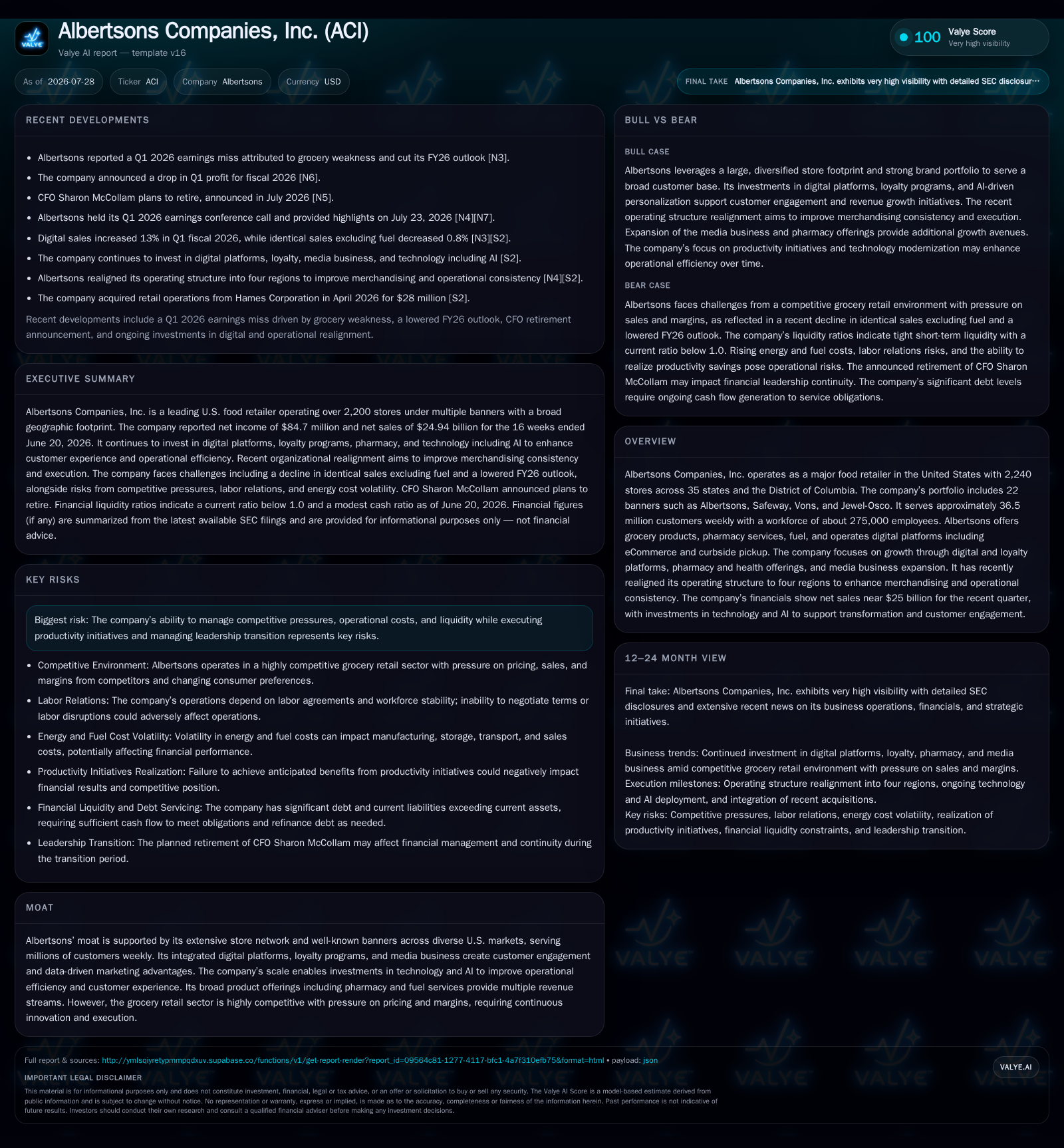
Albertsons Companies, operating over 2,200 stores across 35 states under 22 banners, serves 36.5 million weekly customers with a diversified grocery, pharmacy, fuel, and digital platform offering [S2]. The company reported mixed first-quarter fiscal 2026 results marked by modest slower grocery sales growth impacting overall performance [N2], yet it continues expanding its loyalty program and leveraging AI-driven technologies to enhance personalization and supply chain efficiency [S1]. Strategic realignment into four regions aims to improve operational consistency. Key risks include managing intense pricing competition, evolving pharmacy reimbursement landscapes, and sustaining profitability under labor and inflation pressures. Watch for execution on digital sales expansion, pharmacy profitability improvements, leadership transitions following the CFO’s planned retirement [S3], and disciplined capital allocation as indicators of progress.
Recent Operating Update
While grocery growth softened due to macroeconomic influences and competitive pricing dynamics impacting traffic and basket trends [N2], digital revenues continued their robust climb with a reported increase of roughly 21% for fiscal year 2025 driven by eCommerce platforms — notably curbside pickup (Drive Up & Go) and home delivery services — enhancing convenience for consumers increasingly favoring omnichannel shopping experiences [S1]. Loyalty program enrollment expanded by approximately 12% year-over-year to reach over 51 million members by fiscal year-end February 2026. Loyalty-driven promotions along with private label innovation helped maintain value perception amidst competitive pricing pressures.
Business Model Overview
Albertsons principally derives revenue from multiple streams tied to its diversified retail food ecosystem. Core grocery products constitute the largest share encompassing fresh perishable goods (meat, produce, deli), non-perishables (general merchandise, dairy), as well as ancillary categories such as fuel sales at branded centers. Pharmacy operations contribute materially both through medication sales and health services offered within many store locations. This multi-pronged revenue base buffers the company somewhat from reliance on any single segment.
Importantly, Albertsons has strategically invested in digital platforms that integrate eCommerce order fulfillment with its physical stores via curbside pickup or delivery. These channels monetize convenience while collecting granular shopper data through an evolving loyalty program designed for personalized marketing. The company has leveraged this data infrastructure not only for targeted promotions but also extended it into media advertising via its Media Collective business unit — creating an additional revenue source by selling tailored ads backed by consumer insights derived from loyalty membership.
Technology investments including AI-powered applications form a cornerstone of Albertsons' transformation agenda. An AI-augmented shopping assistant is deployed to improve customer engagement online by personalizing product suggestions aiming to increase customer basket size. Complementarily, proprietary AI forecasting software (‘Gateway’) enhances inventory replenishment efficiency specifically around promotional SKUs in the center store category — elevating inventory turns while managing shrink rates and markdown cadence effectively within highly competitive product categories where margins are tight.
Industry Structure and Competitive Position
The U.S. grocery retail sector is characterized by intense competition spanning national supermarket chains (e.g., Kroger), discount grocers (e.g., Aldi), warehouse clubs like Costco focusing on bulk purchases under membership models, big-box general retailers with grocery segments such as Walmart and Target, alongside online entrants such as Amazon Fresh which target digitally native shoppers.
Albertsons’ competitive positioning rests on its broad geographic footprint with high store density in key markets under multiple regional banners catering to localized consumer preferences while leveraging centralized supply chain capabilities for cost control. Unlike membership-focused warehouse clubs which drive volume at low price points but require annual fees unrelated directly to transactions per se — Albertsons relies heavily on traditional weekly shopper visits enhanced by loyalty economics driving frequency and spend per visit.
The company's integrated pharmacy network further differentiates it versus pure-play grocers without health offerings. Pharmacy adds recurring prescription fill volumes often associated with higher gross margins relative to staple groceries but is subject to regulatory reimbursement uncertainties which impact profitability stability.
That said, margin compression from ongoing price wars especially against discount formats remains a persistent challenge requiring continuous innovation in private label assortments to provide differentiated value beyond price alone as well as operational productivity gains through technology-enabled automation.
Growth Drivers
Digital channels remain the most pronounced growth lever as Albertsons expands eCommerce penetration currently representing a growing but still minority portion of total sales volume. Higher margin opportunities exist in home delivery services although these carry higher fulfillment costs compared to curbside pickup which tends toward better cost efficiency.
Loyalty program expansion fuels repeat purchase behavior essential for stable comparable same-store sales growth — a critical KPI in brick-and-mortar grocery retail where traffic can be volatile. Deeper engagement through program simplification is expected to increase transaction frequency while AI-driven personalization may boost average basket sizes (ticket).
Moreover, the company’s ongoing investments into its pharmacy & health platforms aim not only to counterbalance sluggish grocery demand segments but also tap into broader wellness trends supporting incremental sales beyond prescriptions alone such as immunizations or health screenings hosted within store clinics.
Media Collective commercialization harnesses proprietary consumer data assets into advertising revenue—a relatively nascent line poised for acceleration if the ecosystem achieves higher scale and targeting precision enabling premium ad pricing strategies.
Store remodels completed during fiscal year 2025 (94 remodels plus nine new openings) suggest capital expenditure priorities allocated between physical modernization—improving shopper environment appeal—and technology infrastructure investments underpinning digital growth objectives [S1]
Risks and Watchpoints
Albertsons faces substantial risks inherent to large-scale grocery operators: persistent margin pressure from discount competitors demands vigilant price management without eroding brand value or loyalty; supply chain disruptions or cost inflation could impair gross margin stability; labor availability challenges combined with wage inflation risk increasing operating expenses further squeezing earnings.
Pharmacy segment regulatory changes remain unpredictable including reimbursement rate adjustments potentially compressing margins despite management’s focus on operational efficiencies. Legal proceedings related to federal government healthcare programs involving price-setting practices constitute ongoing contingent risk exposures that could generate financial liabilities or reputational impact depending on outcomes [S14][S19]
What To Watch Next
Key near-term milestones include quarterly comparable same-store sales updates clarifying if recent softness reflects transient demand shifts or structural trends impacting traffic or ticket size [N1]. Progress on scaling digital revenue streams especially expanding home delivery adoption rates alongside improvements in fulfillment cost metrics will serve as indicators of platform viability.
Pharmacy segment profitability trendlines warrant close monitoring given regulatory uncertainties alongside efforts underway targeting operational efficiency improvements. Media Collective’s ramp-up trajectory should be assessed via reported advertising revenue contributions or disclosed engagement metrics evidencing monetization success.
Capital allocation decisions balancing continued store improvement investments versus technology spending against shareholder returns—including dividends or any share repurchase activity—will reveal management’s confidence level in sustainable cash flow generation underlying valuation support.
Finally, any updates regarding debt refinancing terms or covenant compliance status could materially affect perceived balance sheet risk profiles influencing credit ratings or borrowing costs.
Financial Profile Discussion
As of June 20, 2026, Albertsons held approximately $293 million in cash and equivalents contrasted against current liabilities approximating $8.18 billion resulting in a current ratio below one at roughly 0.84—typical for retail-oriented companies carrying significant payables relative to inventories and receivables lag [F1]. Total long-term debt and finance lease obligations net of discounts and deferred financing costs were approximately $7.7 billion in senior unsecured notes plus $434 million in New Albertsons L.P. notes as of June 20, 2026 [S2]. This reflects substantial leverage consistent with historically elevated debt levels used to fund acquisitions and capital projects.
Interest expense remains significant consuming hundreds of millions annually thus requiring stable operating cash flows for servicing obligations [S1]. The company’s capital expenditure run-rate near $1.8 billion in fiscal year 2025 primarily supported store remodels and enhancement of digital/technology infrastructure reflecting priority investment areas aligned with strategic goals described above.
Free cash flow generation will be critical going forward both for deleveraging flexibility amid macroeconomic uncertainty and sustaining dividends/shareholder returns announced in April 2026—the dividend was raised from $0.15 per share quarterly to $0.17 signaling commitment amid cautious earnings revision but dependent on consistent operational performance execution [S1][N6]
This analysis synthesizes publicly filed SEC documents through July 28, 2026 along with recent earnings call information without making investment research views or projections beyond stated facts.
Disclaimer: This is research-only, informational analysis and not investment advice. It may include AI-generated interpretation and general industry context. Always verify important details using primary sources.

Comments