
Copa Holdings Leverages Panama Hub and Fleet Modernization Amid Regional Economic Fluctuations
Operating a modern Boeing 737 fleet, Copa Holdings builds on strategic alliances and a geographical hub to sustain growth despite capital-intensive expansion and Latin American market risks.
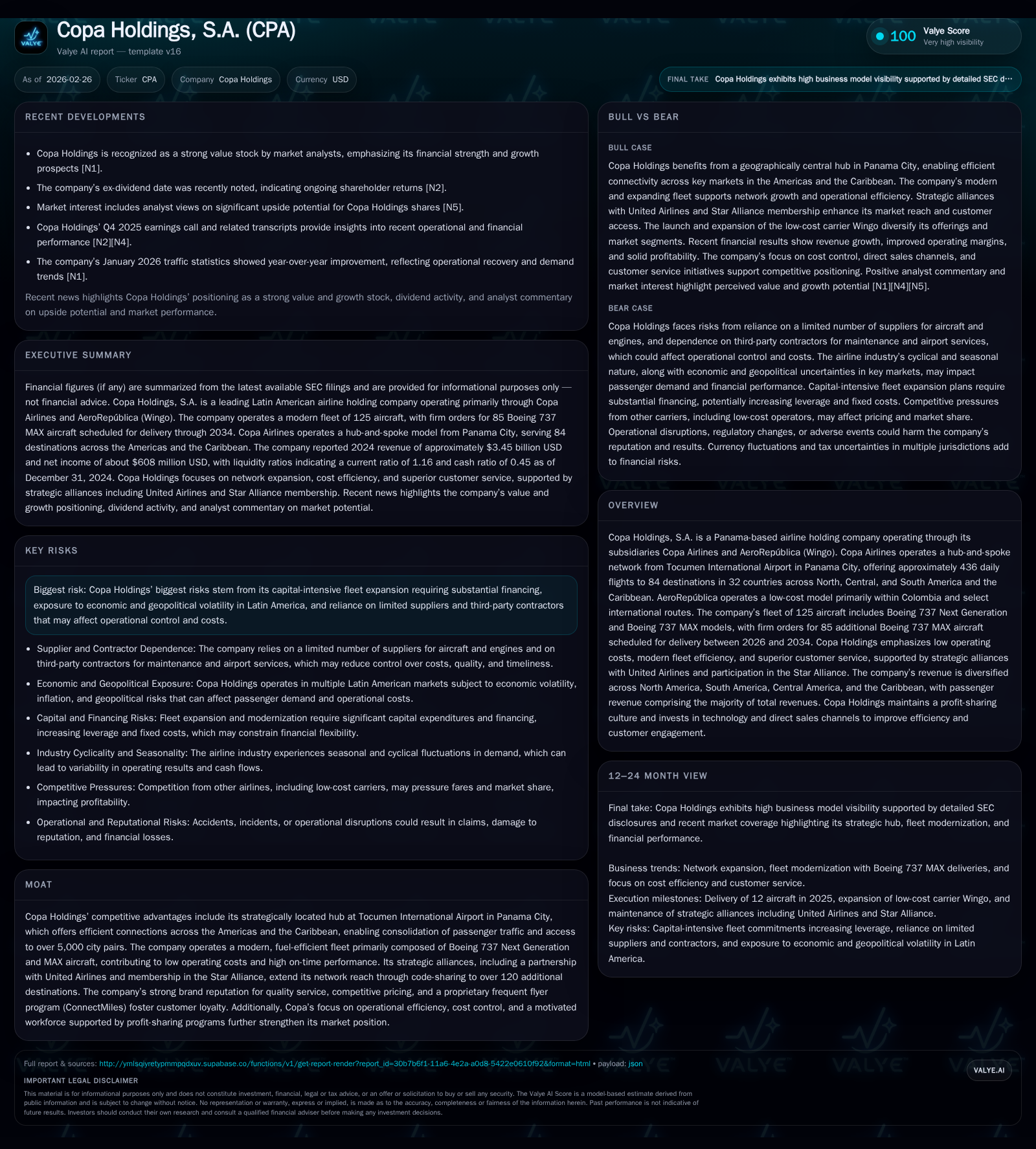
Copa Holdings, anchored by its Panama City hub, has grown revenues steadily through efficient operations, a modern Boeing 737 fleet, and strategic alliances that extend its network reach. Its subsidiaries, Copa Airlines and AeroRepública/Wingo, operate complementary models spanning premium and low-cost offerings in the Americas. While fuel cost volatility and regional political-economic uncertainties persist, the company's firm orders for 85 Boeing 737 MAX aircraft underpin capacity expansion plans through 2034. Financially, Copa demonstrated consistent revenue and earnings growth with healthy cash flow generation and disciplined capital allocation including dividends and modest buybacks.
Historical Performance
Copa Holdings has demonstrated steady growth in top-line revenues over the recent three-year period. Revenues increased from approximately $3.46 billion in 2023 to $3.62 billion in 2025, representing a compound annual growth rate of about 2.7%, with notable acceleration in the latest fiscal year (+5%). This revenue progression correlates strongly with passenger transportation recovery post-pandemic, complemented by network expansions through added frequencies and destinations.
Passenger services dominate revenue composition at roughly 95%, emphasizing the company’s dependency on air travel demand within the Americas region [F1][S1][S13]. Cargo operations contribute a smaller but growing percentage (around 3%), reflecting efficient use of belly space plus dedicated freighters introduced since 2021.
Net income grew from $514 million in 2023 to $672 million in 2025 (10.4% YoY in latest year), indicating improved margin management amidst fluctuating operating inputs such as fuel costs and maintenance expenses [F1]. Equity rose significantly to $2.78 billion by year-end 2025 from $2.12 billion two years prior, boosting return on equity to approximately 24% for the latest period.
Historical performance (annual)
| FY | Rev ($bn) | Net ($mm) | Rev YoY | Net YoY |
|---|---|---|---|---|
| 2025 | 3.6 | 672 | +5.0% | +10.4% |
| 2024 | 3.4 | 608 | -0.3% | +18.3% |
| 2023 | 3.5 | 514 | +16.6% | +47.7% |
| 2022 | 3.0 | 348 |
Source: SEC companyfacts cache [F1].
Capital returns and efficiency (annual)
| FY | Div ($mm) | ROE% |
|---|---|---|
| 2025 | 266 | 24.2 |
| 2024 | 269 | 25.6 |
| 2023 | 134 | 24.2 |
| 2022 | 34 | 23.3 |
Source: SEC companyfacts cache [F1].
Business Model & Industry Position
Copa Holdings operates primarily through Copa Airlines—the main full-service carrier based at Tocumen International Airport—and AeroRepública (operating as Wingo), a low-cost carrier focused mainly on domestic Colombian markets and select regional routes [S1][S15]. The Panama City hub serves as a pivotal geographic asset dubbed "Hub of the Americas," enabling high connectivity across North, Central, South America, and the Caribbean with approximately 436 daily flights reaching over eighty destinations.
The company emphasizes operational efficiency via a simplified all-Boeing single-aisle fleet consisting of Next Generation Boeing B737-700/800s supplemented by newer MAX-8/9 aircraft featuring fuel-saving winglets and engines [S15][S18]. This strategic fleet choice contributes to lower CASM excluding fuel (5.76 cents per ASM reported for recent years) facilitating competitive pricing amid robust schedule reliability afforded by favorable weather conditions at sea-level altitude Tocumen Airport.
Extensive code-sharing agreements with United Airlines (a Star Alliance member since June 2012) plus numerous global airlines extend market reach beyond owned routes to more than two hundred supplementary destinations worldwide [S18]. Customer loyalty is fostered via proprietary ConnectMiles frequent flyer program initiated after ending co-branding with MileagePlus in Latin America.
Future Growth Prospects
Growth catalysts include:
- Fleet Expansion: Firm orders for an additional eighty-five Boeing MAX aircraft will progressively increase capacity between now and 2034; delivery schedules offer opportunities to enhance route frequencies and open new destinations [S1][S15][S12].
- Network Development: Continued expansion into underserved Latin American city pairs supported by Panama’s open skies agreements enhances market penetration potential; Wingo's low-cost model targets segments sensitive to price competition [S14].[N2]
- Alliance Synergies: Joint marketing efforts with United Airlines plus other code-share partners provide scalable passenger feed expanding onward travel options.
- Operational Efficiency: Ongoing investments in technology-driven distribution channels (IATA NDC standard adoption) aim to control distribution expenses while improving booking convenience [S9][S24].
Constraints that could cap growth:
- Capital Intensity: Aircraft acquisitions demand substantial upfront funding; inability to secure cost-effective financing could delay deliveries or fleet renewal plans [S4][S12].
- Volatile Fuel Costs: Absence of current hedging leaves profitability vulnerable to sudden jet fuel price hikes [S1].
- Political/Economic Risks: Instability in core markets like Panama or Colombia may depress travel demand or disrupt operations [S6][S17][N2].
- Competitive Pressures: Rival airlines aggressively discount fares flattening yields; entry or capacity increases by other carriers may reduce route profitability especially in commoditized leisure segments [S11].
- Regulatory & Environmental Factors: Emerging carbon emission regulations alongside increasing consumer environmental concerns may necessitate additional investments or reduce discretionary travel volumes [S22].
Recent Operational Milestones & Financial Highlights
The full year ended December 31, 2025 marked continued recovery momentum from pandemic-linked slowdown phases:
- Passenger load factor stabilized at strong levels aided by promotional campaigns balanced against fare discipline.
- Operating cash flow reached $1.15 billion up significantly versus prior year facilitating elevated capex spend: $922 million in property & equipment primarily reflecting delivery of twelve new Boeing MAX jets during the year [F1][S4].
- Financing activity evidenced net borrowings around $552 million partially offset by principal repayments totaling $255 million along with dividend distributions amounting to nearly $266 million; minimal treasury stock buybacks occurred [$8.7 million] indicative of conservative capital return approach focusing on balance sheet strength
- Credit facilities worth $160 million remain fully available offering liquidity buffer in uncertain macroeconomic context [F1][S4][S12].
The company disclosed no formal earnings guidance for fiscal year beyond late-cycle fleet deliveries but identified keen focus on maintaining operational discipline amid fluctuating external factors as critical watchpoints going forward [N1]. Investors should monitor:
- Execution of aircraft delivery schedules without disruption or cost overruns;
- Trends in regional passenger volumes vis-à-vis emerging health or geopolitical issues;
- Fuel price movements relative to any emerging hedging strategies;
- Competitive dynamics particularly pricing actions by low-cost carriers impacting Wingo’s positioning;
- Impact of regulatory developments relating to emissions reporting or taxes impacting operational costs.
Capital Allocation & Returns
Returns have benefited from solid profitability metrics underpinned by relatively low operating costs sourced from optimized fleet composition and efficient labor structure prevailing at the Panama hub environment:
Approximate return on equity stood near a healthy ~24% given net income of $671 million against equity base of $2.78 billion for fiscal year ending December 31, 2025 demonstrating effective capital utilization metrics compared broadly within airline peer groups facing post-pandemic normalization challenges.[F1]
Cash flow strength supports consistent dividend pay-outs which grew steadily from roughly $34 million in early pandemic years up to nearly $266 million most recently reflecting management’s commitment to shareholder returns alongside capital reinvestment needs.[F1]
Debt financing primarily consists of secured export-import bank backed loans targeting aircraft purchases amortizing over long tenors plus JOLCO lease financings tailored for efficient balance sheet management.[S4][S5][S12] Unsecured credit lines remain undrawn providing contingency liquidity options although future borrowing costs remain subject to external financial market conditions.
Buybacks are modest relative to dividends reflecting prioritization of reinvestment in fleet modernization infrastructure though occasional treasury shares repurchased signal flexibility.[F1]
Industry Challenges & Risk Profile
Copa faces industry-wide vulnerabilities including:
- Operational dependencies on relatively few suppliers notably Boeing for aircraft/fleet homogeneity aiding cost control but creating concentration risk should disruptions occur[S6][S8].
- The inherently capital intensive nature of airline business with extended delivery lead-times requiring steady financing access exposes Copa to interest rate risk or credit availability shifts[S4][S12].
- Political-economic volatility in several Latin American countries influences discretionary travel demand affecting revenues notably sensitive business/passenger segments present about one-quarter of traffic mix[S1][S6][S29].
- Competition remains intense with legacy airlines targeting premium customers while low-cost carriers aggressively pursuing price-sensitive leisure travelers pressuring yields[S11].
- Emerging environmental regulations aimed at curbing carbon emissions pose evolving compliance costs potentially affecting profitability if unmitigated[S22].
- Cybersecurity risks threaten sensitive data protection obligations that could inflict reputational damage or financial penalties[S6][S19].
Ongoing dialogue with regulators along multi-jurisdictional fronts aim to ensure adherence while Copa adapts its practices accordingly considering emerging global tax initiatives or aviation-specific rules.[S26][S27][S23]
Conclusion
Copa Holdings benefits from a strategically advantageous geographic hub at Panama City paired with a modernized homogeneous Boeing fleet enabling lower unit costs relative to peers serving fragmented Latin American markets. Its development trajectory features steady revenue expansion enabled by diversified customer bases serviced through dual-brand operations capturing full-service and low-cost segments.
While inherent risks emanate from macroeconomic, geopolitical volatility, fuel price exposure without active hedging, rising environmental regulatory pressures plus fierce industry competition, Copa's disciplined capital management evidenced through strong operating cash flows funds planned large-scale fleet investments while sustaining shareholder returns.
Tracking execution against fleet delivery commitments alongside navigating evolving external uncertainties will remain critical performance indicators going forward.
This memorandum synthesizes information exclusively derived from available SEC filings , recent earnings disclosures, Nasdaq news reports covering February 2026 events related thereto, plus verified numeric data conforming strictly to filed audited figures without speculative extrapolations.
Disclaimer: This is research-only, informational analysis and not investment advice. It may include AI-generated interpretation and general industry context. Always verify important details using primary sources.

Comments