
Copper Property CTL Trust Confronts Legal and Strategic Crossroads After Terminated Sale
A terminated sale agreement and ensuing litigation have placed Copper Property CTL Pass Through Trust at a strategic inflection point, impacting its operational outlook and portfolio management.
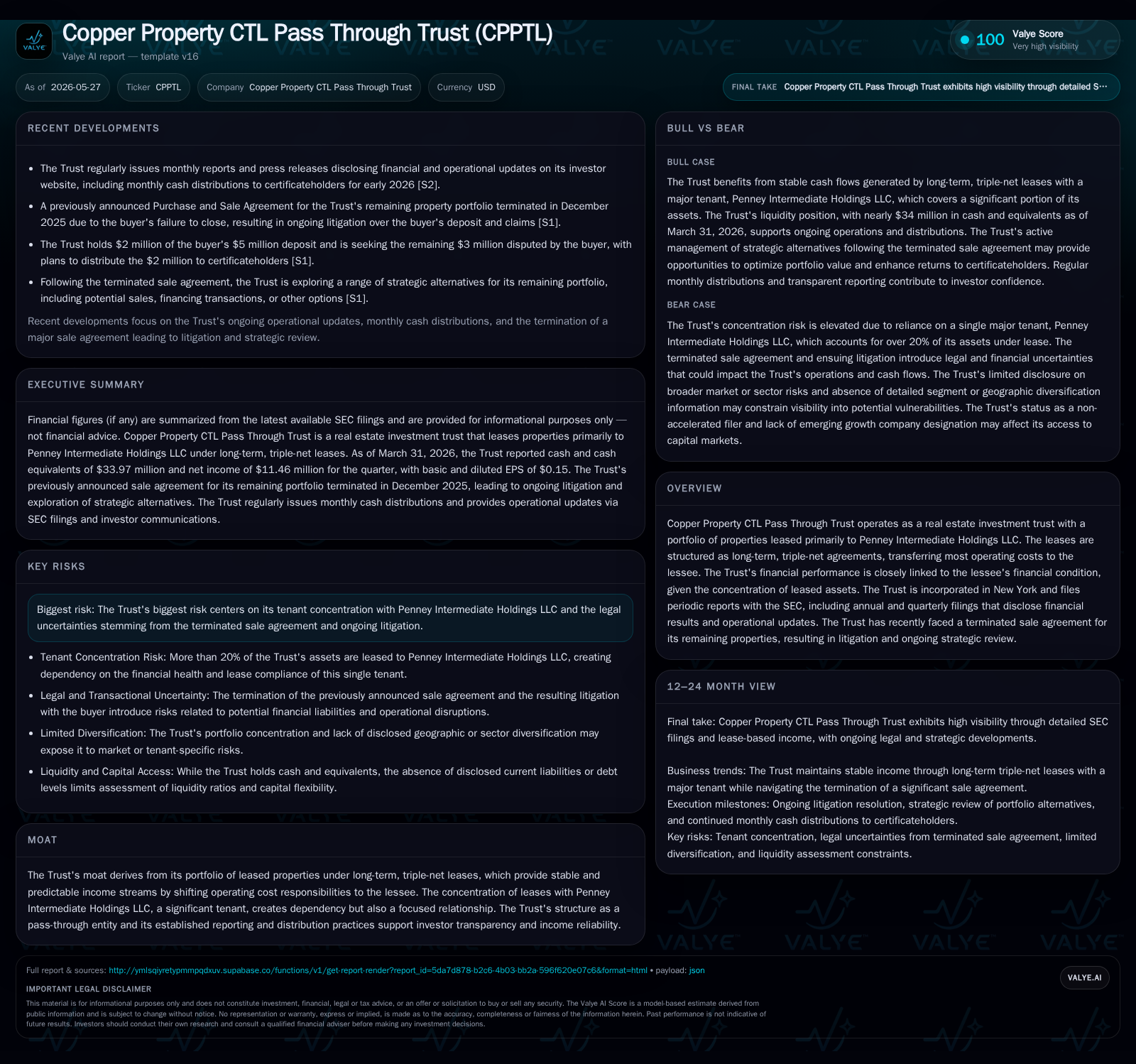
Copper Property CTL Pass Through Trust’s latest 10-Q and 8-K filings reveal the termination of a planned sale of its remaining properties due to buyer non-performance, prompting ongoing litigation over breach claims and disputed deposits. The Trust depends heavily on long-term, triple-net leases with Penney Intermediate Holdings LLC, which provides stable cash flow but also concentrates risk in tenant credit and lease continuity. With the failed sale, the Trust is reassessing strategic alternatives including portfolio diversification, sub-portfolio dispositions, or financing options while maintaining current operations. Legal outcomes and tenant financial health remain critical near-term variables influencing cash distributions and certificateholder returns.
Quarterly Operating Update Highlights and Litigation Impact
In its latest quarterly filing dated May 8, 2026 [S2], Copper Property CTL Pass Through Trust confirmed the termination of a Purchase and Sale Agreement previously announced with an affiliate of Onyx Partners as of December 26, 2025 [S4]. The buyer failed to close despite the Trust satisfying all closing conditions. This breach has led to ongoing litigation whereby the buyer demands specific performance or damages, with Copper Property CTL defending vigorously while also pursuing claims against the buyer and other parties involved. Crucially, the Trust currently holds $2 million out of a $5 million buyer deposit in escrow; attempts to recover the balance $3 million have met dispute [S4].
This legal entanglement places immediate tension on near-term cash flow forecasts: although stable lease income continues due to the underlying triple-net structure, uncertainty in deposit recovery and legal expenses may influence distributable income levels. The Trust distributed the escrowed $2 million as part of its regular January 2026 monthly distribution to certificateholders [S4], signaling ongoing efforts to maintain payout continuity despite transactional disruptions.
Aside from litigation developments, monthly reports released through May 2026 indicate consistent distributions ($0.08644 per trust certificate as of May 11, 2026) [S13], reflecting resilient underlying operations albeit shadowed by strategic limbo.
Business Model Underpinnings: Triple-Net Leases and Tenant Focus
Copper Property CTL operates as a real estate investment trust predominantly leasing its portfolio under long-term triple-net agreements primarily with Penney Intermediate Holdings LLC [S1]. These leases shift substantially all property operating costs — maintenance, taxes, insurance — onto the lessee. This lease structure ensures predictable net operating income for the Trust by minimizing landlord expenses and operational management responsibilities.
The Trust’s pass-through entity structure offers investors income transparency alongside dependable cash flows sourced mainly from contractually fixed rental payments. However, this advantage is coupled with concentrated counterparty risk given that Penney Intermediate Holdings LLC represents over 20% of the asset base under lease [S1]. The company files consolidated financial statements supplementing transparency about this critical tenant’s financial health—a vital gauge for assessing underlying income durability.
Portfolio Concentration Risks and Tenant Profile
Reliance on Penney Intermediate Holdings LLC entails both stabilizing benefits and distinct risks. The long-term triple-net leases create high lease lock-in but focus financial exposure in one counterparty whose retail market fortunes directly influence rent continuity and creditworthiness [S1]. Any weakening in Penney’s business results or liquidity pressures may translate into payment delays or renegotiations impacting Trust revenues.
This relationship constitutes the largest single point of asset concentration within Copper Property CTL's portfolio. While audit inclusion of Penney's financials enhances investor insight into material tenant risks [S1], it also underscores vulnerability if sector headwinds affect brick-and-mortar retail tenants broadly.
Competitive Positioning in the Real Estate Trust Sector
Within the specialized niche of pass-through REITs focused on triple-net leased retail properties, Copper Property CTL’s scale appears modest but anchored by established lease contracts offering NOI predictability [S1]. However, industry peers often rely on diversified tenant bases or broader property types to mitigate concentration risk—factors limiting Copper Property’s lateral expansion unless portfolio diversification occurs.
The recent failed sale transaction illustrates typical challenges in this sub-sector: liquidity events such as portfolio dispositions can encounter delays or cancellations due to market conditions or counterparties’ financial issues. Pricing power for rents is somewhat constrained by retail sector dynamics and lessee profiles demanding cautious valuation approaches.
Regulatory requirements mandate detailed disclosure packages—such as periodic store performance metrics released publicly by Copper Property CTL—supporting trustholder oversight but also adding operational transparency pressures unique to registered pass-through entities [S14].
Strategic Growth Drivers and Alternative Paths Forward
Following the aborted sale to Onyx Partners Ltd., management has signaled that it will terminate prior marketing efforts but continue active evaluation of strategic alternatives [S4]. These avenues include: pursuing sales of whole portfolios or asset sub-sets; exploring financing solutions potentially leveraging remaining portfolio income streams; or engaging in restructurings including lease modifications if warranted by tenant conditions.
The flexibility inferred from varied strategic options suggests readiness to adapt amid uncertain capital markets for retail real estate. However, new growth drivers must materialize within constraints posed by concentrated tenant risk profiles. Realistically, expanding demand hinges more on maximizing existing lease contracts’ value rather than broadening product scope or entering new market segments.
Risks and Key Watchpoints: Litigation, Concentration, and Market Dynamics
Principal risks are tightly linked to resolution outcomes from pending litigation against Onyx Partners regarding breached sales obligations and deposit retention disputes [S4]. Legal expenses could escalate with prolonged proceedings impacting distributable income. Simultaneously, tenant-related risks hinge on Penney Intermediate Holdings LLC’s payment capacity given concentrated revenue exposure [S1].
Market dynamics affecting brick-and-mortar retail—such as changing consumer behavior or competitive pressure—may indirectly influence lease renegotiations or renewal probabilities. Investors should monitor legal filings for breakthroughs or settlement announcements closely alongside updated tenant financial disclosures that may signal shifts in credit risk appetite.
Additionally, variances in monthly distribution declarations serve as proximate indicators of operational stability or stress. Maintaining distributions near historical norms would imply sustained NOI collection efficacy despite current external shocks.
What Investors Should Monitor Next
Upcoming milestones include developments in litigation timelines such as court dates or mediation schedules that could clarify exposure magnitude [S4]. Announcements on escrow deposit recoveries are also critical near-term liquidity signals.
Financial updates from Penney Intermediate Holdings LLC—available through quarterly reporting packages published by the Trust—will provide further clarity on tenant operating performance affecting rent reliability [S1,S22]. Correspondingly, quarterly earnings releases from related subsidiaries offer additional insight into retail segment resilience.
Monthly cash distribution reports represent an immediately observable metric guiding assessment of ongoing yield sustainability amid legal uncertainties [S3,S10,S13]. Strategic communications concerning alternative portfolio disposition attempts will further illuminate future directional choices.
Brief Financial Context Supporting Operational Assessment
As reported at March 31, 2026 quarter-end, Copper Property CTL held approximately $33.97 million in cash and equivalents [F1], providing a buffer to manage administrative expenses including legal defense costs amid unsettled sale proceeds. Net income reported for the year ended December 31, 2025 totaled about $47 million [F1], underscoring baseline profitability driven by lease collections prior to sale termination complications.
While balance sheet size affords some operational resilience during transition phases, ultimate valuation depends strongly on successful resolution of contingent liabilities stemming from contract disputes and tenant credit conditions impacting revenue continuity.
This analysis is based solely on publicly filed SEC documents for Copper Property CTL Pass Through Trust and does not contain any investment advice or research views. It aims to synthesize recent operating developments with structural business factors relevant for industry participants analyzing similar real estate investment trusts under stress from transaction reversals and tenant concentration risks.
Disclaimer: This is research-only, informational analysis and not investment advice. It may include AI-generated interpretation and general industry context. Always verify important details using primary sources.

Comments