
Capri Holdings' Strategic Resilience Evident in Q3 2026 Earnings and Optimization Efforts
Capri Holdings demonstrates financial strength amid operational transformations highlighted by its Global Optimization Plan and upcoming share repurchase program.
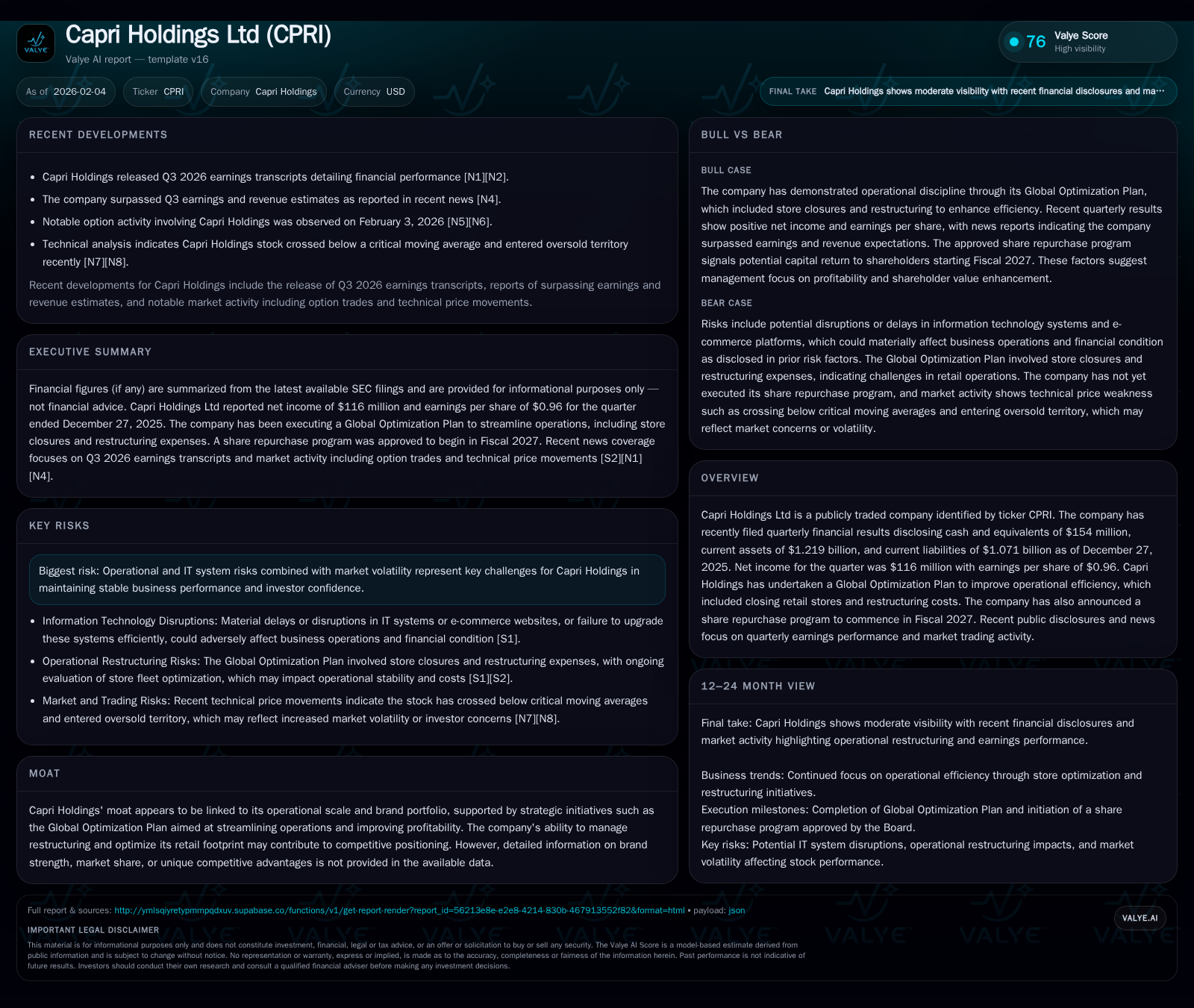
In Q3 2026, Capri Holdings reported robust net income and earnings per share that outpaced market expectations despite ongoing restructuring efforts under its Global Optimization Plan. The company’s balance sheet reveals a moderate liquidity buffer supporting stability amid store closures and operational streamlining. With a $1 billion share buyback slated for Fiscal 2027, Capri signals confidence in its long-term strategy. Meanwhile, technological risks and market volatility remain integral to the risk profile as investor sentiment fluctuates with technical trading indicators and analyst upgrades.
Navigating Market Turbulence: Capri’s Q3 2026 Financial Triumphs
Capri Holdings reported its third-quarter results for fiscal year 2026 showing a commendable performance against analyst expectations. Net income for the quarter reached $116 million, translating to earnings per share (EPS) of $0.96 — an outcome reflecting robust operational execution despite recent transformation activities [N1][N2][N3][N4][F1]. This beat on both top-line and bottom-line estimates underscores the company’s ability to navigate underlying market challenges while delivering shareholder value.
The financial upswing was particularly notable given the backdrop of active restructuring expenditures associated with its Global Optimization Plan. The earnings transcripts reveal that the company managed to absorb these costs without derailing profitability, signaling operational resilience. This juxtaposition between strong financial outcomes and ongoing business recalibration sets the tone for a company actively managing change rather than being overwhelmed by it.
Dissecting the Global Optimization Plan: Costs, Closures, and Operational Streamlining
The Global Optimization Plan represents Capri Holdings’ strategic initiative aiming to recalibrate its retail footprint and streamline operations to foster long-term profitable growth [S1][S2]. Initially approved during the fourth quarter of fiscal 2024, the plan involved closing a total of 83 stores over twelve months ended March 29, 2025, including 40 closures reported in Q4 FY24 alone.
Restructuring expenses linked to these actions were approximately $7 million in the twelve months ending March 29, 2025, primarily related to severance and store closure costs but partially offset by gains on lease terminations [S1]. By December 27, 2025, the plan reached formal conclusion with an additional net restructuring charge of $12 million tied mainly to final lease termination costs [S2].
This phased approach not only allowed Capri to rationalize its retail presence but also enhanced overall operating efficiency by shedding less productive stores and optimizing cost structures. Though future optimization opportunities remain under periodic review, the completion of this extensive reshaping effort marks a critical milestone toward margin improvement.
Liquidity and Leverage: Assessing Capri’s Balance Sheet Stability
Capri’s most recent liquidity profile suggests a measured degree of cushion supportive of ongoing transformations. As of December 27, 2025, cash and cash equivalents totaled $154 million against current assets aggregating $1.219 billion. Current liabilities stood at $1.071 billion yielding a current ratio of approximately 1.14 — indicative of moderate short-term asset coverage over owed obligations [F1].
While not indicative of an overly conservative liquidity posture, this level evidences prudent balance sheet management capable of addressing immediate funding needs without jeopardizing operational continuity during restructuring phases.
The Implications and Strategy Behind the Planned Share Repurchase Program
In November 2025, Capri’s Board authorized a substantial share repurchase initiative capped at $1 billion with execution set to commence in Fiscal Year 2027 [S2]. This program reflects management’s confidence in the company’s strategic trajectory and cash flow generation potential post-optimization.
No shares have been repurchased under this planned authorization as of December 27, 2025; however, such buybacks are expected to be deployed opportunistically either through open market purchases or negotiated transactions subject to market conditions and regulatory constraints [S2].
The share repurchase program serves multiple strategic objectives: enhancing shareholder returns via EPS accretion over time—assuming stable earnings—and signaling capital discipline as Capri balances reinvestment with returning excess cash flow.
Investor Sentiment Reflected in Price Action and Analyst Upgrades
Recent market activity around Capri Holdings reveals nuanced investor sentiment characterized by technical indicators pointing toward volatility and potential near-term uncertainty. The stock entered oversold territory based on momentum oscillators [N11] while crossing below key moving averages traditionally viewed as resistance points [N12]. Concurrently, elevated option volume indicates hedging or speculative positioning reflecting market participants’ divergent views on near-future directionality [N9][N10].
Despite these short-term technical headwinds, fundamental sentiment has seen constructive reassessments manifested through analyst rating upgrades from TD Cowen [N13] and BWG Global [N14]. These positive revisions suggest recognition of improved operating efficiency following restructuring combined with optimistic outlooks on earnings recovery or stability.
This interplay between technical signals cautioning traders and fundamental analysts highlighting sustained improvements encapsulates the transitional phase Capri is navigating.
Technological Risks and the Vulnerability of IT Systems
A salient element of Capri Holdings’ risk profile involves dependence on information technology infrastructure integral to operational continuity across both physical retail management and e-commerce platform delivery [S1]. SEC disclosures explicitly acknowledge that material disruption or inefficiencies in upgrading IT systems could materially impact results.
Given broader retail trends emphasizing omnichannel integration and digital sales penetration, effective IT management remains critical. Potential failures or delays pose downside risks that could undermine revenue growth trajectories or increase operational costs during sensitive transition periods.
Hence, technological robustness emerges not just as an operational necessity but as a strategic priority tied closely to sustaining competitive advantage amidst fast-evolving consumer engagement models.
Forecasting Capri’s Competitive Moat and Growth Prospects
While granular details about brand-specific strength or precise market shares are limited within available disclosures, Capri Holdings’ moat appears fundamentally anchored in its scale advantages alongside purposeful portfolio rationalization efforts led by the Global Optimization Plan [valye_report_excerpt].
Streamlined operations through targeted store closures coupled with lease negotiations improve cost flexibility—a prerequisite for weathering macroeconomic headwinds while investing selectively where returns justify. Moreover, the announced capital return policy via share repurchases signals confidence in sustainable cash flows supportive of growth initiatives or financial leverage management.
However, uncertainties persist given reliance on external factors like consumer spending dynamics, supply chain resilience, and competitive pressures within luxury fashion retail sectors ubiquitously impacted by evolving tastes and emerging digital competitors. Hence, cautious optimism framed by tangible execution progress defines medium-term prospects.
Disclaimer: This analysis is intended solely for informational purposes based on publicly available data as of February 2026. It does not constitute investment advice or recommendations regarding Capri Holdings Ltd or any securities mentioned herein.
Disclaimer: This is research-only, informational analysis and not investment advice. It may include AI-generated interpretation and general industry context. Always verify important details using primary sources.

Comments