
Critical Metals Corp. Accelerates Rare Earth Supply with European Lithium Deal and Tanbreez Control
Critical Metals has secured majority ownership of the Tanbreez rare earth project and entered a binding agreement to acquire European Lithium, broadening its footprint in critical metals.
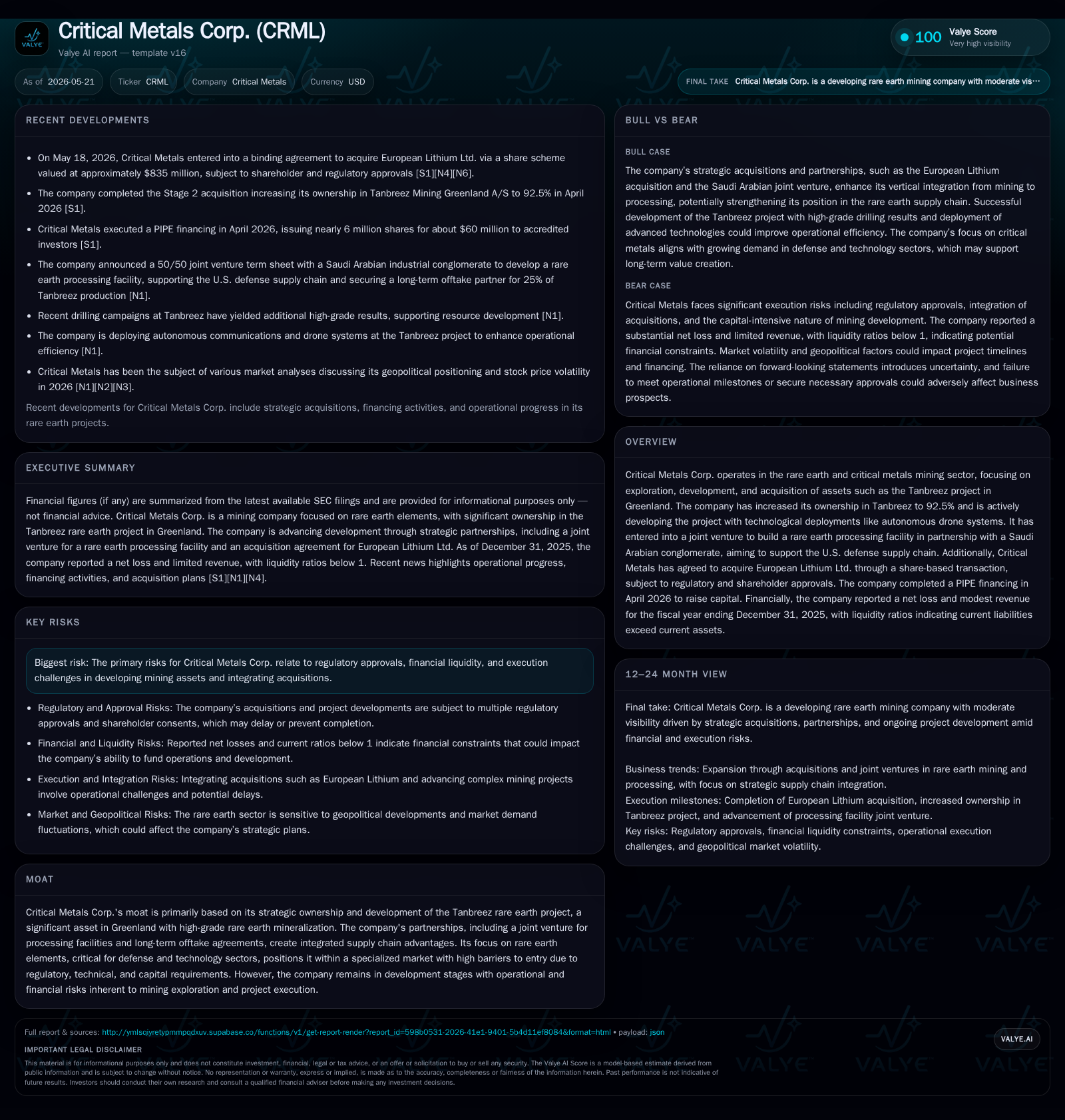
In its latest quarterly filings, Critical Metals Corp. completed the acquisition of a 92.5% stake in the high-grade Tanbreez mining project in Greenland and announced a definitive agreement to acquire European Lithium Ltd. through a share-based transaction. These moves consolidate Critical Metals' position in the rare earths sector and expand its strategic exposure to lithium, enhancing its integrated critical metals supply chain. The company also secured significant capital via a PIPE financing earlier this year, supporting ongoing development and acquisition activities. Risks remain tied to regulatory approvals, required shareholder consents, and operational execution at nascent mining stages.
Recent Operating Developments Transform Stake and Strategy
The latest SEC filings from May 19, 2026 ([S2]) confirm that Critical Metals Corp. has entered into a binding Scheme Implementation Deed to acquire all issued shares and listed options of European Lithium Ltd. This complex transaction will be executed via two interdependent schemes of arrangement under Australian law involving European Lithium's equity and options holders. Shareholders of European Lithium will receive approximately 0.035 Critical Metals shares per existing share held as consideration.
This acquisition is significant because it extends Critical Metals' reach into lithium assets while consolidating control over rare earth minerals critical for defense supply chains.[N1],[N2] The transaction includes treatment arrangements for zero-dollar exercise price unlisted options (ZEPOs), integrating these contingent securities into Critical Metals' capital structure following adjustments linked to share price vesting conditions.[S15]
Parallelly, the Company announced on April 29 and May 1 ([S3],[S10]) completion of its Stage 2 purchase increasing ownership in Tanbreez Mining Greenland A/S from 42% to 92.5%, certifying near-total operational control over this Greenland-based rare earth project. The 7.5% remaining interest is held by European Lithium itself, tying both companies further.
The Stage 2 closing included issuance of 14.5 million ordinary shares to Rimbal Pty Ltd., previously holding that interest stake in Tanbreez.[S3] This transaction was approved by the Greenland Mineral Resources Authority (MRA), reflecting important regulatory clearance enabling Critical Metals to steer development activities directly.
Business Model: Rare Earths Exploration to Integrated Processing
Critical Metals’ core business model centers on upstream exploration and development of high-potential rare earth mineral deposits exemplified by its controlling interest in the Tanbreez Project in Greenland—a rare earth-rich asset yielding significant heavy rare earth elements critical to defense technologies.
Beyond raw mineral extraction, the company has proactively pursued downstream processing capabilities via joint ventures with Saudi Arabian state-related entities to establish refining facilities tailored for products like neodymium-praseodymium concentrates extracted from Tanbreez.[S13], This vertical integration aims at consolidating supply chain control—a key competitive edge given how tightly regulated and geopolitically sensitive rare earth processing remains globally.
The confirmed acquisition of European Lithium adds a strategically complementary lithium resource dimension to Critical Metals’ portfolio.[S2] This broadens product mix across critical battery metals essential for electrification trends driving demand structurally higher worldwide.
Revenue mechanics are driven primarily by contracts with large-scale industrial and defense technology customers requiring secure supplies of critical minerals such as neodymium and lithium compounds. Pricing power benefits from market tightness due to constrained geographies suitable for extraction and processing capacity bottlenecks imposed by environmental regulations.
Industry Dynamics: Rarity, Regulation, and Competitive Barriers
Globally, critical metals like rare earth elements and lithium face high entry barriers rooted in geological scarcity combined with escalating capital expenditure requirements for mine development plus complex permitting regimes especially relevant within emerging jurisdictions such as Greenland.
Greenland’s MRA imposes stringent regulatory oversights reflecting government interests balancing economic opportunities against environmental stewardship concerns; obtaining approvals here is pivotal yet time-consuming—impacting timelines decisively.[S3] Additionally geopolitical factors favor companies possessing diversified asset bases spanning multiple regions amid trade tensions affecting traditional supply chains dominated by China.
Competition is constrained by technological sophistication demands needed for efficient mining (e.g., deployment of autonomous drone systems mentioned in analyst discourse) alongside developing proprietary extraction/refining processes needed to economically recover scarce heavy rare earth mineral fractions.[N4]
Growth Drivers: Asset Consolidation and Downstream Expansion
The main acceleration vectors are anchored on closing the European Lithium acquisition expected in H2 2026 following customary shareholder approvals in Australia along with regulatory consent milestones detailed in recent disclosures [S2]. This transaction extends Critical Metals’ operational footprint substantially into lithium-bearing projects offering diversification beyond heavy rare earths.
Operational control over more than 90% of Tanbreez following Stage 2 Closing enables managerial consistency driving project advancement initiatives from exploration optimization through feasibility studies towards eventual production ramp-up [S3]
Cooperative ventures targeting downstream midstream processing capacity in Saudi Arabia complement upstream asset gains securing end-to-end control over concentrate supply chains catering to US defense sector clients—a major customer demographic relying on non-Chinese sources.
Technological upgrades such as autonomous drone deployments offer productivity improvements addressing exploration efficiency—critical when operating remote Arctic environments where conventional site access complicates operational cadence.[N4]
Risks and Constraints: Regulatory Approvals, Liquidity, and Execution
Achieving final closure for the European Lithium deal hinges on several stringent conditions including shareholder votes by European Lithium itself alongside maintaining minimum AUD $330 million net cash/liquids balance within European Lithium pre-closing,[S2] indicating financial prudence requirements before consummation.
Moreover cancellation deeds required for various unlisted options highlight potential complexities in equity structure adjustments that must be carefully navigated.[S15]
The Greenlandic MRA’s prior approval was essential for expanding Critical Metals’ stake at Tanbreez but future permit layers related to mining operations remain potentially constraining factors impacting timelines [S3]
Financially,[F1] the company reported cash & equivalents of approximately $81 million versus current liabilities exceeding $108 million as of December 31, 2025, resulting in a current ratio around 0.75 which signals liquidity tightness typical among mid-stage explorers still advancing projects prior to steady cash flow generation.
Execution risks inherent to complex mining projects situated in remote arctic regions include potential delays from logistical challenges or cost overruns—all magnified when integrating acquired assets such as those being acquired via share issuance mechanisms with European Lithium., [N5]
What to Watch Next: Transaction Milestones and Project Progress
Key upcoming milestones focus on the timing of the scheme meeting among European Lithium shareholders expected during Q3 2026 necessary for approving the transaction,[S19] without which closing cannot proceed.
Regulatory approvals across multiple jurisdictions remain active monitoring points for timely clearance updates affecting both acquisition implementation and mining permit progression at Tanbreez.[S2],[S3]
Following transaction consummation events expect new share issuance registration statements filing by Critical Metals consistent with private placement exemptions stated,[S17],[S19] facilitating orderly resale provisions.
Project development updates regarding infrastructure buildout at Tanbreez—such as commencement or scale-up of processing agreements with Saudi partners—also serve as tangible indicators tracking progress toward commercial production.
Financial Position: Liquidity and Capital Raising Context
As per latest available metrics ending December 31, 2025,[F1] Critical Metals reported cash reserves at roughly $81 million but current liabilities stood higher at about $108 million producing a current ratio below one (0.75). This underlines short-term liquidity constraints common among developing miners lacking active production cash flow.
Supporting capital needs, the company successfully closed a $60 million PIPE financing in April 2026 aimed at cushioning developmental expenditures associated with asset acquisitions including European Lithium integration alongside ongoing exploratory work programs around Tanbreez [S17]
This financial structure positions Critical Metals cautiously equipped but dependent on seamless deal closures plus disciplined expense management until consistent operating cash flows from these projects manifest.
This analysis is based on publicly available SEC filings dated through May 19, 2026 as well as news sources summarizing corporate developments; no internal or non-public information was considered.
Disclaimer: This is research-only, informational analysis and not investment advice. It may include AI-generated interpretation and general industry context. Always verify important details using primary sources.

Comments