
Crinetics Pharmaceuticals’ Transition to Commercial Stage Challenges Profitability Trajectory
Crinetics progresses from FDA approval to commercial launch with PALSONIFY while managing heavy operating losses and advancing a diversified pipeline.
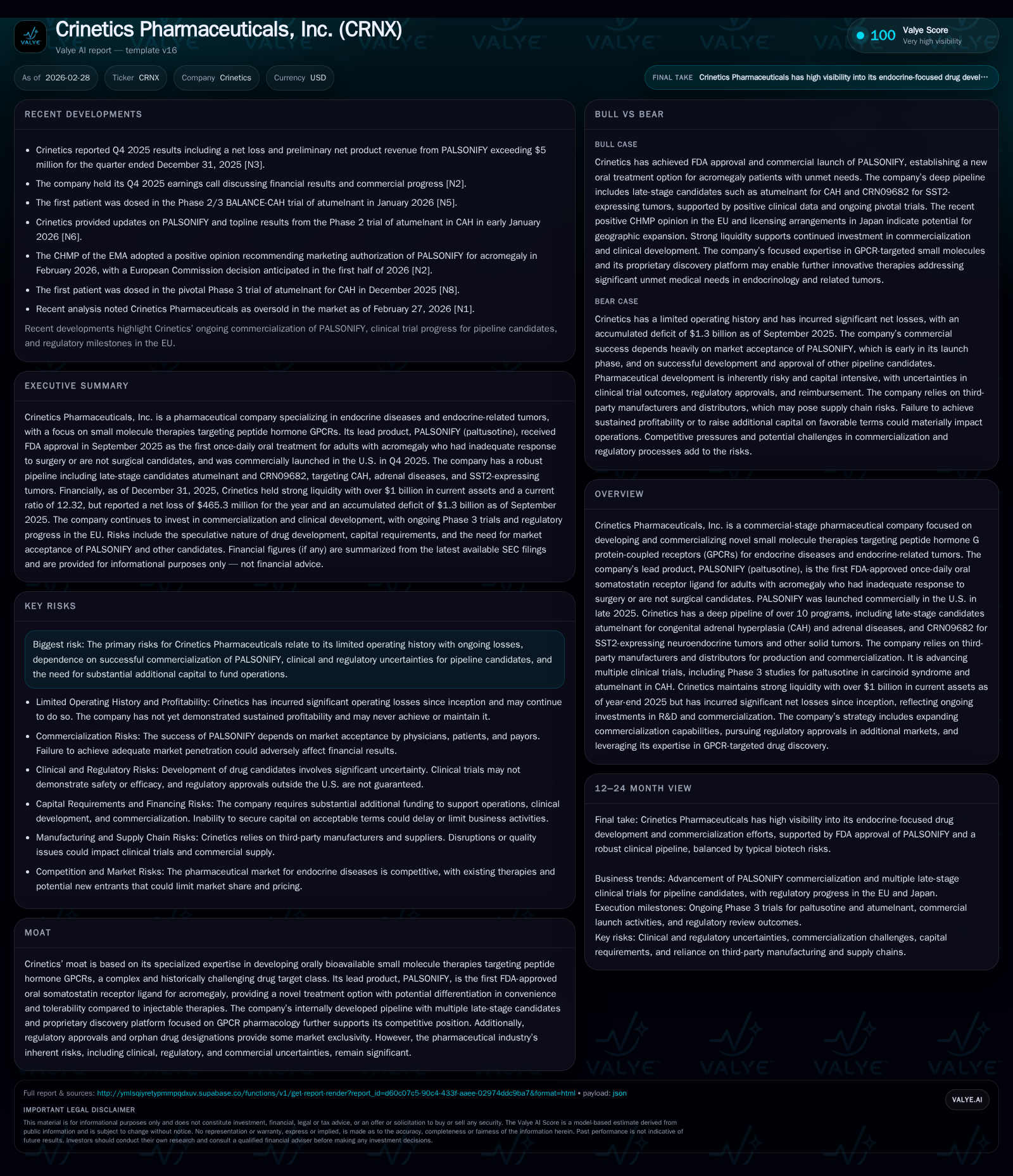
Crinetics Pharmaceuticals marked a pivotal milestone in late 2025 with the FDA approval and U.S. commercial launch of PALSONIFY, the first oral somatostatin receptor ligand for acromegaly. Despite this transition to commercialization, revenue remains modest with full-cycle market adoption yet to be realized. The company's robust clinical pipeline, including later-stage candidates atumelnant and CRN09682, underpins future growth prospects, although significant regulatory and commercialization risks linger. Financially, Crinetics shows steep negative returns on equity, substantial operating losses, and negative cash flows reflecting heavy investment in development and early commercialization activities.
From Pipeline Promise to Market Launch: Historical Growth Overview
Crinetics Pharmaceuticals' operational history has been defined by sustained investment in research and development focused on peptide hormone GPCR targets since its founding. Revenue growth was limited prior to PALSONIFY’s FDA approval, reflecting the company’s pre-commercial stage status. The top-line recorded $4.74 million in FY2022 but contracted sharply by over 78% to about $1.04 million in FY2024 [F1]. This decline precedes the commercial launch of PALSONIFY late in 2025.
Operating income has trended negative throughout these years, reflecting high fixed costs related to R&D and administrative functions critical for pipeline advancement as well as growing commercialization activities. FY2025 saw a steep increase in operating loss to -$517 million from -$339 million in FY2024, a rise of more than 52% YoY [F1]. Net income followed a similar pattern with a loss of -$465 million for FY2025 representing a near 56% catch-up year-over-year deterioration largely attributable to elevated SG&A expenses linked to the market launch [F1].
The cumulative deficit stands near $1.4 billion illustrating the capital-intensive nature of transitioning from biotech development into full commercial operations [S1][S2]. These financial dynamics epitomize the classic profile of emerging pharmaceutical companies navigating costly late-stage development coupled with nascent revenues.
Historical performance (annual)
| FY | Rev ($mm) | Net ($mm) | CFO ($mm) | OpInc ($mm) | Rev YoY | Net YoY |
|---|---|---|---|---|---|---|
| 2025 | -465 | -378 | -517 | -55.9% | ||
| 2024 | 1 | -298 | -226 | -339 | -39.1% | |
| 2023 | -215 | -166 | -223 | -30.9% | ||
| 2022 | 5 | -164 | -115 | -168 | +339.4% |
Source: SEC companyfacts cache [F1].
Capital returns and efficiency (annual)
| FY | FCF ($mm) | ROE% |
|---|---|---|
| 2025 | -384 | -46.9 |
| 2024 | -230 | -22.5 |
| 2023 | -171 | -39.8 |
| 2022 | -117 | -51.8 |
Source: SEC companyfacts cache [F1].
Table: Historical Financial Performance Summary (FY2022–FY2025) [F1]
Commercialization of PALSONIFY: Revenue Impact and Early Market Dynamics
PALSONIFY (paltusotine), approved by the FDA on September 25, 2025, represents Crinetics' first commercial product and is positioned uniquely as the first oral somatostatin receptor ligand indicated for adults with acromegaly who have not responded adequately to surgery or are not candidates for surgery [S1]. This therapeutic delivers distinct patient convenience benefits relative to injectable somatostatin analogs that have dominated treatment paradigms.
The commercial launch commenced late in calendar year 2025 with revenue recognition ramping correspondingly modestly within that period [N2][S3]. Full sales cycles supporting more meaningful topline contribution lie ahead given ongoing physician adoption patterns and payor coverage negotiations.
Commercial risk factors are evident from uncertainties surrounding physician comfort shifting established injectables towards oral therapies, particularly given endocrinologists’ familiarity with legacy options [N1]. Moreover, evolving U.S. Medicare drug pricing reforms such as CMS's GENEROUS Model—which tests supplemental rebate agreements aligning Medicaid prices with most favored nations pricing—could place pressure on net realized pricing despite list prices [S4]. Similar CMS initiatives like GLOBE (Global Benchmark for Efficient Drug Pricing) and GUARD (Guarding U.S.…Rising Drug Costs) add layers of complexity impacting reimbursement dynamics.
Beyond U.S markets, regulatory milestones such as the European Medicines Agency’s Committee for Medicinal Products for Human Use (CHMP) granting a positive opinion in February 2026 positions PALSONIFY for anticipated EU marketing authorization potentially by mid-2026 [N1][S1]. Success here may provide incremental revenue diversification yet subjects launch strategies to multi-jurisdictional regulatory risk.
Robust Clinical Pipeline Supporting Future Growth Prospects
Crinetics boasts a diversified pipeline surpassing ten programs grounded in its proprietary small molecule GPCR targeting platform characterized by tailored pharmacology properties aimed at endocrine diseases [S1]. Central among clinical assets is atumelnant—an investigational compound targeting congenital adrenal hyperplasia (CAH). Positive Phase 2 open-label data reported through multiple cohorts alongside an ongoing operationally seamless Phase 2/3 BALANCE-CAH pediatric trial launched January 2026 signal advancing maturity of this program [N5][S3]. The CALM-CAH pivotal Phase 3 study initiated participant randomization by December 2025 further fortifying clinical momentum.
Another key asset is CRN09682 which addresses SST2-expressing neuroendocrine tumors (NETs) and certain solid tumors; it entered dose-escalation phase of Phase 1/2 study late last year demonstrating progress toward pipeline diversification beyond endocrine indications [S1].
Proprietary intellectual property protection shields these innovations including orphan drug designations that facilitate market exclusivity and regulatory incentives while reinforcing barrier-to-entry against competitors [S1]. Notably, Crinetics' focus on orally bioavailable small molecule GPCR modulators counters historically challenging drug development pathways within this receptor class.
Regulatory Landscape and Approval Milestones to Monitor
Following its FDA milestone with PALSONIFY approval, Crinetics navigates significant regulatory junctions globally needing careful stewardship [N1][S1]. The EMA CHMP positive opinion issued recently could culminate into formal European Commission marketing authorization during H1 of calendar year 2026; this event would represent a critical step expanding potential addressable market size beyond the U.S platform.
Pipeline candidates face their own distinct regulatory hurdles; seamless progression through operationally integrated Phase 2/3 studies such as BALANCE-CAH embodies attempts at efficiency but remains exposed to inherent clinical trial risks including patient enrollment pace, safety readouts, and endpoint achievement applicability under regulatory scrutiny.
Continual compliance obligations post-approval span adverse event reporting mandates along with promotional use restrictions strictly policed by FDA standards which if breached can prompt costly sanctions or marketing limitations [S7][S12]. The evolving healthcare policy terrain around price controls imposes additional uncertainty potentially impacting product labeling strategies and reimbursement eligibility that directly influence commercial viability [S4].
Capital Allocation, Cash Flow Constraints, and Financial Health
Despite transition to commercial stage signaling nascent revenue generation avenues, Crinetics’ financial profile remains challenged by ongoing steep losses largely related to R&D expansion plus increased selling, general & administrative expenses needed for commercialization infrastructure buildout.
Fiscal year-end December 31, 2025 highlighted an approximate ROE of negative −46.9%, confirming heavy unprofitability driven by net loss totals around −$465 million against shareholder equity near $992 million [F1]. Operating cash flow contracted sharply compared to prior years reaching roughly −$378 million with free cash flow after capital expenditures also substantially negative near −$384 million—underscoring intensive cash burn during scale-up phases despite capex increases about +50% YoY reflecting investments in facilities or equipment supporting commercial operations [F1].
Nevertheless, sizable cash reserves sit atop $101 million coupled with current assets exceeding current liabilities twelvefold—yielding a strong current ratio north of 12 which buffers short-term liquidity demands amid volatile expenses [F1]. No dividend distributions or stock repurchase programs have been declared or implemented affirming capital commitment prioritizes innovation sustainment over shareholder returns presently.
Sustained capital investments remain necessary given multiple parallel late-stage trials underway plus international commercialization preparations retaining dependency on favorable capital markets or strategic partnerships for future funding requirements [S1][S3].
Product Liability, Payor Pressures, and Legal Risk Factors
Launching pharmaceutical products inherently heightens exposure to product liability claims particularly as therapy usage expands beyond controlled clinical environments into uncontrolled real-world settings posing unpredictable adverse event occurrences potentially triggering litigation or recalls damaging reputational capital [S4][S14]. Stringent regulations limit promotional activities strictly adhering to FDA-approved labeling; deviations may result in civil penalties signaling costly operational constraints also flagged under federal anti-kickback regulations safeguarding against improper inducements among healthcare providers [S6][S8][S9].
Evolving U.S payor models test price resilience particularly Medicaid-centric models like GENEROUS alongside Medicare Part B/D schemes emphasizing reference pricing caps—a construct shifting pricing power channels possibly compressing margins supported by governmental negotiation leverage [S4][S11][S24]. State-specific transparency laws add layers requiring meticulous compliance particularly regarding payments disclosures under Sunshine Act mandates amplifying scrutiny risk profiles associated with physician interactions or consulting engagements that often integrate equity-based compensation incentives adding complexity around compliance frameworks [S5][S26][S27].
Further legal risks stem from intellectual property disputes potentiality capable of delaying market access or necessitating costly licensing fees undermining competitive positioning in tightly contested specialty pharma segments focused on peptide receptors [S10][S18]. Cybersecurity exposures via social platforms create reputational hazards given greater communication intensity expected during commercialization expansion phases per evolving industry norms [S9].
What to Watch: Upcoming Trial Data and Commercial Execution
Near-term catalysts crucial for directional clarity encompass continued enrollment progression within atumelnant pivotal Phase 3 CALM-CAH study alongside operational updates from BALANCE-CAH pediatric trial initiation marking potentially transformative label expansion enabling broadening patient reach currently limited by age indications [N5][S3]. Monitoring safety/tolerability signals within these studies remains imperative given stringent regulatory evaluation criteria.
EMA’s final marketing decision following CHMP positive recommendation slated for mid-2026 will determine European expansion feasibility provoked through strategic commercialization plans needed ahead of launch execution timelines ensuring successful payer negotiations across fragmented EU health systems influencing uptake velocity across member states [N1].
In parallel, close observation is warranted regarding U.S market reception metrics post-PALSONIFY introduction encompassing prescription trends among endocrinologists balancing new oral administration benefits against entrenched injectable alternatives along with payor formulary positioning assessed under increasingly constrained reimbursement frameworks requiring cost-effectiveness substantiation reinforced through real-world evidence generation efforts shaping payer engagement outcomes [N2][N1][S4].
Capital raising or partnership deals signal vital financial sustainability indicators considering quarterly burn rates maintaining pressure on existing cash cushions meanwhile necessitating prudent fiscal management balancing innovation investment versus commercial overhead commitments under competitive industry pressures frequently shaping mid-stage biotech maturation trajectories experimentally witnessed within small molecule GPCR-targeted specialty pharma peers (analysis).
This analysis aims solely informational purposes based on public disclosures without investment advice or recommendations regarding Crinetics Pharmaceuticals securities or business prospects.
Disclaimer: This is research-only, informational analysis and not investment advice. It may include AI-generated interpretation and general industry context. Always verify important details using primary sources.

Comments