
CrowdStrike Strengthens Cybersecurity Platform with Robust Q1 Growth and AI Integration
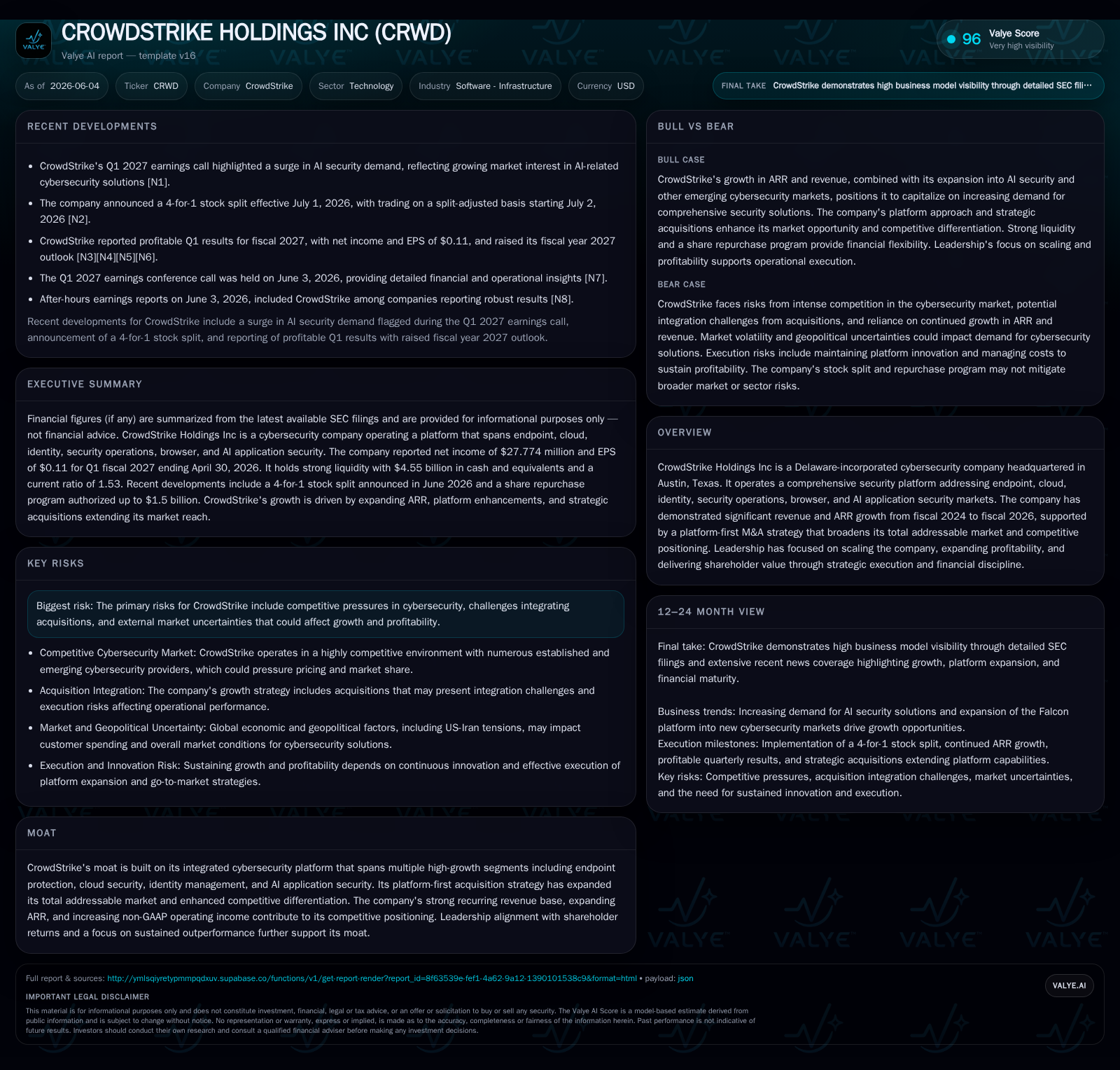
CrowdStrike’s Q1 2027 results underscore accelerating adoption of its AI-native Falcon platform alongside a strategic stock split and strengthened balance sheet.
In its June 4, 2026 quarterly 10-Q filing, CrowdStrike reported sustained momentum in subscription revenues fueled by heightened demand for AI-driven security solutions and expansion across endpoint, identity, and application security domains. The company announced a 4-for-1 stock split, reflecting confidence in future growth and shareholder returns. CrowdStrike’s integrated platform strategy, combined with a scalable global channel ecosystem, has reinforced its competitive moat amid intensifying cybersecurity threats and market competition. Financially, the firm maintains a robust net cash position supported by recent debt issuance and anticipates further profitability improvement through operational leverage.
Q1 Fiscal 2027 Operating Highlights Drive New Growth Narrative
The most recent quarterly filing dated June 4, 2026 ([S2]), with supplemental disclosures on June 3 ([S3]), articulates a sharp uptick in demand for CrowdStrike’s AI-native cybersecurity capabilities. Subscription revenue growth is highlighted as the primary vector underpinning this momentum — driven by an expanding footprint of the Falcon security cloud across multiple high-growth segments including next-generation endpoint protection, identity services, SIEM (security information event management), and newly added AI application security modules. Management commentary on the accompanying earnings call ([N1], [N12]) further underscores accelerating client adoption spurred by the platform’s machine-speed threat detection leveraging cyber Reinforced Learning from Human Feedback (RLHF).
The stock split announcement — a four-for-one division effective July 2 — exemplifies management’s confidence in scaling the business while enhancing liquidity and accessibility for shareholders ([N3], [S9]). Also supporting execution is CrowdStrike’s recent debt raising ($738 million net proceeds from senior notes issuance per [S2]), which provides ample financial flexibility to fund continued organic innovation and tuck-in acquisitions that extend platform breadth.
Integrated AI-Native Security Platform Fuels Recurring Revenue Expansion
CrowdStrike’s foundational asset is the fully cloud-native Falcon platform that operates through a lightweight agent capturing comprehensive telemetry across endpoints, cloud workloads, identity stores, DevOps environments, and third-party inputs ([S1]). This integrated data fabric feeds advanced AI models trained on trillions of weekly cybersecurity events enriched by real-world adversary behavior. The single sensor approach reduces operational complexity compared to legacy fragmented products while improving efficacy through unified threat intelligence.
The firm emphasizes its leadership in creating an AI Security Cloud category— leveraging continuous reinforcement learning at scale to enhance detection accuracy and automate incident response workflows. High ARR growth trajectory documented over fiscal 2024–26 reflects growing enterprise reliance on this consolidated platform strategy. The ability to cross-sell complementary modules such as Falcon Next-Gen Identity or Security Operations elevates customer lifetime value while boosting net retention rates — key SaaS KPIs driving durable recurring revenue.
Channel Partner Ecosystem Amplifies Sales Reach Across Geographies
Complementing its direct salesforce, CrowdStrike leverages an extensive worldwide channel partner network comprising system integrators and value-added resellers ([S2]). This hybrid go-to-market model facilitates access to diverse enterprise verticals and geographies at scalable cost structures. The integration of partner incentives aligns distribution depth with volume growth objectives.
This channel amplification improves customer acquisition cost payback periods by enabling CrowdStrike to efficiently penetrate new accounts while nurturing existing ones through expanded solution sets. Such distribution breadth is increasingly critical in cybersecurity where rapid deployment cycles and geographic coverage confer material advantages relative to pure-play direct sales competitors.
Industry Positioning Amid Evolving Cyber Threat Landscape and Competition
CrowdStrike operates in an intensely competitive arena marked by fast-evolving adversary tactics powered by automation and AI — trends that legacy vendors often struggle to address at scale ([S1], [S2]). Its platform-centric architecture confers differentiation over specialized or narrowly focused SaaS providers by delivering end-to-end visibility and control over cyber risks spanning endpoints to cloud apps.
The firm’s strategy mitigates churn risk through high gross and net retention enabled by cross-product usage within a unified management console. Pricing power derives from demonstrable efficacy gains against sophisticated threats combined with reduced total cost of ownership compared to maintaining multiple disjointed tools. Network effects stemming from aggregated telemetry data create raising barriers for competitors attempting to replicate CrowdStrike’s threat intelligence moat.
Key Growth Drivers: AI Adoption, M&A Synergies, and Cross-Sell Acceleration
Recent quarters have witnessed surging demand for AI-powered security solutions as enterprises grapple with rapidly automating hackers targeting identity systems and cloud environments ([N1], [N12]). CrowdStrike’s strategic acquisitions — Pangea (AI app security), Onum (network intelligence), SGNL (dynamic identity control), Seraphic Security (browser protection) — systematically broaden the Falcon platform’s TAM while deepening competitive differentiation ([S1], [S2]).
Cross-selling these new capabilities into established customers boosts sustainable ARR growth through enhanced per-customer consumption. Furthermore, ongoing improvements in sales efficiency metrics such as customer acquisition cost payback offer increasingly attractive unit economics supporting scaled investment in go-to-market execution.
Risks and Constraints: Acquisition Integration, Intensifying Competition, Market Volatility
Despite strong growth prospects, CrowdStrike acknowledges challenges integrating multiple acquisitions without margin dilution or execution delays ([S1]). The cybersecurity sector remains fiercely contested by entrenched incumbents clinging to legacy endpoint franchises as well as emergent pure-play SaaS innovators vying for wallet share.
Macroeconomic uncertainties could impact IT budget cycles causing more prolonged sales cycles or conservative spend on new cybersecurity initiatives. These dynamics place a premium on sustaining innovation velocity combined with maintaining sales-machine efficiency to preserve ARR expansion momentum.
What to Monitor: ARR Trends, Retention Metrics, Product Adoption Milestones
Key indicators signaling continued success include progression against internal ARR targets reflecting subscription renewal strength augmented by multi-product deployments ([N4], [S2]). Improvements in gross retention rates track reductions in customer churn while net retention gains flag successful upselling of adjacent Falcon modules.
Monitoring milestone achievements around professional service scale-up is also relevant since consultative implementation often accelerates product adoption velocity across complex large accounts. Finally, tracking CAC payback period shifts informs on incremental sales profitability crucial for long-term free cash flow generation.
Financial Overview: Balance Sheet Strength and Guidance Trajectory
As of April 30, 2026, CrowdStrike maintained a robust liquidity profile with approximately $4.55 billion in cash and equivalents against roughly $745 million in total debt yielding a net cash position above $3.8 billion ([F1], [S2]). The recent $738 million senior note offering strengthens capital availability to fund R&D investments and opportunistic acquisitions without near-term refinancing pressure.
Maintaining disciplined capital allocation aligned with growth execution underpins management’s commitment to delivering sustained shareholder value amidst evolving cybersecurity market dynamics.
Disclaimer: This report is intended solely for informational purposes presenting analysis based on publicly available filings without providing investment research views or advice.
Disclaimer: This is research-only, informational analysis and not investment advice. It may include AI-generated interpretation and general industry context. Always verify important details using primary sources.

Comments