
Commercial Vehicle Group Navigates Cyclical Demand and Cost Pressures Amid Revenue Growth
CVGI leverages established OEM partnerships and a global footprint to manage economic uncertainty and trade-related challenges.
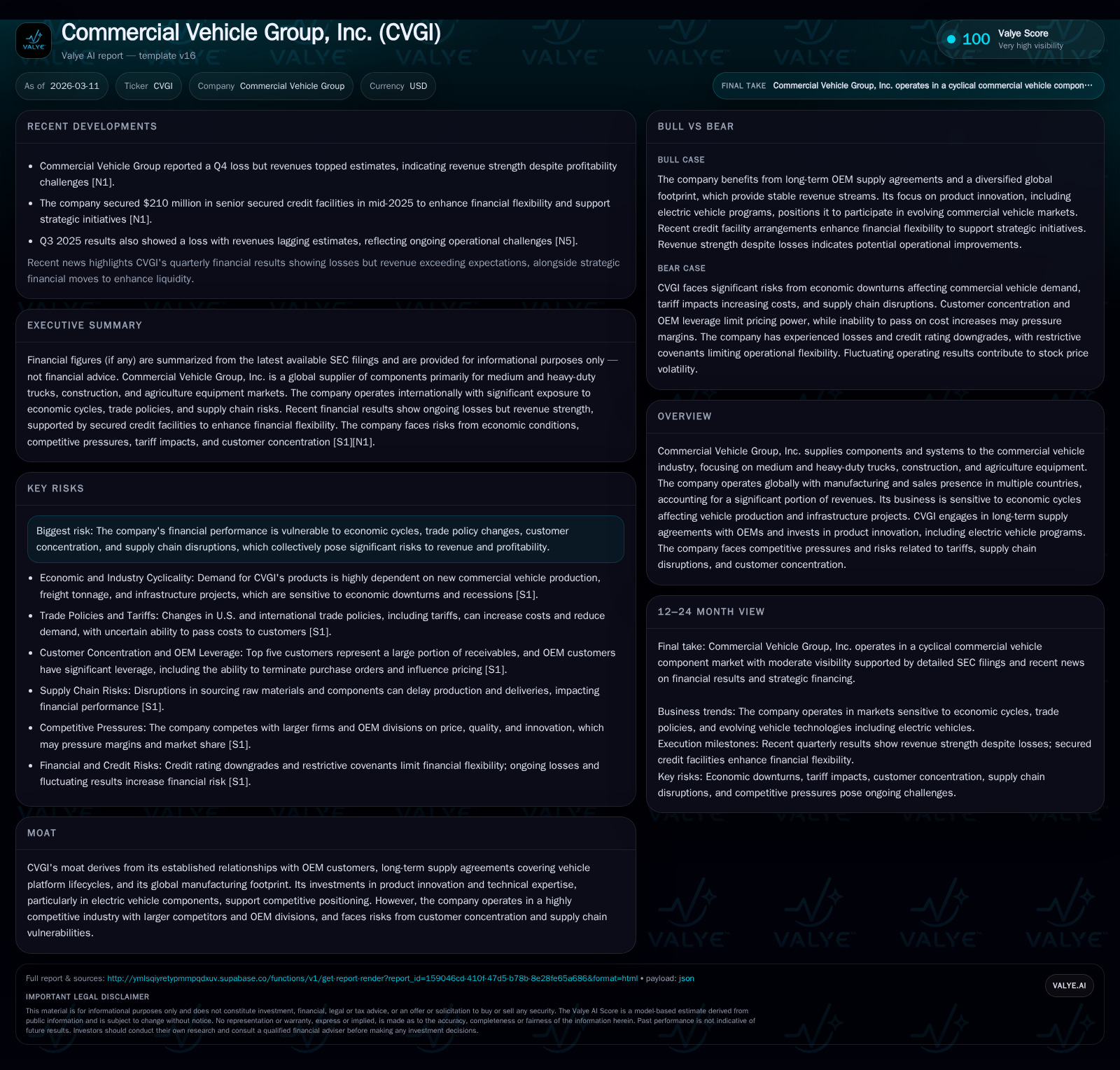
Commercial Vehicle Group, Inc. (CVGI) supplies components primarily for medium- and heavy-duty trucks and related equipment, with financial results closely tied to industry cycles and trade policies. In 2025, CVGI reported a 25.6% revenue increase driven by improved demand but continued to face profitability challenges due to cost inflation, tariffs, and supply chain issues. Operating cash flow improved significantly, generating positive free cash flow after capital expenditures. The company’s concentrated customer base and long-term OEM contracts provide revenue visibility but limit pricing flexibility amid rising input costs. CVGI’s financial position reflects solid liquidity though debt covenants constrain capital deployment. Investments in electric vehicle components represent a strategic growth focus amid competitive pressures and cyclical market dynamics.
Historical Performance
Commercial Vehicle Group, Inc.’s financial results reflect the cyclical nature of the commercial vehicle industry. Revenue grew from approximately $150 million in 2016 to over $188 million by the end of 2017 [F1]. In fiscal year 2025, revenue increased by 25.6% compared with the prior year, reaching $188.3 million, driven by improved demand for medium- and heavy-duty trucks and related equipment [F1]. Despite this growth, the company recorded an operating loss of $656,000 in 2025, an improvement from the previous year’s operating loss of $758,000 [F1]. Net losses narrowed but persisted at $22.8 million compared to $27.9 million in 2024 [F1].
A significant turnaround was observed in operating cash flow, which rose from a negative $33.5 million in 2024 to a positive $44.6 million in 2025. Capital expenditures decreased by over 40% year-over-year to $10.7 million, resulting in approximately $34 million of free cash flow generation for the year [F1]. The company maintained equity of approximately $133 million at year-end.
Historical performance (annual)
| FY | Net ($mm) | CFO ($mm) | OpInc ($mm) | Capex ($mm) | Net YoY |
|---|---|---|---|---|---|
| 2025 | -23 | 45 | -1 | 11 | +18.3% |
| 2024 | -28 | -33 | -1 | 19 | -156.4% |
| 2023 | 49 | 38 | 48 | 20 | +324.9% |
| 2022 | -22 | 69 | 20 | 20 |
Source: SEC companyfacts cache [F1].
Capital returns and efficiency (annual)
| FY | FCF ($mm) | ROE% |
|---|---|---|
| 2025 | 34 | -17.1 |
| 2024 | -52 | -20.6 |
| 2023 | 19 | 28.6 |
| 2022 | 49 | -18.3 |
Source: SEC companyfacts cache [F1].
YoY changes (latest fiscal year vs prior): Revenue +25.6%, Operating Income +13.5%, Net Income +18.3% [F1]
Industry Dynamics and Business Model
CVGI primarily supplies components for medium- and heavy-duty trucks as well as construction and agricultural equipment markets globally [S9][S14]. Long-term supply agreements with OEM customers typically cover entire vehicle platform lifecycles of five to seven years providing revenue visibility; however, these contracts often limit pricing adjustments despite fluctuations in raw material costs or tariff impacts [S9][S14].
The company's global manufacturing footprint spans North America, Europe, Asia, Africa, and Australia enabling diversified market exposure but also creating foreign exchange risk and regulatory compliance challenges across jurisdictions [S14][S17][S19].
Competition is intense with large multinational suppliers as well as OEM captive divisions competing on price, product quality, technical expertise, delivery reliability, and service capabilities.
Risks Impacting Growth Prospects
CVGI’s revenues are sensitive to economic cycles affecting truck production volumes and infrastructure spending as freight tonnage hauled declines during downturns [S1]. Trade policy uncertainty including U.S.-imposed tariffs since early-2025 has increased sourcing costs for imported materials that CVGI finds difficult to fully offset through customer pricing adjustments given contract terms and customer relationships [S1][S21][S22].
Supply chain disruptions continue globally due to raw material shortages and logistics constraints impacting production schedules.
Customer concentration is substantial with the top five customers representing about 46% of receivables as of late-2025 posing revenue volatility if orders decline unexpectedly [S9].
Intellectual property risks include potential infringement claims requiring costly defense or licensing agreements while product liability exposures persist inherent to component suppliers offering warranties on products delivered [S7][S8][S17].
Capital Allocation and Liquidity
At December 31, 2025, CVGI held equity around $133 million with current assets exceeding current liabilities by over two times (current ratio approximately 2.43), indicating solid short-term liquidity buffers [F1].
The recovery in operating cash flow led to positive free cash flow generation after capital expenditures totaling about $10.7 million in fiscal year 2025 [F1]. Nevertheless, debt covenants tied to senior secured revolving credit facilities and term loans impose restrictions on additional borrowings or certain corporate actions limiting financial flexibility under adverse conditions [S4][S5][S11][S15][S20].
There were no dividends paid or share repurchases noted recently consistent with preserving liquidity through earnings volatility.
Future Growth Drivers and Considerations
CVGI is targeting growth opportunities through investments in electric vehicle components aligned with industry shifts toward electrification of medium- and heavy-duty trucks; success depends on securing early design wins amid lengthy development cycles .
Expansion into emerging markets offers potential but introduces operational risks related to cost management and regulatory compliance [S14][S18][S25].
Efforts to recover price increases lost to inflationary pressures such as labor costs, raw material prices, and tariffs will be critical for margin preservation going forward.
Monitoring working capital management remains important given customer concentration risks and payment cycle variability reported historically.
Quarterly financial results will provide insights into demand trends across OEM platforms as well as progress against operational improvements highlighted by recent cash flow enhancements [N1][S3].
Conclusion
Commercial Vehicle Group operates within a highly cyclical commercial vehicle component supply industry where economic conditions heavily influence demand for its products. The firm’s long-term OEM contracts provide stability yet limit pricing flexibility amid inflationary cost pressures exacerbated by tariffs.
Despite a robust sales rebound in fiscal year 2025 accompanied by strong operating cash flows supporting free cash generation, profitability remains challenged due to ongoing margin headwinds from supply chain disruptions and competitive pricing environments.
Strategic execution balancing investment in high-growth areas such as electric vehicle components alongside disciplined cost management will be essential for CVGI’s path toward sustained profitability beyond current market volatility.
This analysis is based solely on publicly available information provided herein without any form of investment recommendation or advice.
Disclaimer: This is research-only, informational analysis and not investment advice. It may include AI-generated interpretation and general industry context. Always verify important details using primary sources.

Comments