
Covenant Logistics' Profitability Erodes Despite Revenue Growth Amid Operational and Regulatory Challenges
Covenant Logistics Group showed solid revenue expansion in 2025 but faced steep declines in operating income due to industry headwinds and higher expenses.
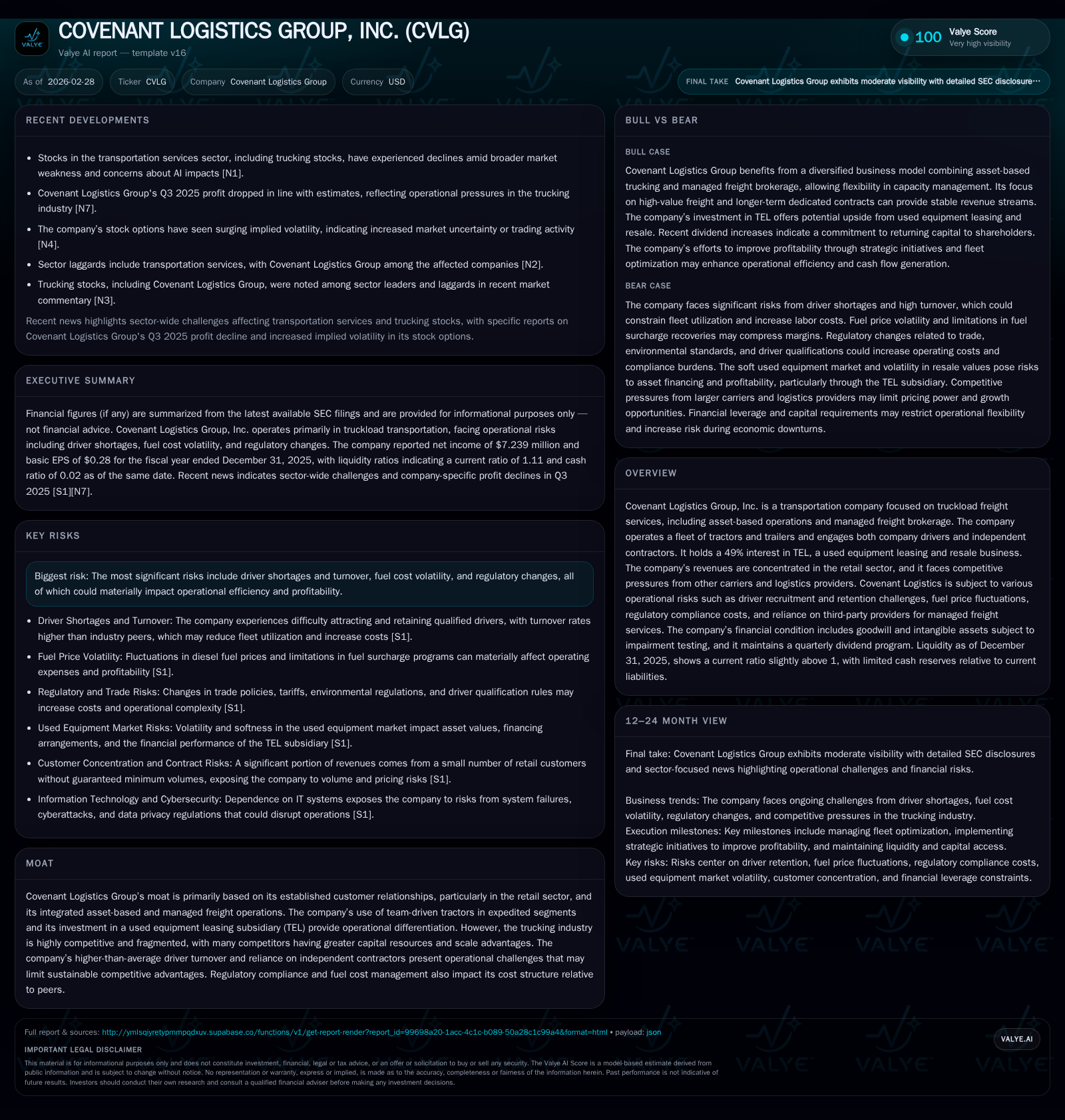
Covenant Logistics Group, Inc. reported a notable revenue increase of approximately 34% for fiscal year 2025 compared to the prior year, reaching $272 million. Despite top-line growth, operating income fell sharply by over 90%, reflecting significant margin pressure driven by heightened costs including fuel volatility, regulatory compliance burdens, and operational inefficiencies. The company’s business is heavily concentrated in retail freight, which ties its performance closely to consumer spending patterns and exposes it to competitive bid pressures. Capital allocation shows ongoing investments with substantial capital expenditures and moderate dividend payouts alongside intermittent share repurchases. Persistent challenges related to driver turnover, independent contractor classification risks, debt covenants, and the used truck leasing subsidiary TEL contribute near-term operational constraints and financial uncertainty.
Historical Financial Performance
Covenant Logistics Group demonstrated a complex financial trajectory over recent years. Revenue grew from about $190.9 million in FY2016 to a peak of roughly $272.3 million in FY2018 [F1]. After a period of relative flux, revenue reported for FY2025 stabilized at the same level ($272.3 million) representing an approximate 33.9% increase relative to the prior fiscal year. This top-line improvement contrasts sharply with earnings metrics that experienced material deterioration.
Operating income tumbled from $44.8 million in FY2024 down to just under $3 million in FY2025 - a staggering decline of about 93.4%. Net income also swung negatively by roughly 79.8% year-over-year from $35.9 million down to $7.2 million [F1]. These shifts reflect acute margin pressure likely influenced by a combination of increased operating costs such as fuel expenses, regulatory compliance outlays, and wage inflation linked to tight labor markets.
Despite profits eroding substantially, Covenant generated robust operating cash flow at approximately $113.6 million during FY2025, although capital expenditures slightly declined year-over-year from $153 million to about $148 million. The company recorded negative free cash flow for the year on this basis [F1]. Equity capital stood at around $404 million by year-end 2025.
Historical performance (annual)
| FY | Net ($mm) | CFO ($mm) | OpInc ($mm) | Capex ($mm) | Net YoY |
|---|---|---|---|---|---|
| 2025 | 7 | 114 | 3 | 148 | -79.8% |
| 2024 | 36 | 123 | 45 | 153 | -35.0% |
| 2023 | 55 | 85 | 59 | 218 | -49.2% |
| 2022 | 109 | 159 | 121 | 100 |
Source: SEC companyfacts cache [F1].
Capital returns and efficiency (annual)
| FY | Div ($mm) | Buybacks ($mm) | FCF ($mm) |
|---|---|---|---|
| 2025 | 7 | 37 | -34 |
| 2024 | 6 | 0 | -30 |
| 2023 | 6 | 25 | -133 |
| 2022 | 4 | 85 | 59 |
Source: SEC companyfacts cache [F1].
Revenue shown for latest year only; operating income and net income YoY declines notable in latest year.
Business Overview and Moat
Covenant operates primarily as a truckload freight carrier offering both asset-based trucking services and managed freight brokerage solutions [N#]. Its fleet includes tractors and trailers staffed by both company-employed drivers and independent contractors — a common mix within the trucking industry aimed at flexibility but complicating labor relations.
A distinguishing feature is its partial ownership (49%) of TEL, a leasing company specializing in used equipment financing and resale targeted at small trucking operators [S19], though this subsidiary's results are volatile due to credit risks associated with lessee bankruptcies and used equipment market softness.
The company's moat is rooted in longstanding retail sector relationships and its integrated model combining asset ownership with freight brokerage . However, industry fragmentation, intense competition from larger carriers possessing scale advantages, and persistent driver turnover limit Covenant’s competitive durability.
Industry and Operational Risks
Covenant's business is tightly linked to economic cycles impacting retail activity; reductions in consumer spending or shifts in supply chain strategies can disproportionately affect freight volumes [S6][S18].
Labor-related risks are salient: the company relies extensively on independent contractors whose legal classification remains under scrutiny nationwide [S1]. Legislative efforts to reclassify such contractors as employees could expose Covenant to back taxes, higher labor costs, and litigation risks.
Regulatory compliance costs continue escalating as environmental regulations targeting emissions grow stricter [S1], impacting fuel usage patterns and fleet investments. Additionally, the company's specialty segment hauling arms and explosives must adhere to stringent security protocols adding operational complexity.
Fuel price volatility remains an uncontrollable variable influencing margin stability given Covenant’s limited ability to pass through surcharges fully [S1][S16].
Capital Structure and Liquidity Constraints
The company maintains a revolving credit facility with a borrowing capacity of $110 million featuring covenants limiting dividends, leverage ratios, asset sales, among other restrictions [S4][S7]. Covenant has faced challenges meeting financial budgets historically requiring loan covenant waivers or amendments — scenarios that underscore liquidity vigilance.
Indebtedness combined with operating lease obligations constrain Covenant’s flexibility for strategic investments or rapid response adaptations [S13][S15]. Near-term refinancing needs or failure to access favorable credit could amplify financial strain.
Capital Allocation Approach
Since January 2022, Covenant instituted a quarterly dividend policy with progressive step-ups culminating in a $0.07 per share quarterly dividend declared most recently in February 2026 [S8]. Dividend payments remain subject to board discretion and financing covenants.
Share repurchases occur opportunistically as evidenced by notable buyback expenditures of roughly $36.6 million during FY2025 following inactivity the prior year [F1].
Capital spending is sustainedly high given fleet maintenance needs with capex exceeding $140 million annually recently — indicative of significant reinvestment requirements tied to regulatory upgrades and capacity adjustments [F1][S27].
Outlook and Key Milestones to Monitor (Analysis)
While explicit financial guidance post-FY2025 is not provided in filings or news reports [N#][S#], several factors will be pivotal:
- Ability to improve operating margins largely depends on controlling input costs (fuel, labor) amid evolving regulation costs.
- Execution of fleet optimization plans focusing on higher-margin freight segments could alleviate margin pressures documented last year [S22].
- Navigating ongoing legal risks regarding contractor classification litigation remains critical for cost containment.
- Financial covenant compliance will necessitate strong cash flow generation; any deterioration could compel equity issuance or restrict strategic initiatives.
- TLC subsidiary’s performance will influence consolidated results given ride-through lease defaults risk amid soft used truck markets.
- Customer retention within retail sector matters deeply due to volume concentration risks; bid competitions may depress rates further.[S6][S22]
- Macro factors including tariff impacts on equipment prices,fuel tax adjustments,and infrastructure policies are uncertain yet crucial cost determinants.[S1][S16]
Returns Profile
Return on equity calculated for FY2025 stands at approximately 1.8%, drastically lower than levels exhibited pre-2024 reflecting profitability headwinds [F1]. The sharp drop-off underlines transitional challenges Covenant faces balancing revenue growth against swelling expenses.
Free cash flow was negative around -$33.9 million recently indicating reinvestment outpacing operational cash generation—typical for capital-intensive trucking operations but unsustainable long-term without earnings recovery or financing support [F1].
Dividends paid represent moderate distribution levels aligned conservatively beneath available cash flows constrained by loan terms [S8]. The board’s cautious stance toward payouts reflects balancing shareholder returns against debt servicing requirements.
Concluding Perspective
Covenant Logistics Group stands at a crossroads: revenue gains signal underlying demand resilience but steep profit declines highlight operational stress points exacerbated by regulatory complexity, labor dynamics, and financing limitations. Its niche retail customer base offers some insulation yet comes with inherent cyclicality that mandates agile cost management.
Effective execution of its strategic plan emphasizing selective fleet reductions alongside investment in premium freight tiers will be critical amid an intensely competitive arena dominated by larger players better fortified with scale advantages. Continued monitoring of capital structure resilience alongside progress resolving contractor classification uncertainties will also be essential for assessing Covenant’s medium-term viability.
Disclaimer:
This analysis is for informational purposes only based on available public disclosures dated up through February 28, 2026, including SEC filings and market news sources cited herein. It does not constitute investment advice or recommendations regarding securities of Covenant Logistics Group or any other entities.
Disclaimer: This is research-only, informational analysis and not investment advice. It may include AI-generated interpretation and general industry context. Always verify important details using primary sources.

Comments