
Deckers Outdoor Boosts Operating Profit on HOKA and UGG Momentum
Robust quarterly results driven by HOKA’s performance growth and UGG’s resilient brand sustain Deckers' operating income gains despite margin pressures.
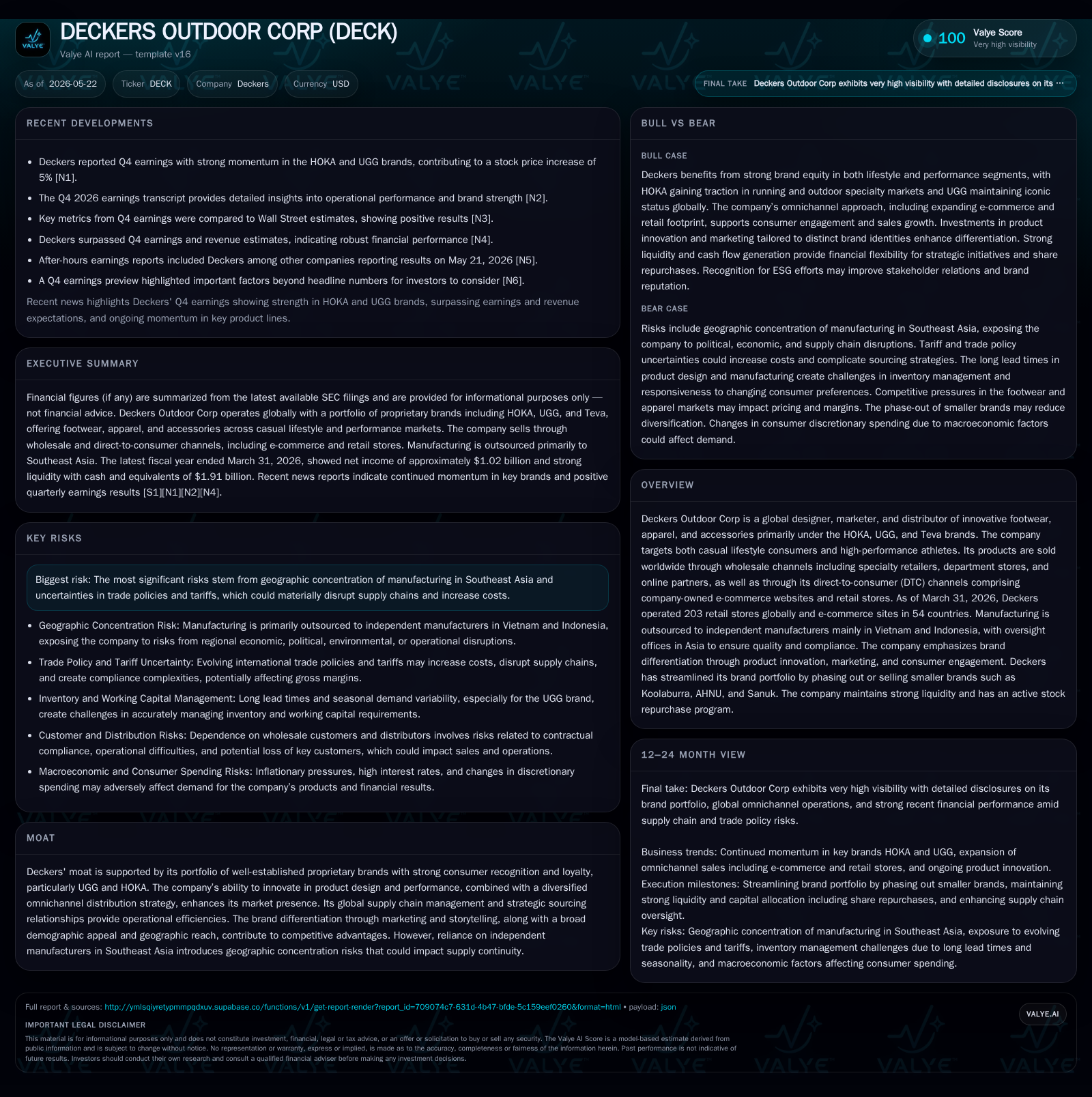
Deckers Outdoor Corp's latest quarterly report as of February 2026 highlights a 7.1% increase in operating income to $1.26 billion, fueled by strong sales momentum from its HOKA and UGG brands. Despite a slight compression in operating margin by 50 basis points to 23.1%, the company improved earnings per share by nearly 11%, supported by effective product innovation and omnichannel expansion. The firm's business model leverages iconic proprietary brands targeting diverse demographics with global wholesale and direct-to-consumer distribution, backed by outsourced manufacturing concentrated in Southeast Asia. Although growth prospects remain intact through product line expansions and international ecommerce scaling, supply chain risks tied to regional concentration and tariff uncertainties require vigilant management. Deckers’ robust liquidity with negligible debt further supports its strategic initiatives and capital allocation flexibility.
Quarterly Operational Update and What Changed
Deckers Outdoor's Q3 fiscal 2026 filing dated February 3, 2026 [S2] reveals a substantial 7.1% increase in income from operations to approximately $1.26 billion [F1]. This uptick is achieved despite a modest operating margin contraction of about 50 basis points to 23.1% [S5]. The underlying drivers reported include robust performance from the HOKA brand — buoyed by expansions into adjacent outdoor and lifestyle categories — alongside enduring resilience from the UGG brand across domestic and international markets [N1][S3]. Elevated SG&A spending by roughly 11% accompanied these gains, suggesting continued investment in marketing and digital infrastructure [S5]. The company’s May event filing reinforced these positive trends through updated financial outlooks and multi-year frameworks underscoring confidence in sustainable growth trajectories [S3].
Margin pressures reflect ongoing inflationary costs affecting raw materials, freight, and labor amid a challenging macroeconomic backdrop including tariff uncertainties [S5][S22]. Nevertheless, effective pricing strategies, selective cost-sharing arrangements with suppliers, and optimized inventory management enabled overall profitability enhancement.
Business Model and Product Offering Quality
Deckers operates as a global designer, marketer, and distributor specializing in innovative footwear, apparel, and accessories targeted at both casual lifestyle consumers and high-performance athletes [S1]. Its portfolio mainly comprises three proprietary brands: HOKA (performance running/outdoor), UGG (fashion lifestyle), and Teva (outdoor sandals) [S1]. This multi-brand strategy serves broad demographic segments ranging from ultra-runners to fashion-conscious consumers seeking comfort apparel.
Revenue streams arise chiefly from wholesale relationships with specialty sports retailers, department stores, international distributors, plus a growing direct-to-consumer (DTC) channel that spans owned ecommerce sites covering 54 countries globally along with 203 physical retail locations worldwide as of March 31, 2026 [S12][S26]. The DTC channel significantly enhances consumer engagement while helping diversify sales concentration risks inherent in wholesale partnerships.
Deckers outsources all manufacturing to independent contractors predominantly located in Vietnam and Indonesia [S19]. Oversight offices ensure quality control and compliance with ethical standards amidst complex supply chains. Raw material sourcing includes contracts for specialty inputs such as Australian sheepskin critical to UGG products secured under fixed-price agreements mitigating volatility risk [S1]. Strategic product innovation features HOKA’s proprietary cushioning technology delivering lightweight stability that sustains its competitive differentiation [S18]. Sustainability initiatives aimed at reducing environmental impact also reinforce brand equity in increasingly value-conscious markets.
Competitive Positioning and Industry Structure
The broader footwear and apparel industry encompasses various segments — fashion lifestyle, performance athletic footwear, running specialty, and outdoor categories — all characterized by rapid shifts in consumer preferences influenced by evolving styles, technology innovation, and cultural dynamics [S22]. Deckers sustains competitive advantages through strong brand loyalty manifest in differentiated portfolio offerings like UGG’s iconic fashion status paired with technical prowess embodied by HOKA products designed for elite athletes as well as aspirational everyday users.
Operationally, Deckers faces complexities common within global supply chains including dependency on Southeast Asian manufacturing hubs that are subject to economic fluctuations, geopolitical tensions, weather disruptions, tariffs, regulatory oversight, and labor conditions [S19][S22]. Competitors typically include large multinational brands integrating vertically or relying heavily on diversified supplier bases; Deckers counters this with focused supplier relationships complemented by strategic sourcing diversification efforts yet acknowledges concentration risks remain noteworthy.
Inventory management strategies combine owned physical stores augmented by third-party logistics (3PL) partnerships enabling agile response to channel demand variability [S26]. The balance between wholesale reach and scalable DTC expansion creates a hybrid model balancing risk exposure while maximizing global footprint efficiency.
Growth Drivers: Innovation, Expansion, and Channel Mix
Key drivers of Deckers’ growth center on accelerating the HOKA brand beyond footwear into apparel and accessories leveraging elevated marketing campaigns stressing authenticity and experience-centric storytelling [S18][N2]. This expansion taps into the burgeoning athleisure trend where performance attributes meet lifestyle appeal.
Concurrently, UGG seeks to broaden its demographic reach with year-round offerings moving beyond traditional seasonal demand patterns to capture more consistent revenue streams globally supported by online penetration advances across emerging markets [S1][N2]. The build-out of international DTC channels enhances margins by bypassing intermediary markups while reinforcing direct customer relationships enabling data-driven loyalty programs improving lifetime value metrics.
Investment into digital infrastructure facilitating seamless omnichannel experiences aligns with shifting consumer buying behaviors favoring ecommerce convenience alongside experiential retail environments anchored in flagship stores. Pricing power emerges from differentiated product innovation coupled with strong brand resonance allowing for selective premiumization amidst inflationary pressures.
Risks: Supply Chain Concentration and Market Dynamics
Deckers highlights significant exposure stemming from geographic concentration of contract manufacturing predominantly within Vietnam and Indonesia presenting notable supply chain fragility against escalating trade policy volatility including tariffs imposed under US International Emergency Economic Powers Act temporarily invalidated pending judicial clarifications impacting duty cost recoverability scenarios [S5][S19]. Such regulatory flux increases complexity around cost planning inventory provisioning potentially leading to price escalation or margin dilution if not navigated effectively.
Raw material price volatility—particularly concerning sheepskin critical for UGG lines—may impinge margin sustainability unless offset by hedging mechanisms or contract pricing structures currently employed to manage some degree of input cost risk [S1]. Rapid consumer preference shifts characteristic of footwear/apparel sectors require vigilant design innovation maintaining relevance lest sales erosion or heightened promotional discounting adversely impacts gross margins [S22].
Other identified risks include intellectual property infringement threats given prominent brand visibility necessitating costly enforcement measures internationally potentially detracting focus/resources; macroeconomic downturn weakening discretionary consumer spend; discrete disruptions triggered by climate events or pandemic resurgences imperiling supply continuity or retail traffic flows without full mitigant coverage from insurance programs [S22][S24]
Near-Term Catalysts and What to Watch Next
Upcoming material checkpoints encompass the next quarterly earnings announcements which will clarify trajectory sustainability for revenue growth particularly within HOKA apparel extensions plus continued strength of UGG year-round penetration efforts alongside ongoing margin trends vis-à-vis input cost inflation passage [N2][S3]. Updates on tariff refund proceedings via US Customs phased refund claim processes will inform contingent asset recognition impacting future periods [S5].
Product pipeline innovations introduced at upcoming seasonal launch windows warrant close observation for market acceptance signals supporting SKU rationalization strategies implemented following recent brand portfolio pruning of AHNU/Koolaburra phase-outs effectuated without material exit costs enhancing operational focus on core franchises [S18]
Monitoring shifts in channel mix—especially acceleration within emerging market e-commerce platforms—as well as executions against approved multi-year financial frameworks including capital allocation priorities such as share repurchases authorized up to approximately $4.8 billion reflects management’s confidence levels while indicating deployment prudence under prevailing market conditions.
Current Financial Health Snapshot
As of March 31, 2026, Deckers maintains a robust liquidity position backed by cash & equivalents totaling nearly $1.9 billion [F1]. Current assets approximate $2.85 billion against current liabilities below $0.81 billion yielding a current ratio near 3.54 [F1].
The firm generated approximately $1.18 billion in cash flow from operating activities for fiscal year ended March 2026 reflecting disciplined working capital management alongside improving net income totaling just over $1.02 billion supporting both organic reinvestment capacity plus sizable stock buybacks executed throughout the quarter demonstrating efficient capital return execution aligned with shareholder value enhancement.
In summary, Deckers combines strong profitability adjacent to an abundant liquidity cushion providing strategic optionality navigating external macro challenges while pursuing sustainable growth investments across its differentiated branded portfolio.
This analysis is prepared solely for informational purposes based on public SEC filings dated February-May 2026 alongside corroborated news disclosures. It does not constitute investment advice or research views.
Disclaimer: This is research-only, informational analysis and not investment advice. It may include AI-generated interpretation and general industry context. Always verify important details using primary sources.

Comments