
Diodes Inc.'s Strategic Resilience Amid Semiconductor Market Turbulence
Navigating innovation, market diversification, and geopolitical headwinds, Diodes Inc. charts a path through semiconductor industry complexities.
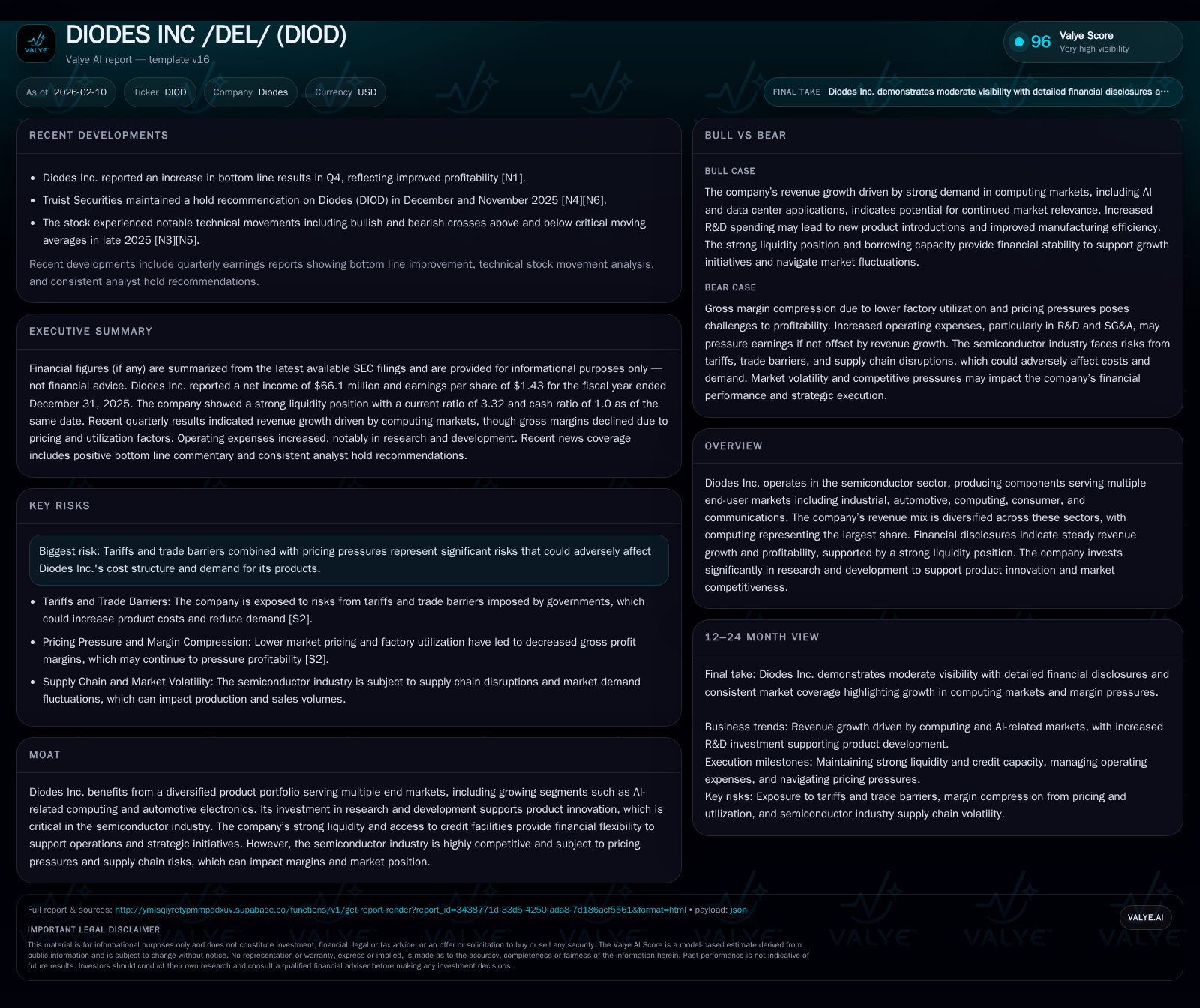
Diodes Inc. continues to exhibit steady revenue and profitability growth, buoyed by a diversified portfolio spanning computing, industrial, automotive, and consumer markets. Quarter-to-quarter gains reflect strong demand in AI-driven computing sectors, despite ongoing margin pressures from product mix shifts and tariff-induced cost challenges. The company’s robust investments in R&D and a solid liquidity base underpin its ability to innovate and adapt amid supply chain uncertainties and intense competitive dynamics.
Quarterly Momentum: Q4 and Beyond
Diodes Inc. closed the year demonstrating resilient momentum in its quarterly results. Notably, the bottom line advanced as reported on February 10, 2026, evidencing underlying strength despite margin headwinds (N1). Sequentially and year-over-year comparisons reveal a net sales increase to $392.2 million in Q3 2025 from both the prior quarter's $366.2 million and a year earlier $350.1 million (S2). Although gross profit experienced only modest growth of around 2%, margin compression was evident—down to approximately 30.7% from 33.7% one year prior—driven largely by product mix shifts favoring lower-margin offerings (S2).
Operating cash flow remained robust with $79.1 million generated during Q3, supporting capital expenditure programs totaling $16.3 million as well as contributing to a healthy net positive cash flow position (S2). Year-end financial snapshots corroborate sustained profitability with reported net income reaching $66.1 million for full-year 2025 alongside strong current ratios indicating balance sheet stability (F1).
While these trends highlight operational efficacy amidst choppy conditions, margin constraints signal continuing challenges that stem from diverse market dynamics as well as external cost pressures.
Diverse Market Threads: From AI Servers to Automotive Electronics
The company’s multifaceted market exposure stands out amidst semiconductor industry fluctuations. Computing retains primacy within Diodes’ revenue composition; driven by surging demand for AI-centric server applications alongside general data center expansions and edge computing deployments across Asia and North America (S2). This segment's strength is pivotal amidst broader macroeconomic uncertainties.
Conversely, Diodes’ automotive and industrial segments portray a more nuanced picture—recovery trajectories remain gradual but indicate positive sequential progress with revenues edging higher compared to prior periods (S2). Given that these markets also tend to deliver higher margins relative to volume-centric computing products, their acceleration bears significant implication for future profitability enhancements detailed in the company's risk acknowledgment and moat narratives.
Consumer electronics participation also contributes incrementally with sequential improvements noted in recent quarters (valye_report_excerpt; S2). Overall, this diversified footprint shields Diodes from sector-specific shocks yet necessitates agile adjustments across a spectrum of product cycles.
The Innovation Engine: R&D Fuelling Diodes’ Edge
Innovation emerges as an indispensable pillar bolstering the firm’s competitive moat within an intensely dynamic semiconductor ecosystem. According to corporate disclosures emphasizing sustained R&D commitments, Diodes prioritizes development efforts that directly complement its expanding presence in AI-related computing hardware as well as automotive electronic components (valye_report_excerpt).
Despite prevailing pricing pressures and supply risks—a universal semiconductor challenge—the ability to introduce differentiated products underpins potential margin expansion strategies outlined internally (valye_report_excerpt; S1). Embracing rapid technological evolution enables Diodes not only to meet current customer demands but also to anticipate longer-term applications critical for market relevance.
Such proactive investment fosters resilience against commoditization trends common in some product lines while positioning the company strategically vis-à-vis peers lacking similar dedicated innovation frameworks.
Navigating Tariffs and Trade Tides
Trade policy upheavals represent palpable headwinds that Diodes continues to address with prudence. Following recent U.S.-initiated tariffs imposed on imports—including raw materials essential for semiconductor fabrication—countervailing actions from multiple nations have triggered reciprocal trade barriers leading to elevated input costs and operational complexities (S1; S2).
Management acknowledges these tariffs could depress demand or exacerbate costs if negotiations fail to yield relief measures, injecting unpredictability into near-term planning horizons (S1). Active analysis of tariff impacts coupled with mitigation efforts—such as supply chain optimization or geographic sourcing adjustments—reflects a vigilant approach aiming to cushion adverse effects without sacrificing delivery commitments or innovation momentum.
Nonetheless, this domain remains fluid with persistent negotiation uncertainties entwining geopolitical risk factors directly into business performance matrices.
Balance Sheet Strength in a Competitive Landscape
Financial robustness stands out as a core enabler for Diodes amid sectoral volatility. As of late 2025 filings, cash plus equivalents approached $367 million accompanied by $225 million in accessible revolving credit facilities under existing agreements (F1; S2). This liquidity reservoir empowers continued investment into growth initiatives including R&D and selective acquisitions while safeguarding operational continuity against short-term disruptions.
Inventory management metrics reveal marked reductions exceeding 25% from peak levels both in dollar terms and weeks of supply suggesting healthier channel inventories aligned with actual end-market consumption rates (S2). Such inventory discipline lessens working capital strain and limits obsolete stock risk—a crucial factor given technological obsolescence speed prevalent in semiconductors.
Capital expenditure outlays remain measured relative to cash flows indicating judicious deployment favoring scalable capacity enhancements rather than aggressive fixed asset expansion during uncertain periods (S2).
Technicals Under the Microscope: Price Movements and Moving Averages
Turning attention briefly toward market sentiment as interpreted through technical analysis reveals layers beneath fundamental narratives. On December 31, 2025, share prices crossed below key moving averages which some interpret either as cautionary signals or potential buying opportunities depending on investor time horizon considerations (N3).
This technical inflection encapsulates how external forces—including sector rotations or macroeconomic data releases—can transiently influence stock performances independently yet still echo underlying business fundamentals. For stakeholders monitoring DIOD's trajectory, understanding such technical markers supplements holistic appraisal without dominating strategic perspectives.
Structural Risks and Industry Dynamics
The semiconductor industry’s inherent volatility is no abstraction here but rather a concrete eventuality shaping Diodes’ operational realities. Persistent pricing compression amid intense competition erodes margins even for established players possessing diversified portfolios like DIOD (valye_report_excerpt; S1).
Supply chain fragility amplified by geopolitical tensions adds complexity—occasional shortages or logistics disruptions impose unpredictable costs impacting lead times and customer satisfaction simultaneously (valye_report_excerpt). This environment demands uncompromising agility across procurement, production scheduling, and customer engagement disciplines.
Furthermore, tariff regimes inject additional uncertainty dampening investment visibility while compelling continuous reassessment of global manufacturing footprints potentially altering cost bases long term.
Such embedded risks elucidate why durable moats must rest on multiple pillars: innovation leadership paired with financial strength enabling adaptability across market cycles.
Strategic Outlook: What Lies Ahead for DIOD?
Synthesizing recent quarterly performance alongside articulated corporate strategies reveals an enterprise balancing cautious optimism with pragmatic risk awareness moving forward. Sustained demand growth within AI-powered computing platforms combined with gradual improvements in automotive electronics revenue streams sets an encouraging commercial backdrop reflected through steadily rising order inflows (N1; valye_report_excerpt; S2).
Crucially, innovations poised for rollout may unlock incremental pricing power or margin enhancements vital given existing product mix headwinds documented earlier this cycle (S2). Meanwhile, comprehensive trade policy monitoring paired with proactive supply chain strategies will be decisive factors influencing resilience under evolving geopolitical climates (S1; S2).
In essence, DIOD's pathway appears calibrated towards leveraging its diversified end-market reach coupled with committed R&D investments—as securities markets adjust technically—to sustain competitive differentiation amidst ongoing sector complexities.
Disclaimer: This analysis is intended solely for informational purposes based on publicly available data as of February 10, 2026. It should not be construed as investment advice or recommendation.
Disclaimer: This is research-only, informational analysis and not investment advice. It may include AI-generated interpretation and general industry context. Always verify important details using primary sources.

Comments