
Delek US Holdings Navigates Refining Profit Recovery and Persistent Regulatory Challenges
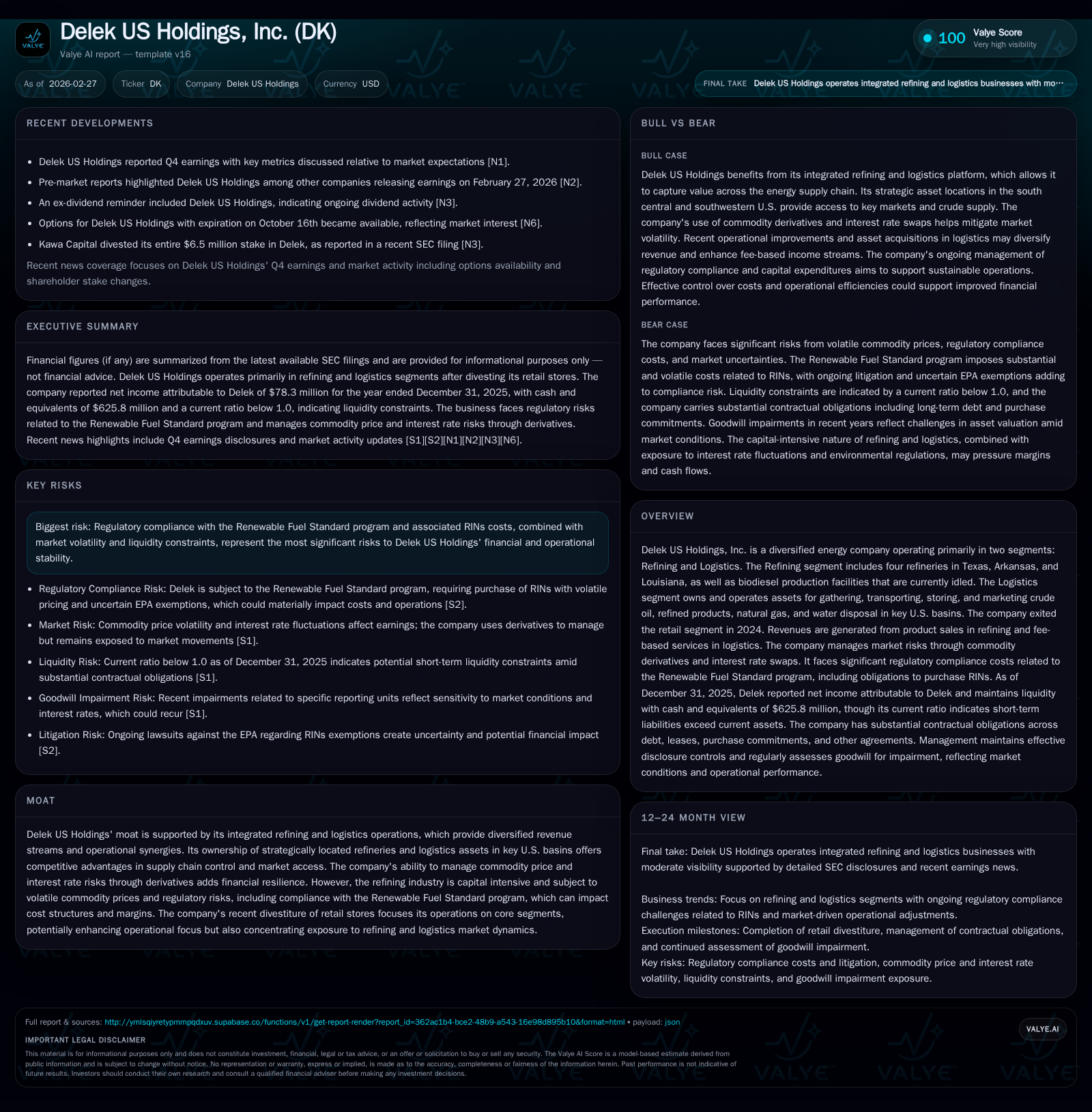
After recent operational shifts, Delek US Holdings shows modest profitability in refining amid ongoing Renewable Fuel Standard costs and evolving liquidity management.
Delek US Holdings, Inc. operates integrated refining and logistics asset bases primarily in Texas, Arkansas, and Louisiana, generating revenue through product sales and fee-based logistics services. Historical volatility defined the recent years, with steep losses in the 2024 fiscal year followed by an operating income rebound to $164.6 million in 2025 [F1]. Regulatory compliance under the Renewable Fuel Standard (RFS) remains a critical cost driver and litigation focus. Capital allocation reflects a cautious approach balancing modest free cash flow generation against sizable debt obligations and dividend payments.
Company Overview
Delek US Holdings, Inc. functions primarily through two segments: Refining and Logistics. The refining operations consist of four strategically located refineries across Texas, Arkansas, and Louisiana. While they historically included biodiesel production facilities, these remain idled as of the latest reporting period. The Logistics segment supports gathering, transportation, storage, and marketing activities for crude oil, natural gas, refined products, and water disposal within key U.S. basins — integral to the company's vertically integrated business model that balances product sales and fee-based services [S1][S9].
Notably, Delek exited its retail convenience store business during 2024 to concentrate resources on core refining and logistics functions, ceasing retail as a reportable segment [S9]. This streamlining aligns with the company’s strategic shift amidst industry volatility.
Historical Performance
Delek’s financial results over recent years exemplify the cyclicality inherent in integrated energy companies exposed to commodity price swings and regulatory pressures. FY2019 revenue was approximately $2.28 billion but note that earlier data showed an anomalous spike attributable to acquisitions or non-recurring items leading revenue as high as $7.27 billion in FY2017 (likely including discontinued businesses) [F1].
Profitability fluctuated sharply:
- Operating income swung from losses of -$103.5 million (FY22) and an even steeper -$403.4 million (FY24), reflecting headwinds from market conditions and regulatory costs.
- The rebound in FY25 operating income to $164.6 million indicates partial recovery driven by stronger refining margins.
- Correspondingly, net income turned positive to $78.3 million after consecutive years of losses.
Operating cash flow mirrored this rollercoaster, showing healthy positive cash flow ($1 billion+) in 2023 before plunging negative in 2024 (-$66.8 million), then rebounding significantly to $535.8 million in FY25 as working capital normalized and operational efficiency improved [F1].
Historical Financial Summary
Historical performance (annual)
| FY | Net ($mm) | CFO ($mm) | OpInc ($mm) | Capex ($mm) | Net YoY |
|---|---|---|---|---|---|
| 2025 | 78 | 536 | 165 | 530 | +118.9% |
| 2024 | -414 | -67 | -403 | 428 | -2189.9% |
| 2023 | 20 | 1014 | 280 | 420 | +116.7% |
| 2022 | -119 | 425 | -103 | 311 |
Source: SEC companyfacts cache [F1].
Capital returns and efficiency (annual)
| FY | Div ($mm) | Buybacks ($mm) | FCF ($mm) |
|---|---|---|---|
| 2025 | 62 | 6 | |
| 2024 | 64 | 0 | -494 |
| 2023 | 60 | 0 | 594 |
| 2022 | 43 | 130 | 114 |
Source: SEC companyfacts cache [F1].
Note: Revenue for years other than shown is not directly comparable due to divestitures.
Growth Prospects
Delek’s future growth hinges on navigating several levers:
- Refining margins: Margin recovery beyond FY25 levels could lift earnings amid ongoing macroeconomic uncertainty.
- Regulatory environment: The Renewable Fuel Standard (RFS) program imposes a high-cost burden via Renewable Identification Numbers (RINs). Delek has limited pricing power to offset RIN costs as they cannot be passed fully onto customers.
- Small refinery exemptions (SREs): Timely grant or denial of SRE petitions materially impacts costs; recent EPA decisions denying exemptions led to legal challenges from Delek subsidiaries seeking relief for refineries including Krotz Springs and Big Spring [S10][S16].
- Logistics expansion: Fee-based services provide stable cash flow less susceptible to commodity cycles but depend on sustained throughput volumes.
Capital expenditures are planned selectively—$529 million spent in FY25 with moderate year-over-year increase suggesting a measured approach towards sustaining capacity rather than aggressive expansion at this stage [F1][S22].
Forecasts & Milestones
Delek’s official filings do not disclose explicit earnings or capital guidance post-FY25 at this time; however, major milestones include:
- Planning related litigation outcomes against EPA regarding RINs compliance measures later in calendar year 2026 which will influence cost structures significantly.
- Finalization of downstream asset sales or acquisitions that may reshape logistics segment exposure.
- Monitoring market crack spreads which impact refining unit economics considerably.
Market observers should watch quarterly updates for changes in EBITDA margins and cash flow from operations given their volatile nature tied closely to both regulatory developments and commodity cycles.
Returns & Capital Allocation
Return on equity approximates about 4% based on FY25 net income relative to equity base noted internally [F1]. This modest figure reflects capital-intensive nature of refining coupled with regulatory drag.
Cash flows serve internal reinvestment priorities while supporting consistent dividend payouts:
- Dividends paid were stable around $62 million annually through FY25.
- No share repurchases have been reported post FY22 when buybacks totaled nearly $130 million; pause likely reflects prioritizing balance sheet strength amid volatile earnings [F1][S23].
Free cash flow after capex presently hovers near breakeven territory (approximately +$6 million) indicating tightly balanced operational efficiency vs capital demands.
Liquidity management focuses on maintaining strong revolver capacity plus managing sizeable contractual commitments—with total debt exceeding $3 billion bearing rates between ~7% –8%, maturing predominantly between late decade periods (2027-2033) necessitating careful refinancing strategies [S4][S6][S7].
Regulatory & Litigation Risks
Compliance with the EPA’s Renewable Fuel Standard program presents ongoing cost volatility risks due primarily to:
- Required purchase or blending of costly RIN credits without full pass-through ability.
- Recent EPA small refinery exemption denial decisions spurred multiple appeals filed by subsidiaries at federal appellate courts challenging eligibility for hardship relief covering various compliance years back to 2019 [S10].
- Uncertainty around timing or availability of market-purchased RINs impacting short-term liquidity planning underlines risk profile.
Environmental liabilities related to contamination remediation are accrued at around $36 million extending up to two decades but deemed manageable within current operational scope [S16].
Summary & Outlook Analysis
Delek US Holdings' integrated model combining refining assets focused on Gulf Coast basin geographies with complementary logistics infrastructure provides diversification that helps partially offset sector cyclicality pressures. The firm’s exit from retail underpins greater strategic clarity albeit concentrating overall exposure on commodity markets influenced heavily by regulatory frameworks like the RFS.
Financial performance improvement into FY25 signals some margin normalization benefiting from market conditions but remains constrained by unavoidable RIN compliance costs that add complexity rarely fully addressed by competitors due to geographic footprint uniqueness.
Liquidity remains adequate bolstered by revolving credit lines though leverage levels warrant continued monitoring especially given material debt maturities ahead and limited free cash flow cushion post-capex.
Key developments such as resolution of current litigation over SRE denials may materially affect cost structures going forward while capital allocation appears balanced toward sustaining dividends over buybacks currently.
Investors tracking this name should closely observe quarterly disclosures around refining margins dynamics, regulatory actions on RFS compliance enforcement, along with any shifts signaling expansions or contractions within logistics throughput volumes affecting fee revenues.
This analysis is presented for informational purposes based on publicly available data as of February 27, 2026, including SEC filings and recent news sources referenced herein.
Disclaimer: This is research-only, informational analysis and not investment advice. It may include AI-generated interpretation and general industry context. Always verify important details using primary sources.

Comments