
DarkIris Inc.: Navigating Growth and Globalization in Mobile Gaming Ecosystem
DarkIris Inc. leverages integrated game development, publishing, and marketing to expand its global footprint amid intensifying platform economics.
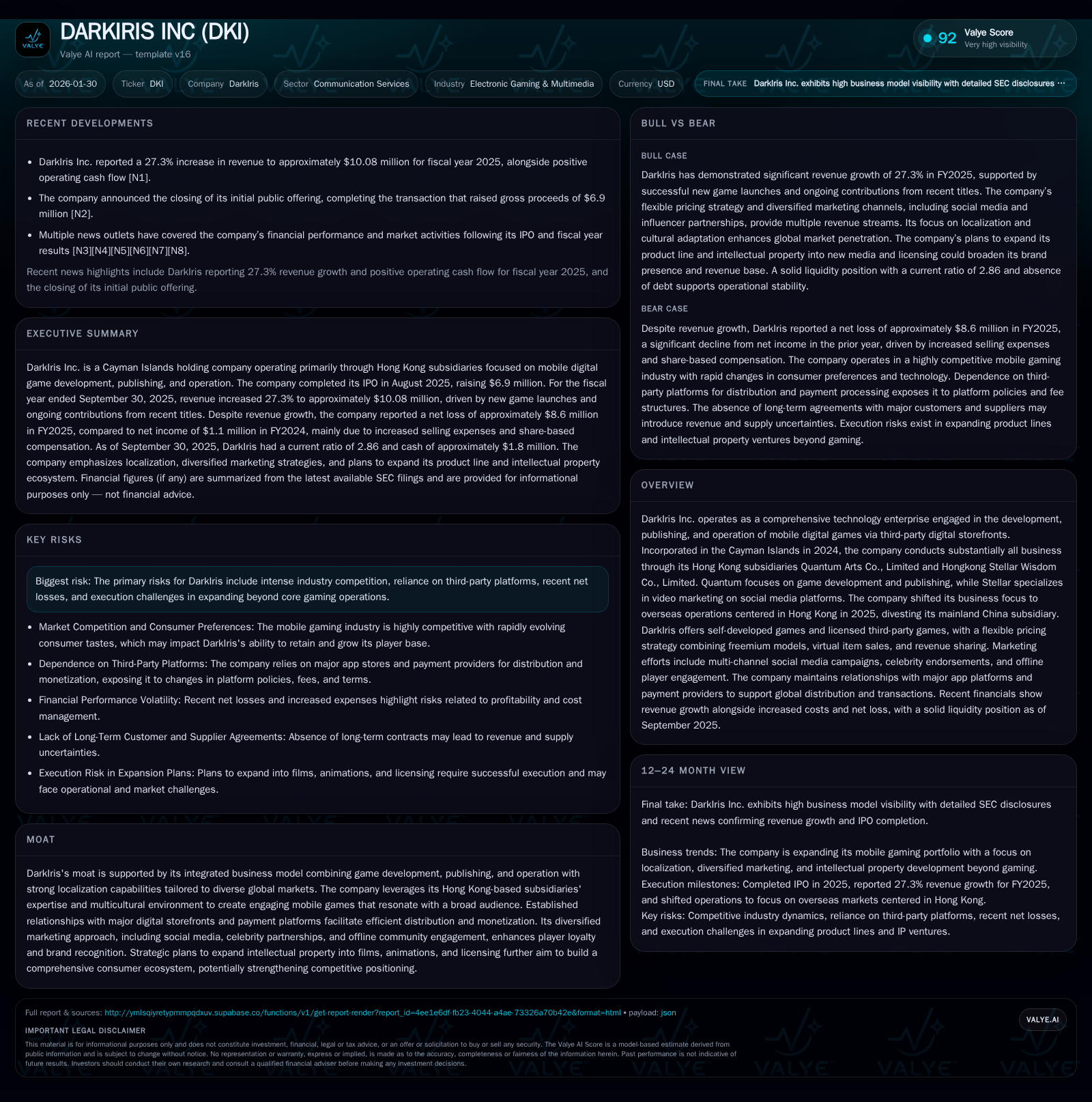
DarkIris Inc., operating primarily through its Hong Kong-based subsidiaries, reported a significant 27.3% revenue growth and positive operating cash flow for fiscal year 2025, reflecting successful overseas expansion following its strategic exit from mainland China. The company’s integrated model spans self-developed and licensed mobile games marketed through diverse channels, including social media, celebrities, and offline community engagement, fostering strong player loyalty. Despite revenue growth, margin pressures from increased platform fees and share-based compensation highlight operational leverage challenges amid a competitive and platform-dependent marketplace.
What Changed Recently
DarkIris Inc. reported a 27.3% revenue increase and achieved positive operating cash flow for fiscal year 2025, following its August 2025 IPO on Nasdaq which raised approximately $6.9 million in gross proceeds. This financial milestone comes after the company’s strategic shift in 2025 to focus on overseas operations via its Hong Kong subsidiaries, Quantum Arts Co., Limited and Hongkong Stellar Wisdom Co., Limited, after divesting its mainland China subsidiary [N1, N3, S1]. The revenue growth reflects an expanded game portfolio, including self-developed and licensed titles, as well as enhanced collaboration with third-party digital storefronts.
However, despite top-line growth, gross margin contracted due to increased platform handling fees and revenue-sharing arrangements, a dynamic that underscores the pressure from dominant app store platforms. Share-based compensation expenses also surged, significantly increasing selling expenses and impacting operating profitability [S11, S13, S14, S18]. These factors highlight the challenge of balancing growth with cost control in a platform-dependent environment.
Business Model as a System
DarkIris operates as a holding company incorporated in the Cayman Islands, conducting nearly all business through its Hong Kong subsidiaries, with Quantum focusing on game development and publishing and Stellar on video marketing and social media promotion [S1, S10]. The company’s business is built around three interlinked pillars:
Game Development and Publishing: The company offers a mix of self-developed mobile games and licensed third-party titles. In 2025, self-developed games contributed 45% of revenue, up from negligible levels two years prior, while licensed games constituted 55% [S3]. This diversified product lineup allows DarkIris to manage risk and leverage external creative talents.
Distribution via Third-Party Platforms: DarkIris distributes games through dominant digital storefronts, primarily Apple App Store and Google Play, along with other third-party platforms. These platforms handle payment processing and user acquisition but command significant revenue shares, ranging from 15% to 60%, which impact gross margins [S3, S11]. The company does not have long-term agreements with these suppliers, indicating ongoing dependence on platform terms.
Marketing and Player Engagement: DarkIris employs a data-driven, multi-channel marketing strategy, incorporating social media campaigns, celebrity endorsements, livestreaming partnerships, and offline community events aimed at cultivating player loyalty and engagement. Their marketing team is lean but supplemented by external advisors and partnerships, optimizing promotional efficiency [S4, S5].
The pricing strategy is flexible, combining freemium models with virtual item sales and revenue sharing, designed to maximize player conversion and monetization across diverse regions [S5]. Localization is a key competency, with adaptations including language options and culturally relevant content to increase regional appeal.
Industry Map & Competitive Battlefield
The mobile gaming sector is intensely competitive and platform-centric. Major app stores dominate distribution and monetization, setting terms that compress publisher margins. DarkIris competes with global and regional studios, many backed by large technology firms with deep pockets for development, marketing, and user acquisition.
DarkIris's moat derives from its integrated model of development, publishing, and marketing anchored in Hong Kong’s multicultural environment, which supports effective localization and cultural tailoring—critical for success in diverse overseas markets such as Southeast Asia, North America, and Europe [S1, S22, S23].
The company also aims to expand its intellectual property beyond gaming into films, animation, and merchandise licensing, seeking to build a broader consumer ecosystem and deepen brand equity—an approach mirroring strategies by larger gaming platforms to diversify revenue and audience touchpoints [S22].
Partnerships with payment providers like MyCard, PayPal, WeChat Pay, and Alipay are vital to facilitate seamless transactions and accommodate regional payment preferences, a non-trivial barrier in global monetization [S23].
Where the Economics Become Real
DarkIris’s economics are shaped by the interplay of revenue growth, platform fees, revenue sharing, marketing expense leverage, and R&D investment:
Revenue & Cost Dynamics: The company doubled revenue from FY2023 to FY2024, driven by new game launches and expanded platform partnerships. However, platform handling fees rose significantly (up 76% in FY2025), reflecting both increased revenue share payments and growth of partner platforms, compressing gross margins from 38.0% in 2024 to 24.8% in 2025 [S11, S13, S18].
Revenue Sharing: Payments to external game developers increased modestly, associated with licensing deals typically ranging from 10% to 20% of related revenues, balancing the mix of self-developed and licensed content [S11, S14].
Marketing & Selling Expenses: Marketing spend surged in 2025, largely due to share-based compensation (approximately $8.8 million), overshadowing advertising cost reductions from more targeted platform collaborations [S14, S18]. The company relies heavily on precise data analytics, celebrity endorsements, and influencer partnerships to maximize marketing ROI.
R&D Expenses: Investment in proprietary game engines and analytics increased, reflecting a strategic push to differentiate gameplay and improve monetization potential [S7, S18].
Liquidity & Capital Structure: As of September 2025, DarkIris held $1.8 million in cash, with working capital of approximately $3.1 million, supported by positive operating cash flow and IPO proceeds. The company maintains a debt-free balance sheet, providing financial flexibility for future growth or acquisitions [S15, S16, S17].
Diligence Questions / Disconfirming Signals
Platform Dependency: The absence of long-term agreements with app stores and payment platforms exposes DarkIris to pricing and policy risks that could materially impact margins and distribution control.
Margin Pressure: Significant increase in platform fees and share-based compensation stresses profitability. How sustainable is margin compression amid rising costs?
Execution Risk in Expansion: The company’s pivot towards overseas markets and non-gaming IP expansion is capital intensive and competitive. Does management have a clear roadmap and sufficient resources to execute these initiatives effectively?
Marketing Efficiency: The surge in selling expenses driven by share-based compensation raises questions about underlying marketing cost discipline and the ability to scale user acquisition profitably.
User Metrics Transparency: Key operating metrics such as Daily Active Users (DAU) and paying user conversion rates are not disclosed in detail, limiting visibility into user engagement and monetization trends.
Cybersecurity Risks: Despite no material incidents reported, cybersecurity remains a material risk factor given the digital nature of the business and global operations [S20].
Competitive Intensity: How does DarkIris plan to sustain differentiation against larger competitors with deeper pockets and proprietary distribution channels?
Conclusion
DarkIris Inc. operates at the intersection of game development, publishing, and marketing with a clear strategy to globalize its mobile games portfolio. The company’s recent financial improvements post-IPO and strategic focus on localization and diversified marketing suggest potential for scalable growth. However, margin pressures from platform economics and high share-based compensation costs present operational challenges. The company’s ability to execute its expansion plans, control costs, and maintain competitive differentiation in an evolving digital gaming landscape will be critical to its long-term trajectory.
This analysis is based on publicly available information as of January 2026 and does not constitute investment advice. Investors should conduct their own due diligence before making any investment decisions.
Disclaimer: This is research-only, informational analysis and not investment advice. It may include AI-generated interpretation and general industry context. Always verify important details using primary sources.

Comments