
DICK'S Sporting Goods Boosts Margins Through Vertical Brands Amid Robust Q1 Performance
Q1 results show elevated comparable sales and margin improvements driven by proprietary product lines and omni-channel strength.
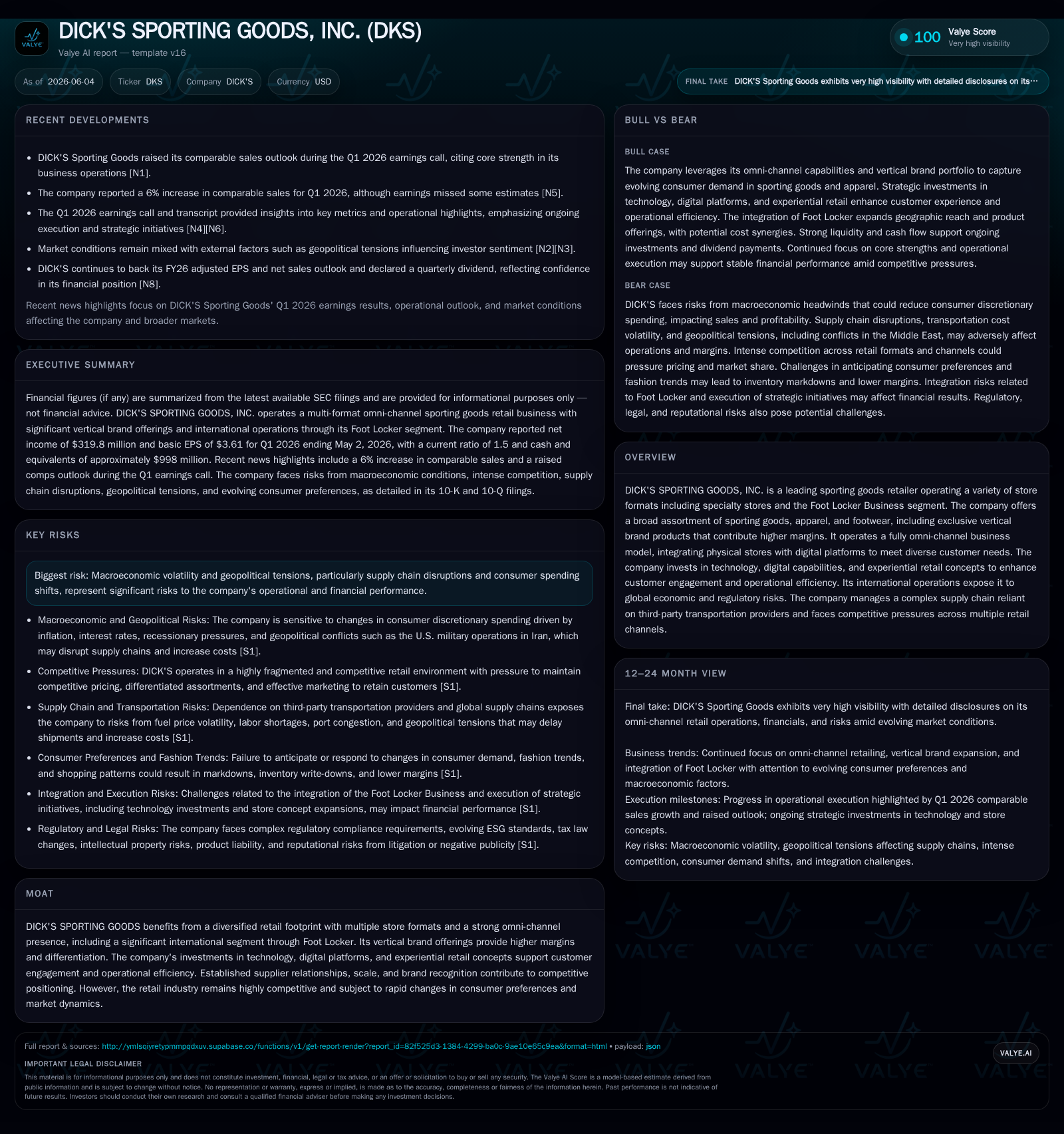
DICK'S Sporting Goods posted a solid first quarter ending May 2026 with comparable sales growth of 6%, prompting management to raise its full-year comparable sales outlook [S2][N1]. The retailer’s diversified store formats and exclusive vertical brands continue to underpin margin expansion despite competitive pressures [S1][S2]. An integrated omni-channel strategy combining experiential retail and digital investments supports customer engagement and operational efficiency. Risks remain from macroeconomic volatility, global supply chain challenges, and Foot Locker's international exposure. Financially, the company maintains a strong cash position relative to modest debt, providing flexibility for ongoing initiatives [F1][S3].
Quarterly Operating Update: Raising Comps Outlook
In its latest quarterly filing for the period ending May 2, 2026, DICK'S Sporting Goods reported a notable +6% increase in comparable store sales across its retail footprint, encompassing both physical stores and digital channels [S2]. Management announced an upward revision to the full-year comparable sales guidance, signaling confidence in sustained demand driven by core categories and the traction of vertical brand offerings [N1][N2]. Although reported earnings marginally missed some analyst expectations due to certain cost headwinds, underlying revenue momentum displays operational resilience in a challenging macroeconomic environment.
The company highlighted strength across multiple formats — traditional sporting goods stores and the integrated Foot Locker segment — while noting that digital penetration continues to grow as part of their fully omni-channel approach. Elevated traffic conversion rates from seamless digital-physical interaction events underpin lifted sales volumes despite ongoing industry competition.
Business Model Overview: Retail Formats and Vertical Brands
DICK’S operates a diversified portfolio consisting primarily of specialty sporting goods stores augmented by the Foot Locker business, with geographic reach spanning domestic U.S. markets and international territories through Foot Locker’s presence [S1]. This multi-format model allows tailored assortment curation catering to varied consumer preferences while leveraging scale advantages.
Central to margin enhancement has been the company’s investment in exclusive vertical brand products which present higher gross margin capture compared to third-party branded merchandise [S2]. These proprietary lines provide differentiation during intense price competition prevalent in sporting goods retailing. Moreover, vertical brands reduce dependence on key vendors (Nike accounts for ~31% of purchases) while offering improved control over product innovation and pricing strategy [S8]. Omni-channel fulfillment capabilities tightly integrate these assortments across stores and eCommerce platforms.
Industry Dynamics and Competitive Positioning
Operating within a fragmented market populated by large specialty chains, mass merchants, department stores, alongside an expanding cohort of direct-to-consumer vendors, DICK’S faces significant competitive complexity [S1]. Pricing power is pressured by real-time price transparency enabled via digital channels. Assortment breadth is critical to retain market relevance; however, it invites logistic complexity.
Supplier concentration risks are high given industry reliance on marquee brands; Nike alone represents roughly one-third of merchandise purchases [S8]. This necessitates robust vendor relationship management amidst a backdrop of tariff uncertainty, raw material cost inflation, and potential allocation changes.
The company's ability to deploy a sophisticated marketing mix blending traditional advertising with digital/social media efforts is essential to maintaining customer loyalty. The retail sector’s technological disruption compels continuous platform upgrades incorporating AI-driven personalization.
Technology and Omni-Channel Integration Driving Customer Engagement
DICK’S Sporting Goods positions its omni-channel strategy as foundational for sustaining customer acquisition and retention [S1][N10]. Investments in digital infrastructure enable unified user experiences where consumers engage through online browsing, buy-online-pickup-in-store (BOPIS), curbside pickup, or direct home delivery seamlessly
Experiential retail concepts augment value perception through in-store offerings that include personalized services or interactive product demonstrations leveraging emerging technologies. Attention to AI and machine learning adoption enhances inventory management precision, reduces promotional overuse by targeting pricing effectively, and contributes to higher inventory turns.
This technological synergy has expanded operational efficiency allowing better margin control while improving conversion rates across channels.
Growth Drivers: Expanding Margin Mix and Digital Penetration
Comparable sales remain the primary growth driver coupled with strategic expansion of vertical brand penetration into customers’ baskets. Proprietary products command premium pricing enhancing average unit margins amidst cost inflation pressures noted in supply chains [S2]. Furthermore, growing eCommerce sales penetration supplements physical store volumes increasing overall market reach.
Data-driven cross-sell opportunities supported by AI marketing augment revenue per customer through personalized offers aligning with sport-specific preferences or lifestyle segments identified via purchase behavior analysis [N10]. Enhanced inventory turns driven by actionable analytics further compress working capital requirements.
These elements collectively support sustainable margin improvement trajectories while maintaining competitive prices compelling consumer loyalty.
Risks and Growth Constraints: Macroeconomic Sensitivity and Supply Chain Complexities
Macroeconomic volatility poses persistent risks including shifts in discretionary spending due to inflation or recessionary sentiments reducing traffic levels or average transaction values which might trigger inventory markdowns adversely affecting margins [S1]
Global supply chain risk remains elevated due mainly to heavy reliance on third-party transportation influenced by geopolitical conflicts (e.g., recent tensions near the Strait of Hormuz), fuel price surges, port congestions, labor shortages in freight handling — all factors elevating logistics costs impacting timely product delivery at optimal cost points [S15][S8].
International operations through Foot Locker bring added regulatory exposure alongside currency fluctuations. Price wars induced by aggressive promotional tactics from competitors may limit pricing flexibility leading to margin erosion especially if consumer demand softens unexpectedly.
What to Watch Next: Guidance, Execution Milestones, Demand Signals
Close attention should be paid to forthcoming Q2 earnings results expected later this year which will clarify durability of comparable sales momentum as well as any shifts in promotional cadence responding to economic conditions [S2]. Progress on rollout of new technological platforms or experiential retail formats represents important execution milestones influencing top-line growth.
Monitoring vertical brand launches or expansions will provide insight into the company's capacity for continued margin improvements. Additionally, any regulatory changes or geopolitical developments affecting supply routes carry implications for operational resilience particularly within Foot Locker’s international markets.
Financial Snapshot: Balance Sheet Strength Underpinning Flexibility
As of May 2026 quarter-end, DICK’S reported approximately $998 million in cash and equivalents based on companyfacts data [F1]. Current assets of $7.3 billion and current liabilities of $4.8 billion imply a current ratio near 1.5x as of May 2, 2026 [F1].
This capital flexibility supports ongoing investment in omni-channel capabilities, store innovation programs, and selective capital returns including consistent quarterly dividends paid at $1.25 per share as declared recently [S3]. Conservative leverage allows the company optionality to withstand macroeconomic stressors or pursue opportunistic acquisitions without compromising balance sheet integrity.
This analysis synthesizes publicly filed SEC documents alongside recent earnings commentary without offering investment advice or research views.
Disclaimer: This is research-only, informational analysis and not investment advice. It may include AI-generated interpretation and general industry context. Always verify important details using primary sources.

Comments