
DocuSign’s Strategic Shift Amid AI Disruption and Financial Pressures
DocuSign navigates the tension between its iconic eSignature dominance and emerging IAM platform ambitions under AI-driven market shifts and liquidity challenges.
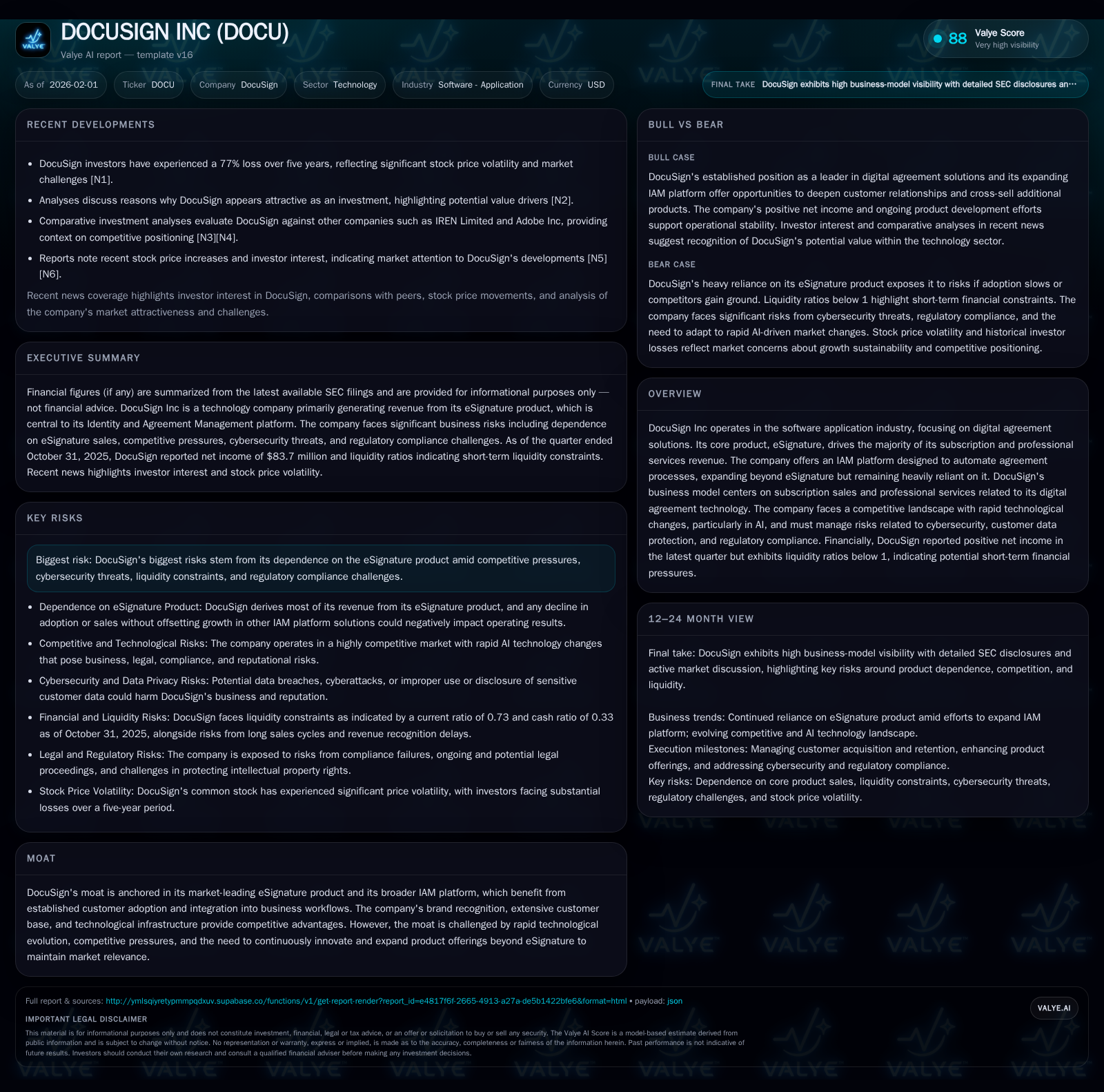
DocuSign’s strong legacy in digital agreements, particularly through eSignature, faces pivotal tests as the company seeks to expand its identity and agreement management (IAM) platform. While recent earnings showed profitability, liquidity below 1 signals short-term financial constraints that may temper growth investments. Concurrently, rapid advances in AI and intensifying competition introduce strategic challenges, compelling DocuSign to innovate beyond its flagship offering while managing cybersecurity and regulatory risks. This analysis unpacks these dynamics within broader industry context and evolving investor perspectives.
From eSignature Dominance to IAM Ambitions: Charting DocuSign’s Evolution
DocuSign built its reputation—and a significant customer base—on pioneering electronic signature technology, transforming paper-bound contract signing into a streamlined digital process. This flagship eSignature product still accounts for the lion’s share of subscription and professional services revenue [F1][S2]. Yet the company recognizes that resting solely on this legacy is untenable in a market rapidly evolving with new technological paradigms.
The transition towards an Identity and Agreement Management (IAM) platform reflects DocuSign’s broader ambition to automate the entire agreement lifecycle. This approach intends to integrate authentication, workflow orchestration, analytics, and compliance into one cohesive environment. However, this strategic pivot presents inherent challenges: adoption inertia among customers accustomed to standalone eSignature tools; competitive pressures from nimble startups and established tech giants expanding their own contract management suites; and the difficulty in demonstrating clear incremental value beyond well-entrenched workflows [S2].
The risk disclosures explicitly underscore concerns about IAM market acceptance and maintaining relevance against evolving customer needs [S2]. This duality—dependence on eSignature coupled with aspirations for IAM—forces a delicate balancing act. The evolution is not merely incremental product development but requires reshaping customer perceptions to embrace a more comprehensive agreement ecosystem.
How effectively DocuSign can leverage its existing footprint as a gateway into enhanced IAM services remains a fundamental question shaping its medium-term prospects.
Financial Snapshot: Navigating Profitability Amid Liquidity Constraints
In its latest quarterly filing, DocuSign reported a net income of approximately $83.7 million [F1], signaling operational profitability—a notable milestone given prior periods marked by heavier R&D investments and elevated expenses. On surface-level metrics, this indicates disciplined cost control and maturation of core revenue streams.
Yet juxtaposed against this profit figure is a more sobering liquidity picture: current assets stand at about $1.31 billion while current liabilities exceed $1.78 billion, resulting in a current ratio near 0.73 [F1]. A ratio below 1 typically indicates potential short-term financial stress, reflecting obligations outpacing readily convertible assets.
This tension between profitability and liquidity encapsulates critical operational trade-offs. Suboptimal liquidity could constrain DocuSign’s flexibility to invest aggressively in new product development or make strategic acquisitions vital for competing in an AI-driven environment. It may also impact working capital management amid elongated sales cycles common in enterprise software deals [S2].
Moreover, investor-facing messaging must reconcile this nuanced reality—positive bottom-line momentum tempered by balance sheet caution—so as to maintain confidence without overselling financial resilience.
Does this blend of profit gains yet liquidity pressure imply incremental tightening ahead or a recalibrated focus on cash flow optimization?
AI and Competitive Pressures: Opportunity or Threat?
The software landscape is witnessing an unprecedented surge in AI capabilities—tools that redefine productivity workflows through natural language understanding, automation, predictive analytics, among others [N1]. For incumbents like DocuSign entrenched in document-centric processes, this creates a double-edged sword.
On one hand, embedding AI features promises enhanced contract analysis speed, anomaly detection, intelligent routing, and even automated negotiation assistance—capabilities aligned with deeper IAM ambitions. On the other hand, falling behind rapidly advancing competitors who integrate cutting-edge AI risks eroding market share and relevance [N2][S2].
DocuSign’s risk disclosures highlight concerns around "the inability to anticipate or effectively respond to rapid changes in AI technology," emphasizing not only commercial threats but legal, compliance, and reputational ramifications stemming from flawed AI deployment or misuse [S2]. These multifaceted dimensions complicate straightforward integration strategies.
Industry reports illustrate market leaders becoming "AI victims" when transformation lags or execution misfires [N2]. For DocuSign, staying abreast demands substantial investment into internal AI competencies or partnerships with specialized innovators.
This scenario propels pressing strategic questions: Can DocuSign harness AI advantages swiftly enough to defend its moat? Or will disruptive forces relegate it from market leader toward commoditized status?
Cybersecurity and Data Protection: The Silent Battleground
As the guardian of sensitive contractual data spanning myriad industries, DocuSign operates under intense scrutiny regarding cybersecurity defenses. The stakes are high—not only possible financial repercussions from breaches or system downtimes but enduring damage to customer trust that underpins subscription renewals.
SEC filings explicitly call out risks related to "systems and security measures being compromised," highlighting threats from malicious actors seeking exploitation avenues within digital agreement platforms [S2]. Recent global escalation in cyberattacks targeting cloud-based SaaS companies further validate these concerns.
Moreover, any real or perceived mishandling of customer data—whether due to inadvertent leaks or deliberate insider actions—could derail business momentum amid tightening privacy regulations worldwide [S2]. Given the growing prevalence of ransomware attacks specifically targeting enterprise SaaS infrastructures, robust preemptive measures are non-negotiable.
Thus cybersecurity transcends IT operations; it functions as a strategic imperative directly linked to DocuSign’s brand integrity and client retention.
Are ongoing investments sufficient in building resilient defenses commensurate with emerging threat landscapes?
Investor Sentiment and Market Comparisons: Reading the Signals
DocuSign’s stock dynamics recently showed resilience: appreciation despite broader software sector softness captured multiple headlines [N3]. This relative upside was accompanied by heightened investor search activity indicative of renewed market attention [N7].
At the same time, analyses reveal an ambivalent consensus around valuation—some characterize DOCU as a top-ranked value stock with growth potential [N5][N12], whereas others spotlight losses sustained by long-term investors (cited at around 77% loss over five years) signaling caution [N8]. Comparisons with peers such as Adobe indicate competitive tension in evaluating best-in-class investment opportunities within contract management domains [N4][N9].
These diverging perspectives reflect underlying uncertainty about sustainability of current strategies amid an evolving tech frontier. The dichotomy embodies hopes pinned on successful pivoting versus skepticism over legacy reliance and missed growth inflection points.
This mixed investor narrative invites careful monitoring of guidance revisions, new product uptake metrics, and competitive maneuvers moving forward.
Risks and Regulatory Challenges: The Unseen Headwinds
Beyond technology execution risks lie complex regulatory frameworks that must be navigated meticulously. DocuSign faces intricate compliance demands across data privacy laws (e.g., GDPR), electronic transaction standards globally, intellectual property protections, as well as emerging regulations governing AI usage—a domain fraught with novel legal ambiguity [S2].
Furthermore, the company flags its long sales cycles as operational constraints delaying revenue recognition—a common feature in enterprise software but one that heightens forecasting difficulty amid volatile markets [S2]. Talent acquisition and retention also emerge as notable vulnerabilities given competitive labor markets for tech skills necessary to sustain innovation pipelines.
These multidimensional headwinds collectively shape an environment where disciplined governance is key to avoiding costly missteps or litigation that could undermine operational continuity.
Will scaling compliance frameworks keep pace with product complexity escalating from AI integration?
Looking Forward: Innovation, Partnerships, and Market Adaptation
Looking ahead requires parsing how DocuSign can successfully translate strategy into sustained advantage. Its extensive installed base offers fertile ground for upselling IAM capabilities if execution achieves seamless integration enhancing user experience without disruption [F1][S2].
Strategic partnerships represent another lever—in blending complementary technologies across identity verification providers or AI specialists—to accelerate go-to-market velocity while mitigating internal resource limitations [S2]. Continuously refreshing innovation beyond eSignature is indispensable not just for differentiation but addressing shifting buyer priorities in hybrid work settings where automation drives efficiency mandates.
Financial discipline balancing liquidity management alongside investment appetite will profoundly influence capacity to execute transformative initiatives amidst economic uncertainty.
Ultimately, reconciling these elements determines whether DocuSign broadens its moat or gradually concedes ground within increasingly congested digital agreement ecosystems.
Disclaimer: This analysis is for informational purposes only. It does not constitute investment advice or recommendations.
Disclaimer: This is research-only, informational analysis and not investment advice. It may include AI-generated interpretation and general industry context. Always verify important details using primary sources.

Comments