
Destination XL Group’s Strategic Turnaround with Inclusive Apparel Merger
DXLG addresses sector softness with cost controls and inventory discipline while pursuing a merger to scale its inclusive apparel market position.
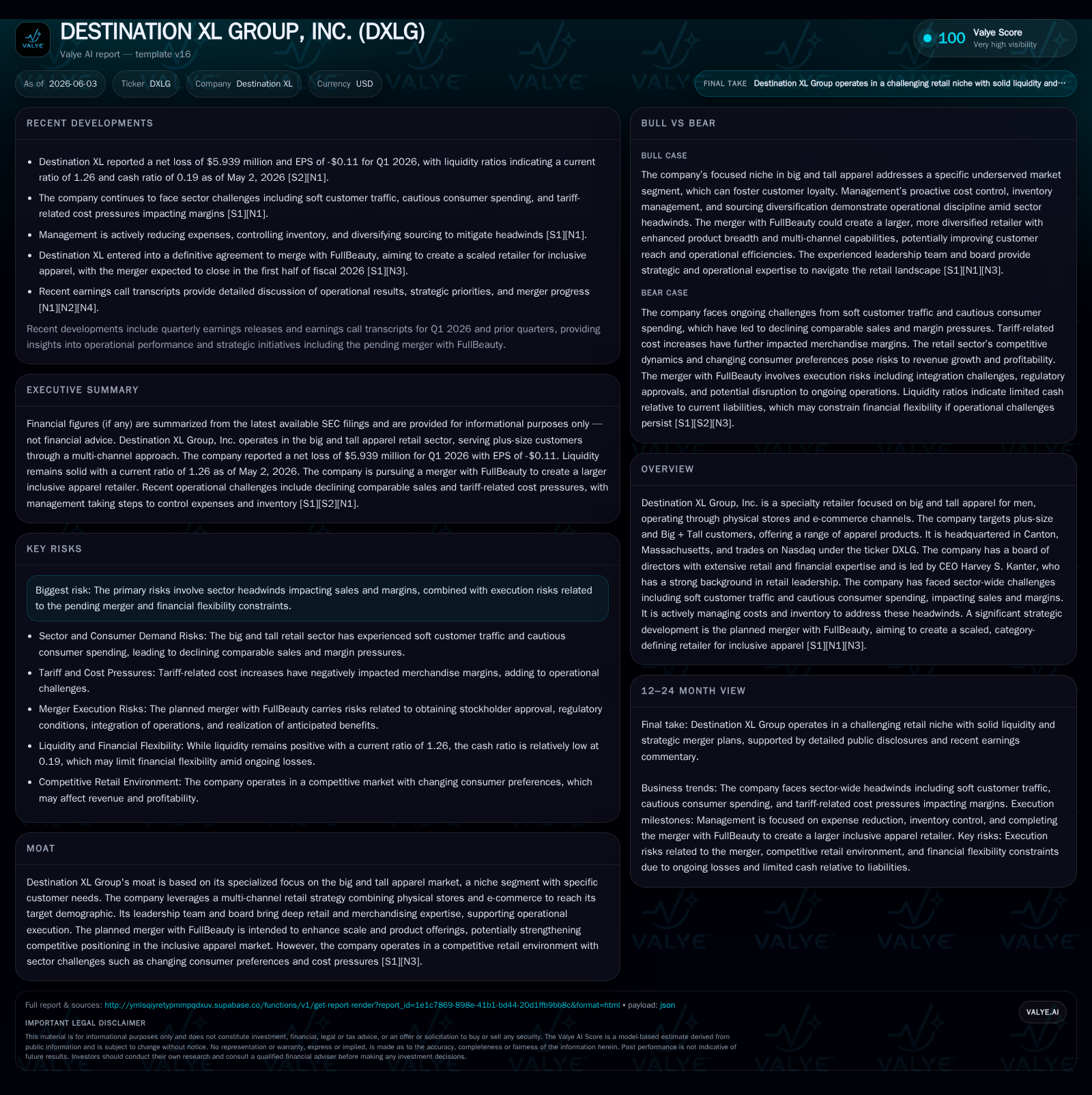
In its latest Q1 2026 report, Destination XL Group (DXLG) continued to face challenging retail headwinds marked by soft comparable store sales and cautious consumer spending impacting its margins. The company is actively managing these pressures through rigorous cost control and tighter inventory management. The most consequential strategic development is the pending merger with FullBeauty, aimed at creating a scaled, category-defining retailer focused on big & tall and plus-size apparel across multiple channels and genders. While the merger offers potential for operational synergies and improved competitive positioning, DXLG remains exposed to execution risks and liquidity constraints amid ongoing sector difficulties.
Latest Operating Results and Strategic Developments
Destination XL Group's first quarter fiscal 2026 results, disclosed in its June 3, 2026 Form 10-Q filing [S2], underscore ongoing sectorwide challenges facing the big & tall apparel niche. Comparable store sales trends remain soft reflecting subdued customer traffic as consumers prioritize essentials amid cautious discretionary spending. Fiscal year 2025 ended with an approximate 8.4% drop in comparable sales, driven by fewer transactions rather than significantly lower spend per visit [S1]. These demand pressures coincided with tariff-induced merchandise cost inflation in the back half of last year that compressed gross margins despite proactive expense containment efforts.
The company continues rigorous inventory management aiming to reduce excess stock that would otherwise drive markdown cadence—critical in specialty apparel segments where fit-specific SKUs can become obsolete quickly if unsold. Destination XL emphasizes cost discipline including controlled SG&A spend aligned with volume realities [N1], recognizing that fixed retail infrastructure demands prudent overhead governance. Although there were no material changes in risk factors reported this quarter [S25], a key highlight is the ongoing momentum towards completing the transformative merger with FullBeauty (FBB), first announced late 2025 [S3][S4]. Management projects closing this merger in the first half of fiscal 2026, positing it as a pivotal inflection for scaling an inclusive apparel platform.
Business Model and Customer Value Proposition
At its core, Destination XL operates a specialty retail model focused exclusively on men’s big & tall apparel—an underserved demographic segment requiring unique size assortments not adequately addressed by mainstream retailers. This specialization translates into a tailored product mix spanning casual wear, outerwear, formal attire, and complementary accessories designed specifically for plus-size physiques. Such product differentiation establishes meaningful switching costs for customers accustomed to limited fit alternatives elsewhere.
The company sells through a multi-channel approach combining physical retail stores—offering personalized sizing assistance—with an e-commerce platform catering to broader geographic reach. This omnichannel balance reflects evolving customer preferences for convenience without sacrificing fit confidence essential to big & tall shoppers [S1]. Revenue mechanics depend on sustaining assortment breadth across sizes at varying price points while efficiently managing inventory turns to minimize markdown-driven margin erosion.
Competitive Environment and Industry Nuances
Destination XL faces competition from both niche inclusive apparel brands (for example, FullBeauty’s portfolio) as well as general apparel retailers increasingly broadening plus-size offerings. However, DXLG's concentrated expertise in big & tall men’s clothing provides a moat segment-wise but presents scale limitations versus larger peers who leverage global sourcing networks for cost advantages.
Sector dynamics continue to challenge pricing power due to persistent cost inflation—the tail-end impact of tariffs referenced in FY25 filings—and mixed consumer sentiment curtailing full-price sell-through rates. Comparable store sales softness affects traffic more than ticket size, putting emphasis on stimulating footfall or digital visits without excessive discounting that erodes margins [N1][S1]. Inventory management efficiency directly influences markdown cadence; slower turns compel deeper discounts which are difficult to recoup later due to highly fragmentary sizes.
Key Growth Drivers from Merger and Market Trends
The pending merger with FullBeauty Holdings I aims to redefine DXLG’s trajectory by creating a scaled specialty retailer serving expanded inclusive apparel markets encompassing both plus-size men and women. The strategic rationale hinges on complementing DXLG’s big & tall men’s focus with FBB's extensive women’s offerings plus enhanced omnichannel capabilities [S4][S6]. This combination targets diversified revenue streams across gender segments while increasing product assortment breadth.
Operationally, scale benefits include potential supply-chain optimization enabling better vendor terms—a critical factor given DXLG’s prior sourcing cost pressures—and streamlined fulfillment networks enhancing e-commerce efficiency. Additionally, cross-brand marketing initiatives intend to create customer acquisition synergies within the plus-size demographic increasingly seeking affinity brands offering style variety.
Risks, Execution Challenges, and Operational Constraints
Despite these strategic advantages, risks remain salient. Execution risk encompasses integration complexities—from aligning IT systems and supply chains to harmonizing corporate culture—which could delay synergy realization or inflate costs beyond initial expectations [S6]. Regulatory approvals including DXL shareholder votes present gating events; delays or adverse outcomes would materially disrupt planned benefits.
Foundation liquidity metrics reveal moderate financial flexibility: as of May 2026, cash stands at approximately $11 million against current liabilities near $86.6 million yielding a current ratio of about 1.26 [F1][S2]. While not indicative of distress outright, constrained net working capital could limit maneuverability if macroeconomic weakness persists longer-term. Persistent operating losses (operating income was negative $18 million at FY end Jan-31-26) further pressurize balance sheet strength absent quick turnaround [F1].
Upcoming Catalysts and Milestones to Monitor
Investors should monitor several near-term developments as barometers for operational health post-merger announcement: timely completion of the merger transaction within first half fiscal 2026 remains critical [N1][S3]; subsequent quarterly guidance updates will reveal whether demand recovery gains traction amid macro uncertainty; observable improvements in merchandise margin stability or inventory turnover efficiency would signal successful operational adjustments; finally, progress integrating multi-channel retail capabilities—physical store enhancements combined with e-commerce scalability—will be pivotal for long-run growth trajectory.
Financial Context Supporting Operational Outlook
As of May 2026 quarter-end, Destination XL exhibits liquidity consistent with cautious sector norms: cash availability was roughly $11 million supported by current assets totaling approximately $109 million versus current liabilities near $86.6 million resulting in a current ratio around 1.26 [F1][S2]. Operating income remains negative highlighting substantial profitability challenges tied primarily to margin compression from cost inflation and reduced volume levels last fiscal year ending January 31, 2026 (-$18 million operating loss). No recent disclosures indicate material refinancing or debt restructuring activity, suggesting leverage exposure remains stable [F1].
This analysis is based solely on information extracted from Destination XL Group's recent SEC filings including the Q1 2026 Form 10-Q (June 3), related Form 8-K releases concerning merger developments, annual amended Form 10-K content as of May 26, 2026, supplemented by publicly available transcripts from earnings calls. All insights reflect reported company data without speculative extrapolation beyond cited evidence. No investment research views are offered or implied.
Disclaimer: This is research-only, informational analysis and not investment advice. It may include AI-generated interpretation and general industry context. Always verify important details using primary sources.

Comments