
Ebang International Charts Sector Expansion Through Fintech and Renewable Energy Synergies
The latest quarterly filing underscores Ebang's operational steadiness and liquidity amid strategic diversification across technology-driven sectors.
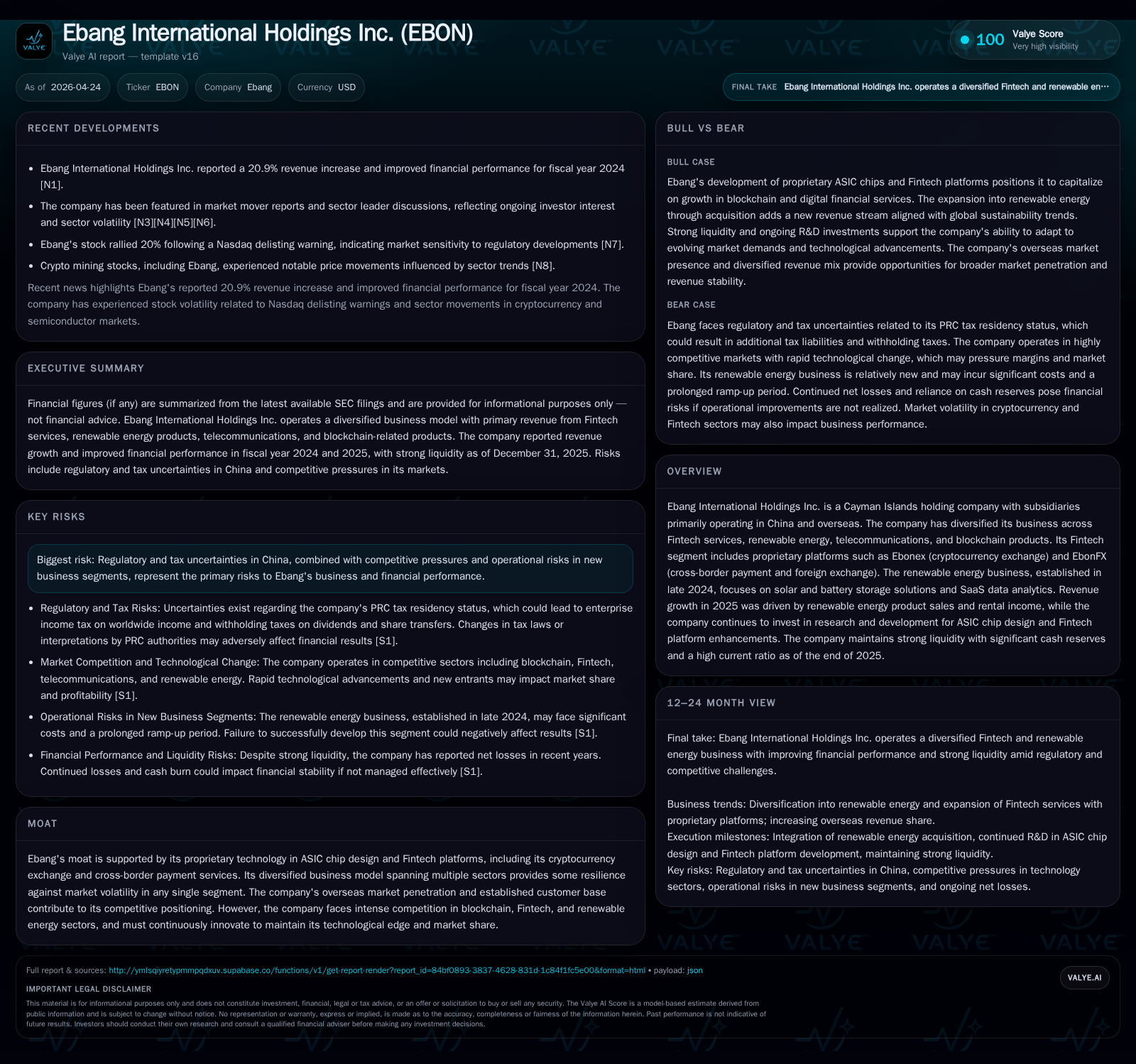
Ebang International’s 2025 results reflect a pivotal shift towards renewable energy and Fintech, balancing legacy ASIC chip design with new growth vectors. The company’s sturdy liquidity position underpins ongoing R&D investments despite persistent operating losses. Its proprietary ASIC technology and multi-sector approach offer competitive advantages but require sustained innovation to counter fierce market competition and regulatory risks. Monitoring upcoming product milestones and platform adoption will be key to assessing future growth execution.
Latest Quarterly Update Flags Operational Stability and Liquidity Strength
Ebang’s latest quarterly interim report filed on April 24, 2026 ([S2]) reiterates the company’s operational stability with no material deviations or adverse events disclosed. The filing confirms the company’s continuation as a foreign private issuer filing Form 20-F annually. Of particular note is the firm’s liquidity position supported by its balance sheet snapshot as of December 31, 2025, which shows cash and equivalents of approximately $200 million and a current ratio of 27.31 ([F1]). This sizable liquidity cushion is vital for Ebang as it navigates capital-intensive sectors such as ASIC chip manufacturing, Fintech platform development, and renewable energy deployment.
Such liquidity strength provides flexibility for sustained investments in research & development (R&D) while managing market volatility in operating segments. No current debt obligations impose immediate risk ([F1]). These factors set an immediate context of resilience underpinning Ebang’s expanding multi-sector strategy.
Ebang’s Diversified Business Model: Integrating ASIC Chip Design, Fintech Platforms, and Renewables
Ebang International operates primarily through subsidiaries based in China with a growing footprint overseas. According to its annual Form 20-F filed simultaneously ([S1]), the company has evolved from a legacy Bitcoin mining hardware manufacturer into a diversified technology conglomerate. Its core business lines include:
ASIC Chip Design & Blockchain Products: Proprietary chips designed using advanced process technologies (notably achieving 5nm optimization) underpin hardware for cryptocurrency mining. However, sales of Bitcoin mining machines represented zero revenues by end-2025 ([S20]), indicating a strategic pivot away from this historically volatile segment.
Fintech Platforms: Ebang developed two proprietary platforms—
Ebonex, a cryptocurrency exchange focusing on secure multi-currency trading; andEbonFX, launched in 2022 to address cross-border payments and foreign exchange services ([S4], [S11]). These platforms contribute the majority of revenue via service fees but face margin pressure due to FX market volatility affecting spreads ([S11]).Renewable Energy Business: Established through acquisition in late 2024 in Australia ([S1], [S9]), this segment offers solar panels, battery storage products, and SaaS-based data visualization and analytics solutions dedicated to energy monitoring. The renewable division accounted for about 8.6% of total revenue in 2025 ([S9]) amid fast sector growth projected at over 17% CAGR globally ([S1]).
Other Services: Includes rental income from property management as well as telecommunications product sales that have diminished over time ([S9]).
Collectively, these segments reflect Ebang’s deliberate diversification strategy aimed at creating operational synergies across semiconductor tech, financial services digitization, and sustainable energy. The integration allows cross-pollination of R&D innovations—especially leveraging ASIC design expertise—for emerging industry needs.
Competitive Landscape: Proprietary Technology versus Intensifying Market Competition
Ebang’s moat primarily derives from its internally developed ASIC chips leveraging cutting-edge semiconductor processes like the shift from legacy 7-8nm to optimized 5nm nodes ([S21]). Maintaining this technological edge is crucial given competitors’ similar pursuits toward efficiency gains in mining chip designs or financial platform innovations.
The Fintech sector competitiveness is acute with global players ranging from large incumbents adapting digital transformation strategies to specialized startups capturing niche cross-border payment flows ([S1]). Pricing pressure is evident within FX spreads and transaction volumes reflecting macroeconomic currency fluctuations ([S11]).
In renewable energy products and SaaS analytics space ([S9], [S1]), while demand accelerates rapidly worldwide, industry incumbents benefit from scale economies reducing unit costs—a challenge for Ebang’s relatively nascent operations requiring ongoing capex for production capacity expansion ([S8], [S12]).
Further complicating competition is intensified investment in R&D required not just for product iteration but also compliance with evolving regulations across multiple jurisdictions where Ebang operates ([S7], [S19]). This continuous innovation imperative raises fixed costs but is indispensable for sustaining relevance as newer entrants emerge.
Growth Catalysts: Renewable Energy Expansion and Fintech Market Penetration
The global Fintech market outlook remains robust with forecasted growth from $357 billion in 2025 to nearly $687 billion by 2030—aligned with digital finance adoption trends ([S1]). Ebang’s dual-platform approach taps into rising demand for cryptocurrency trading services alongside cross-border payment facilitation anchored by regional footholds.
Renewables represent an even faster growth vector; the solar plus battery storage solutions align strategically with increasing government mandates on carbon reduction coupled with expanding ESG compliance needs driving demand for related SaaS analytics tools ([S1], [S9], [S11]). This segment offers not only direct revenue via hardware sales but also recurring income potential via data service contracts.
Moreover, rental income derived from property management supplements the sustainability of cash flows while providing operational diversification ([S20]). Importantly, synergy exists between Ebang’s technology infrastructure capabilities across segments—e.g., data analytics expertise supporting both renewable energy management platforms and Fintech risk analysis tools—which could enhance long-term customer retention.
Risks and Constraints: Regulatory Landscape, Inflation Impacts, and Technological Investment Requirements
Operational risks are anchored foremost in regulatory uncertainty within China—where core subsidiaries reside—as well as increasingly complex compliance across Australia, Hong Kong, U.S., and other markets targeted by expansions ([S6], [S7], [S19]). Tax disputes or licensing delays could impair market access or increase costs unpredictably.
Inflationary pressures notably impact overseas personnel recruitment expenses and raw material procurement costs particularly for renewable energy components sourced internationally ([S1], [S14]). Unless cost increases can be effectively passed through pricing adjustments to customers—which itself faces sensitivity amid competitive pricing—profitability risks escalate.
Substantial up-front capital expenditures associated with ASIC chip fabrication using new process technologies introduce operational leverage risks; high initial setup unit costs must be offset by volume uptake for profitable scaling ([S21], [S8]). Extended ramp-up periods remain plausible especially given Ebang’s relatively recent entry into renewables requiring customer acquisition among utilities or commercial clients ( [S1]).
Key Upcoming Milestones to Monitor and Executive Guidance
Critical future progress indicators include advancing releases of next-generation ASIC chips following the reported success on proprietary designs at the 5nm node targeting non-Bitcoin cryptocurrencies like Litecoin ([S21]). Incremental updates on mining machine performance coupled with customer acceptance metrics will signal whether technology leadership sustains.
In Fintech platforms Ebonex and EbonFX, monitoring trading volume trends amid global FX volatility will provide insight into resilience or contraction of core revenue streams ([S11]). Adoption rates within cross-border payments especially will reveal competitive traction.
Scaling solar panel installations alongside expansion of SaaS contract subscriptions for energy data analytics represent key growth markers within renewables—and their timing may materially affect near-term revenue trajectory given this segment is nascent but rapidly expanding since late-2024 inception ([S9], [S1]).
Management commentary embedded within MD&A points to prioritization of R&D investments balanced against cost control initiatives suggesting ongoing emphasis on iterative innovation while optimizing operational efficiency ([S8], [S2]). Tracking capital expenditure pacing relative to planned capacity additions will illuminate execution progress.
Financial Profile: Supporting Evidence of Capital Structure, Cash Reserves, and Performance Trends
Historical performance (annual)
|
| FY | Rev ($mm) | Net ($mm) | CFO ($mm) | OpInc ($mm) | Rev YoY | Net YoY |
|---|---|---|---|---|---|---|
| 2025 | 7 | -14 | -9 | -25 | +11.4% | +30.4% |
| 2024 | 6 | -20 | -18 | -30 | +20.9% | +44.9% |
| 2023 | 5 | -37 | -12 | -54 | -85.0% | +19.6% |
| 2022 | 32 | -46 | 4 | -48 |
Source: SEC companyfacts cache [F1].
Capital returns and efficiency (annual)
|
| FY | FCF ($mm) | ROE% |
|---|---|---|
| 2025 | -14 | -5.8 |
| 2024 | -18 | -7.8 |
| 2023 | -13 | -13.1 |
| 2022 | -14.2 |
Source: SEC companyfacts cache [F1].
Financially, Ebang reported revenue growth of approximately +11.4% year-over-year reaching around $6.54 million for fiscal year ended December 31, 2025 ([F1]), bolstered chiefly by renewable energy product sales coupled with rental incomes replacing declining Bitcoin mining hardware sales.
Despite top-line growth sustainability challenges remain evident as operating income persists negative at roughly -$25.3 million albeit improving from prior year loss levels (-16.7% YoY improvement) reflecting expenditures tied to R&D ($4+ million capex) plus general administrative expenses focused on geographic expansion ( [F1], [S8], [S12]). Net loss narrowed significantly to -$14.1 million (-30% YoY), demonstrating some operating leverage gains but highlighting ongoing profitability hurdles necessitating close scrutiny on margin drivers.[F1]
Operating cash flow remained negative (-$9 million), compounded by capex outlays totaling roughly $4.5 million in 2025 exceeding prior years markedly (+1915.7% YoY), consistent with intensifying investment phases across ASIC manufacturing upgrades and new business verticals such as renewables ([F1], [S12]). Equity stands solid at approximately $244 million supporting liquidity headroom without reliance on external debt financing given nominal debt levels reported last at ~$5.75 million (end-2022) implying low financial leverage risk ( [F1], [S3]).
In summary, Ebang sustains substantial liquidity enabling strategic investments while navigating incremental improvements toward breaking operational breakeven milestones hinging on successful diversification execution across sectors.
Disclaimer: This is research-only, informational analysis and not investment advice. It may include AI-generated interpretation and general industry context. Always verify important details using primary sources.

Comments