
FMX Navigates Inflation, Currency Volatility, and Regulatory Challenges with Diversified Growth Strategy
Latest quarterly disclosures highlight operational resilience amid macroeconomic headwinds and strategic investments across core divisions.
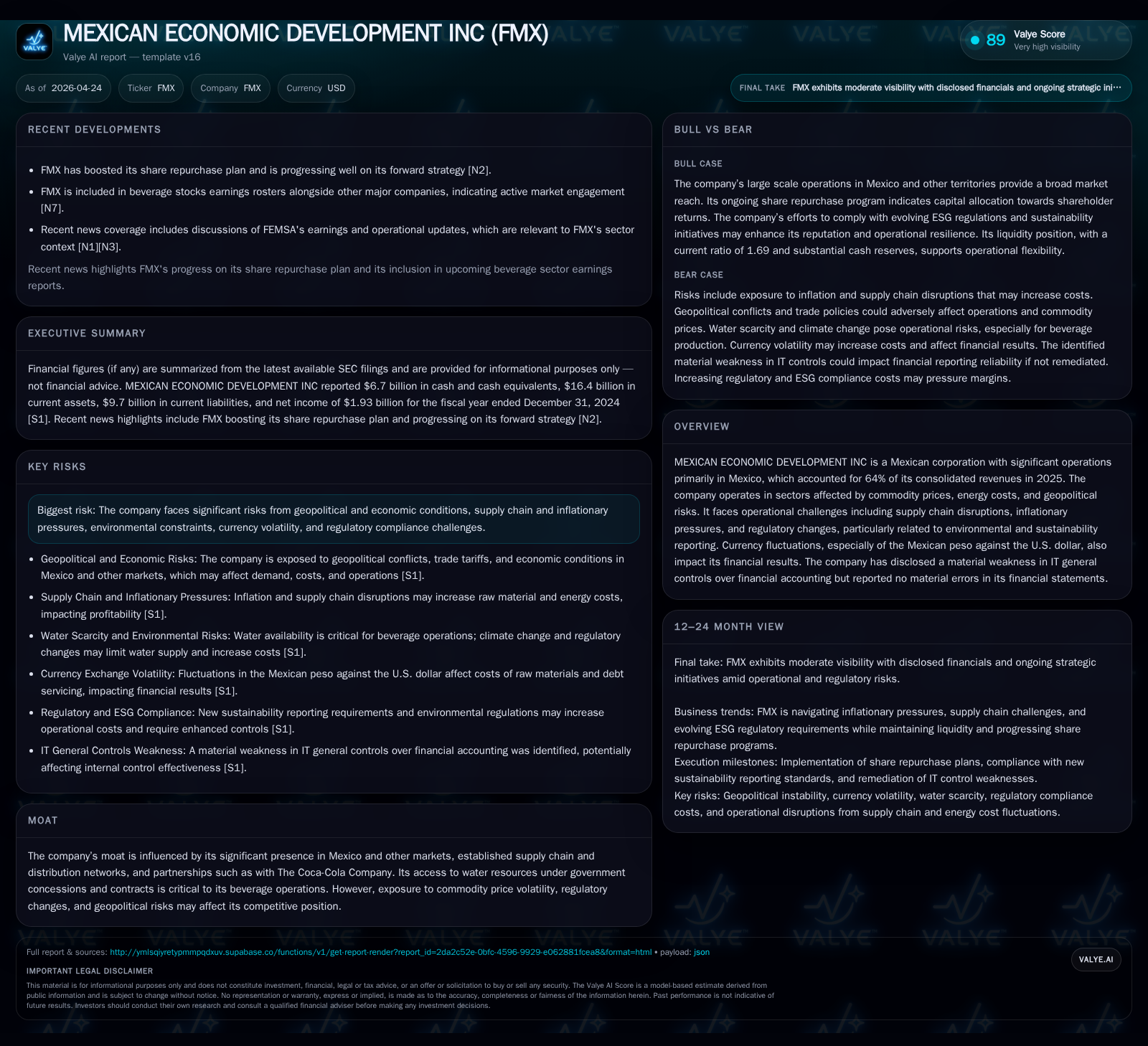
Mexican Economic Development Inc (FMX) reported its latest quarterly results showing continued revenue growth despite inflationary pressures and currency swings. Its diversified business model spans beverage bottling, convenience retail (OXXO stores), health services, and fuel retailing, with Mexico representing about 64% of revenues. The company manages risks from commodity volatility, geopolitical uncertainties, and regulatory shifts through capital expenditures targeting new store openings, capacity expansion, and IT modernization. Its competitive position benefits from strong brand partnerships such as Coca-Cola FEMSA and a widespread retail footprint in Latin America and the U.S. Going forward, FMX’s growth will hinge on execution of capex plans, expansion in e-commerce and digital platforms, and navigating evolving environmental regulations.
Recent Operating Update: Quarterly Filings Anchor Current Performance
FMX’s most recent Form 6-K filings dated April 24, 2026 [S2] and March 27, 2026 [S3] confirm continued momentum across the company’s primary business units. The latest disclosures portray steady progress in expanding its retail network—highlighting a net addition of more than 1,100 OXXO convenience stores in Mexico, Colombia, Chile, Peru, and the U.S. during 2025. This broad footprint now includes approximately 24,297 stores in Mexico alone. These openings are a direct driver of rising revenues in the Proximity Americas Division.
Capital expenditures remain robust with an approved budget of approximately Ps. 49.9 billion (US$2.6 billion) for fiscal 2026 [S1], which is strategically allocated among Coca-Cola FEMSA's capacity enhancements (7–7.5% of its revenues), Proximity Americas’ store openings and refurbishments (~Ps.17 billion), IT system updates including ERP software refreshes, as well as health division expansions primarily focused on new pharmacy locations and infrastructure.
Notably, FMX faces persistent challenges including inflationary pressures on commodity inputs—particularly for beverage production—and currency volatility affecting costs due to dollar-denominated raw materials purchases [S18]. The Mexican peso experienced significant fluctuations against the U.S. dollar during late 2024 through 2025 (ranging between Ps.17.91 - Ps.20.94 per USD) [S1], influencing cost structures and debt valuations.
The company also disclosed a material weakness related to IT general controls in financial accounting systems but reported no material misstatements [S1]. This signals ongoing internal control improvements alongside operational scale-up.
Business Model: Diversification Across Consumer-Facing Sectors
At its core, FMX generates revenue through four main divisions: beverage bottling (Coca-Cola FEMSA), small-format convenience retail (Proximity Americas and Europe Divisions featuring OXXO stores), health services via pharmacy operations across several Latin American countries, and fuel retailing predominantly in Mexico.
Beverage Bottling
Coca-Cola FEMSA is FMX’s flagship segment with a dominant market position bolstered by exclusive distribution rights for Coca-Cola products across multiple territories [S18]. Its business model leverages entrenched supply chains supported by ownership or concessions for critical resources such as water—essential for beverage manufacturing—and extensive cold chain logistics involving coolers at retailer points-of-sale.
Pricing power is subject to commodity cost inputs (sugar, PET plastics) and operating leverage dynamics arise as fixed production capacities achieve higher utilization rates enhancing gross margins [S7]. Nonetheless, regulatory risks tied to environmental sustainability reports and water resource management pose medium-term operational constraints.
Small-Format Retail (OXXO Network)
The Proximity Americas Division operates the largest small-format store network in Latin America by store count [S23]. Its differentiated proposition rests on rapid profitable expansion into underserved markets coupled with proprietary data-driven location analytics that tailor product mix discovery to local microeconomics.
Customer retention is driven by strong private labels offering value-conscious alternatives alongside branded products; omnichannel advancements include digital sales platforms enriching user engagement [S10]. Despite low per-store margins characteristic of convenience retailing sectors [S7], operating leverage improves with scale growth delivering incremental profitability gains.
The recent U.S. market acquisition through Delek US Holdings marked a strategic international diversification extending reach into Texas — positioning FMX to tap cross-border consumer demand dynamics [S17].
Health Services
The Health Division comprises thousands of pharmacy points in Mexico, Chile, Ecuador and Colombia exhibiting seasonal demand spikes coinciding with cold/flu seasons plus holiday-driven beauty product sales increases [S8]. Its operating model entails real estate expansion combined with ERP infrastructure upgrades enhancing supply chain reliability and customer service quality.
Fuel Retailing
With over 552 service stations concentrated mainly in northern Mexico [S11], the Fuel Division integrates fuel product sales with adjacent OXXO convenience offerings creating a synergistic customer value proposition designed to increase foot traffic and optimize per-customer spend.
Competitive pressures stem from fragmented regional station players under PEMEX branding alongside growing international entrants like British Petroleum operating dealer networks within Mexico. Revenue management adaptations focus on pricing agility amidst volatile global fuel prices while leveraging institutional sales channels for volume stability.
Industry Structure & Competitive Position
FMX operates predominantly within markets influenced heavily by macroeconomic variables such as commodity prices (energy inputs for fuel; raw materials for beverages), inflation trends impacting consumer purchasing power, geopolitical tensions affecting supply chains (notably Russia-Ukraine conflict ripple effects) plus regulatory developments prioritizing environmental sustainability standards.
Its competitive moat stems from:
- Deep-rooted market presence especially in Mexico contributing nearly two-thirds of consolidated revenues [S21]
- Exclusive partnerships particularly the Coca-Cola bottling franchise enabling access to world-class brands coupled with robust route-to-market infrastructure including owned truck fleets plus third-party distributors tailored regionally [S19]
- Extensive multi-channel retail networks providing high consumer contact frequency supporting both branded products sales and proprietary private-label offerings [S23]
- Geographic diversification into key emerging Latin American markets complemented recently by selective U.S. acquisitions broadening growth runway beyond core Mexican economy dependencies [N3]
- Capital intensive operations exhibiting operating leverage effects allowing margin expansion when volumes rise via fixed cost absorption efficiencies across production plants and distribution infrastructures [S7]
However, risks remain important: exposure to FX volatility given USD-pegged debts and input costs; regulatory uncertainties over water concessions critical to beverage operations; labor market constraints; plus competition intensifying especially within fuel retail where small regional chains counterbalance larger international players [S29].
Growth Drivers & Constraints
Drivers:
- Strategic Capital Expenditure: Budget nearly Ps.50 billion emphasizes technology-enabled process improvements (ERP modernization), network expansion (new stores/service stations), asset upgrading fueling operational scalability [S1].
- Digital Transformation: Adoption of AI-powered commercial platforms like Juntos+ enhances salesforce effectiveness increasing customer loyalty while enabling dynamic pricing strategies responding faster to competitive pressures [S15].
- Geographic Expansion: Executing acquisitions like Delek boosts footprint into higher-income U.S markets diversifying revenue exposure away from solely Latin American economies vulnerable to cyclical slowdowns [N3].
- Product Portfolio Enhancement: Accelerating non-carbonated beverages growth along with value-brand extensions caters to evolving consumer preferences toward healthier options plus economic-tier product shifts amid inflationary backdrop [S15].
- Cross-Divisional Synergies: Integrating fuel retail with adjacent OXXO convenience stores builds resilient ecosystem capturing varied consumer needs under one brand experience increasing average spend per visitor while optimizing fixed asset utilization levels [S11].
Constraints:
- Macroeconomic Cyclicality: Mexican GDP growth remains modest (~0.7% annualized) with spillover effects from U.S economic conditions dictating consumer discretionary spend patterns impacting store traffic volumes [S21].
- Currency Volatility: Peso depreciations versus USD spike input costs due to dollar-denominated raw materials procured globally; conversely currency appreciations reduce reported debt burdens but create earnings translation complexities [S13].
- Regulatory & Environmental Factors: Increasing scrutiny around sustainable water usage threatens continuity of existing concessions essential for the beverage bottling segment potentially curbing output expansions or requiring costly mitigants [S18][S29].
- Competition Intensity: Highly fragmented fuel retail sector along with emergent local rivals in proximity retail challenge calls for continual investment into differentiation via pricing agility plus customer experience innovation reducing margin compression risks [S11].
- Operational Risks: Supply chain disruptions caused by inflationary environments constrain inventory availability forcing tactical product substitutions or promotions risking brand loyalty dilution at downstream retailer levels [S18].
- IT Control Weaknesses: Reported material weakness related to IT general controls necessitates ongoing remediation efforts limiting short-term agility albeit aimed at longer-term process robustness gains [S1].
What To Watch Next: Milestones And Execution Triggers
Key upcoming milestones include:
- Monitoring Q2 through Q4 2026 earnings releases focusing on organic same-store sales trends within Proximity Americas emphasizing digital sales channel contributions as test cases evolve.
- Capex deployment cadence versus targets assessing new store/satellite locations rollout velocity balanced against refurbishment completions across core regions using granular unit-level productivity metrics.
- Updates on environmental compliance progress tied to water concession renewals particularly in water-stressed territories or those facing climate-change-exacerbated scarcity impacting Coca-Cola FEMSA operations.
- Debt servicing patterns aligned with currency movement trends indicating if hedging strategies mitigate impact of peso-dollar swings effectively maintaining stable interest expense profiles.
- Progress monitoring on integration effects following recent acquisitions notably Delek U.S convenience network integration reflecting synergy realization or operational challenges delaying return thresholds.
- Regulatory landscape developments concerning tax reforms or legal contingencies that may adjust effective tax rates or raise provisions altering net income projections materially.
Financial Profile & Supporting Context
Historical performance (annual)
|
| FY | Net ($bn) | Net YoY |
|---|---|---|
| 2024 | 1.9 | -57.5% |
| 2023 | 4.5 | +154.3% |
| 2022 | 1.8 | -2.8% |
| 2021 | 1.8 |
Source: SEC companyfacts cache [F1].
Capital returns and efficiency (annual)
|
| FY | Div ($bn) | ROE% |
|---|---|---|
| 2024 | 31.8 | 10.6 |
| 2023 | 18.8 | 20.3 |
| 2022 | 17.5 | 10.3 |
| 2021 | 13.4 | 11.2 |
Source: SEC companyfacts cache [F1].
Leveraging data from the most recent annual disclosures ending December 31, 2024 ([F1]) combined with year-end balances:
|
| FY | Revenue (USD bn) | Net Income (USD bn) | Cash & Equiv (USD bn) | Current Ratio | Dividends Paid (MXN bn) | Rev YoY % | Net Income YoY % |
|---|---|---|---|---|---|---|---|
| 2024 | 26.87 | 1.93 | 6.71 | 1.69 | 31.79 | 12.3 | -57.5 |
| 2023 | 23.92 | 4.54 | NA | NA | 18.80 | NA | NA |
The large drop in net income percentage year-over-year highlights margin compression pressures likely linked to cost inflation spikes plus increased investments aligning with long-term growth initiatives noted above.
At December 31, 2025 cash equivalents stood broadly stable relative prior year despite increased capex spending reflecting healthy operating cash generation exceeding Ps.124 billion before working capital changes supporting daily operations funding requirements smoothly ([S1],[F1]). Additionally, weighted average cost of borrowing approximated ~7% post swaps illustrating competitive financing conditions preserved through favorable intercompany lending structures navigating complex multinational debt portfolios ([S12]). FMX maintains full compliance across all credit covenants indicating sound risk management governance practices ([S9]).
Disclaimer
This report is an analytical summary intended for informational purposes only without providing investment recommendations or advice regarding securities transactions.
Disclaimer: This is research-only, informational analysis and not investment advice. It may include AI-generated interpretation and general industry context. Always verify important details using primary sources.

Comments