
First Industrial Realty Trust Boosts Financial Flexibility with New Unsecured Term Loans
Q1 2026 results showcase robust operational performance underpinned by enhanced liquidity and capital structure.
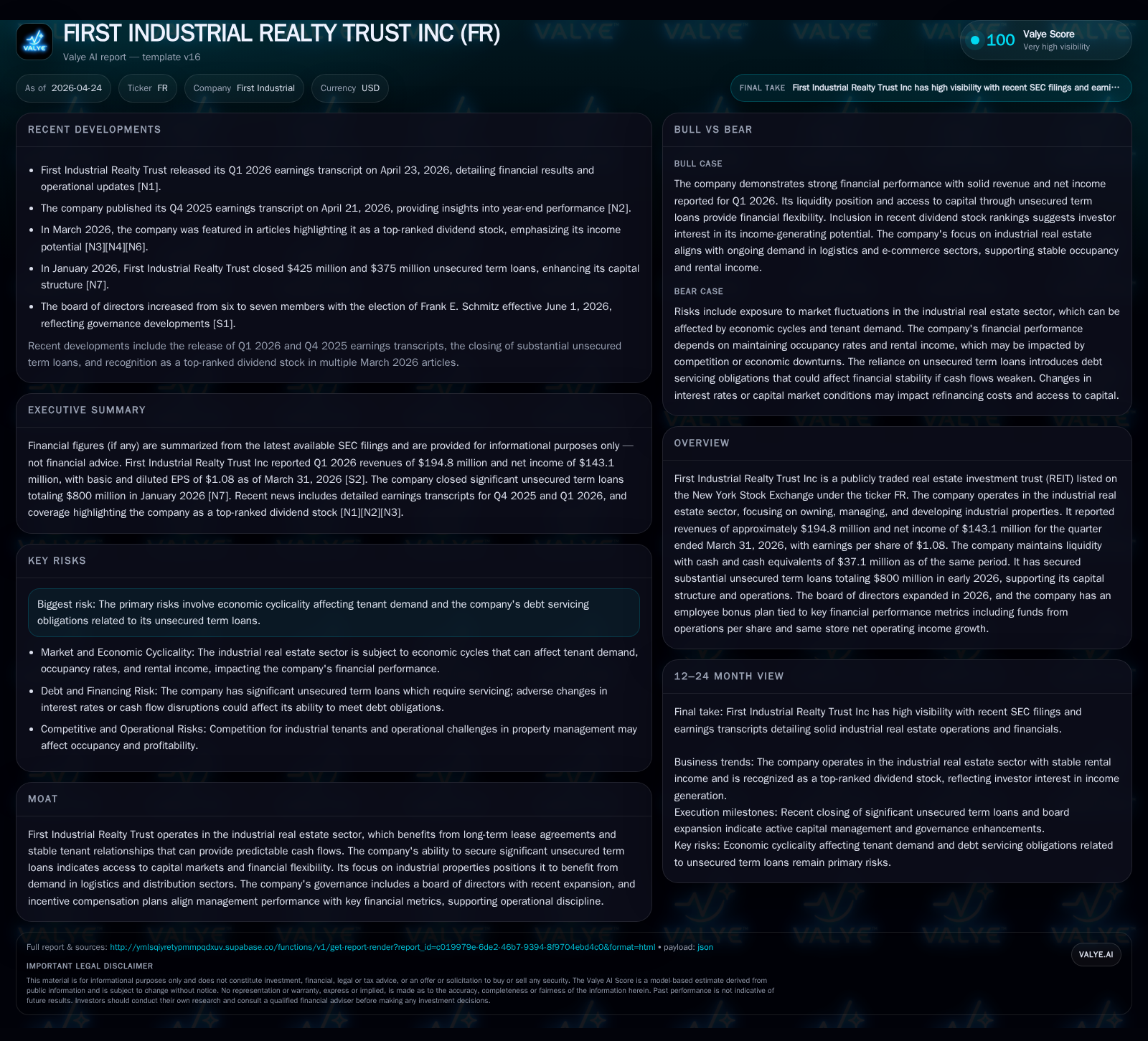
First Industrial Realty Trust reported solid first-quarter results with revenues of approximately $194.8 million and net income of $143.1 million, supported by stable industrial leasing fundamentals. The company’s recent arrangement of $800 million in unsecured term loans significantly bolsters its financial flexibility, positioning it well for growth amid sustained demand in logistics real estate. While economic cyclicality and tenant renewal risks persist, management alignment through bonus plans tied to key operating metrics highlights disciplined execution.
Latest Quarterly Operating Update and Its Strategic Implications
In the quarter ended March 31, 2026, First Industrial Realty Trust (FR) generated $194.8 million in revenues alongside a net income tally of approximately $143.1 million, reporting earnings per share of $1.08 [S2][F1]. These figures reflect a business sustaining steady demand for its industrial properties despite prevailing economic uncertainties.
Crucially, the company reinforced its capital structure by securing $800 million in unsecured term loans earlier in the year [S2][S3]. This material infusion of debt capital—unencumbered by specific asset collateral—provides First Industrial with significant financial flexibility to fund development projects, strategic acquisitions, or refinance maturing obligations.
As of quarter-end, the firm maintained cash reserves totalling $37.1 million, balancing liquidity against total debt obligations that approximated $2.58 billion [F1]. The interplay between this liquidity profile and the secured unsecured term loans denotes a deliberate strategy to optimize capital costs while positioning to capitalize on market opportunities.
Investor communications during the April 2026 earnings webcast underscored management’s confidence in operational momentum and prudent capital deployment aligned with sustained industrial real estate tenancy growth themes [N1].
Business Model Focus: Industrial Property Ownership, Management, and Development
First Industrial's revenue generation is fundamentally anchored in ownership and active management of high-quality industrial real estate assets, complemented by selective development activities that enhance portfolio value [S1]. The company leases industrial space predominantly to logistics firms, distributors, manufacturers, and third-party supply chain operators.
A key business strength lies in securing long-term lease agreements that provide stable cash flows often linked to inflation escalators or contractual rent bumps. This leasing model reduces volatility compared to shorter lease commercial real estate sectors.
Development activities focus on build-to-suit projects or speculative developments near major transportation hubs where leasing velocity supports attractive returns. Property management involves asset-level operations ensuring high occupancy rates and tenant retention.
Quality of Assets and Tenant Portfolio Characteristics
The company’s portfolio comprises strategically located warehouses and distribution centers concentrated near top U.S. logistics corridors such as the Midwest, Southeast, and California markets [S1]. This geographic dispersal aligns with major shipping nodes where e-commerce demand is strongest.
Tenant quality remains robust with a diversified mix across industry verticals exhibiting strong creditworthiness metrics. Occupancy rates remain elevated, reducing downtime risk from vacancy churns observed more commonly in less specialized property classes.
Lease terms average several years with staggered maturities mitigating concentrated rollover risk; however, ongoing attention to tenancy renewal conditions remains critical amid evolving supply-demand balances [S2].
Industry Structure: Competition and Position in Industrial Real Estate Market
In the evolving commercial real estate landscape, industrial properties stand out due to increasing structural demand driven by e-commerce proliferation and supply chain reconfiguration focused on speed and reliability [S1]. Compared to retail or office REITs facing secular headwinds, industrial-focused REITs like First Industrial benefit from higher leasing activity and pricing power.
The competitive environment includes peers specializing in logistics assets; success factors hinge on portfolio quality, location density near transit nodes, tenant mix diversification, and development capability — attributes where FR demonstrates strength through tactical acquisitions and project execution.
Supply pipeline constraints in prime markets support rent growth potential creating pricing power that underpins same-store NOI expansions central to investor returns.
Financial Flexibility: Debt Profile and Access to Capital
The recent unsecured term loans totaling $800 million—formalized under amended agreements dated January 22, 2026—reflect strategic financial engineering enhancing First Industrial’s borrowing capacity outside traditional mortgage-backed structures [S2][S3]. These facilities provide medium-term funding options without tying up asset collateral.
Coupled with existing liquidity of $37.1 million cash on hand as at end-March 2026 [F1], this financing extension enhances the company's ability to selectively pursue accretive development projects or property acquisitions without pressing equity issuance amidst uncertain market conditions.
Total debt stands near $2.58 billion as per latest disclosures [F1], posing leverage considerations balanced against a stable operating cash flow profile derived from recurring lease income streams.
Growth Drivers: Demand from Logistics & Distribution Sectors
Structural forces underpinning First Industrial’s growth trajectory center on accelerating e-commerce penetration driving heightened need for last-mile fulfillment centers, cross-dock facilities, and regional distribution hubs [N1][S1].
Just-in-time inventory philosophies compel companies to deploy more distributed warehousing closer to consumer clusters – benefiting specialized industrial landlords.
Importantly, rising consumer expectations around delivery speed impose continuous leasing momentum into high-barrier-to-entry locations — a strategic sweet spot serviced by FR’s portfolio composition.
Potential Constraints: Economic Cyclicality and Leasing Risks
Despite strong tailwinds, cyclical macroeconomic risks remain pertinent for First Industrial. Economic downturns can slow tenant expansion or provoke downsizing affecting lease renewal activity negatively.
Vacancy spikes following tenant defections are an inherent risk especially given lease rollover concentrations potentially clustered over short horizons requiring careful management oversight [S8].
Interest rate sensitivity on refinancing costs also poses constraints although unsecured loan terms secured recently may help smooth liability maturities.
Executive Governance and Incentives Aligning Management with Shareholder Value
In early 2026 governance enhancements included expanding the Board size from six to seven members effective June 2026 with appointment of Frank E. Schmitz as director demonstrating commitment towards diversified oversight [S5].
Further alignment mechanisms were implemented through the 2026 Employee Bonus Plan focusing incentives on NAREIT-defined funds from operations (FFO) per share (55% weighting), same-store net operating income (SS NOI) growth (30%), plus discretionary performance objectives (15%) set by leadership [S5].
This compensation system promotes operational discipline linking pay directly to key financial outcomes enhancing shareholder value orientation.
Forward-Looking Indicators: What Investors Should Monitor Next
Key upcoming markers include lease renewal success rates especially in segments facing challenging economic backdrops along with quarterly FFO reporting that serves as a primary metric for operating performance under REIT frameworks.
Capital allocation decisions — particularly relating to future development starts or acquisition pacing funded potentially via unsecured credit capacity — will influence growth outlook clarity.
Broader macro trends influencing logistics real estate demand including interest rate movements or global trade dynamics warrant ongoing attention given their indirect impact on occupancy trends.
Supporting Financial Analysis: Key Metrics From Recent Filings
Historical performance (annual)
|
| FY | Rev ($mm) | Net ($mm) | CFO ($mm) | Capex ($mm) | Rev YoY | Net YoY |
|---|---|---|---|---|---|---|
| 2025 | 727 | 247 | 461 | 70 | +8.6% | -13.9% |
| 2024 | 670 | 288 | 352 | 46 | +9.1% | +4.6% |
| 2023 | 614 | 275 | 305 | 56 | +13.7% | -23.5% |
| 2022 | 540 | 359 | 411 | 86 |
Source: SEC companyfacts cache [F1].
Capital returns and efficiency (annual)
|
| FY | Div ($mm) | FCF ($mm) | ROE% |
|---|---|---|---|
| 2025 | 231 | 391 | 9.3 |
| 2024 | 193 | 306 | 10.8 |
| 2023 | 169 | 249 | 10.7 |
| 2022 | 155 | 324 | 14.6 |
Source: SEC companyfacts cache [F1].
|
| FY | Revenue ($M) | Net Income ($M) | CFO ($M) | Capex ($M) | Dividends Paid ($M) | Q1 Rev ($M) | Q1 Net Inc ($M) | Q1 EPS | Q1 Cash & Eq ($M) | Q1 Total Debt ($B) |
|---|---|---|---|---|---|---|---|---|---|---|
| 2023 | 614 | 275 | 305 | 56 | 169 | |||||
| 2024 | 670 | 288 | 352 | 46 | 193 | |||||
| 2025 | 727 | 247 | 461 | 70 | 231 | |||||
| Q1-26 | ~195 | ~143 | 1.08 | 37 | 2.58 |
(Source: Company filings S2; Companyfacts F1)
The financial data reveals healthy top-line growth at approximately +8.6% YoY for FY2025 along with elevated operating cash flow enabling sizable dividends (~$231 million paid FY2025) alongside capex scaling reflecting development focus. The solid EPS performance for Q1 corroborates underlying operational resilience despite some net income contraction seen historically versus prior year peaks.
Overall leverage is moderate relative to asset base but requires monitoring given the sizeable total debt load balancing liquidity provisions retained [F1].
This analysis is provided solely for informational purposes outlining First Industrial Realty Trust’s recent operational updates and industry context without constituting investment advice or recommendations.
Disclaimer: This is research-only, informational analysis and not investment advice. It may include AI-generated interpretation and general industry context. Always verify important details using primary sources.

Comments