
Apogee Enterprises Strengthens Market Position through Operational Excellence and Portfolio Focus
Apogee’s Q3 2026 report highlights strategic execution advancing customer-centric growth and cost efficiency amid cyclical headwinds.
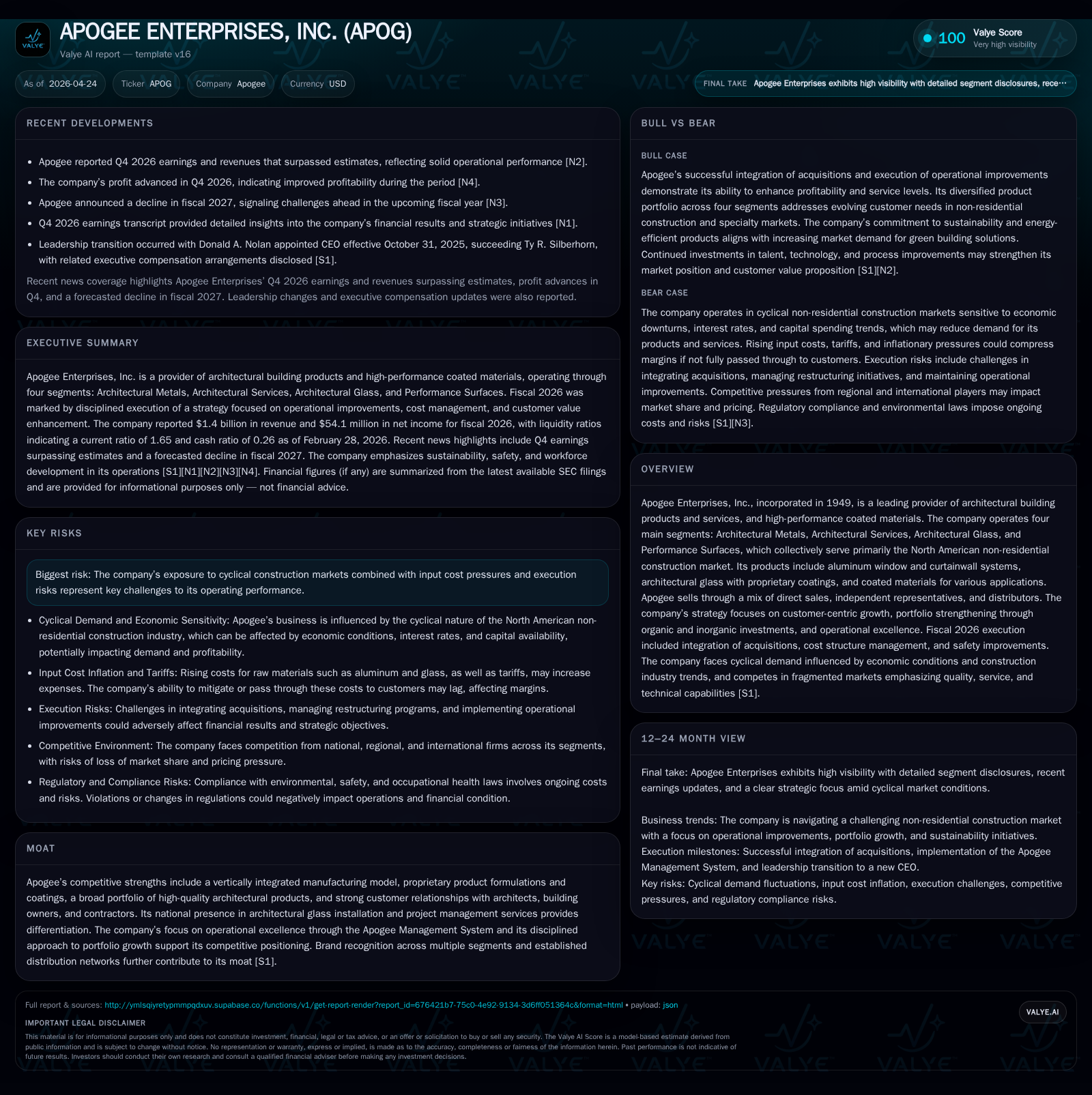
In its latest quarterly filing on January 7, 2026, Apogee Enterprises reported steady revenue with pressure on operating income due to inflation and cost challenges, reflecting a mixed but controlled performance across its four architectural segments. The company continues implementing the Apogee Management System to enhance operational efficiency while integrating recent acquisitions, notably within its Performance Surfaces segment. Despite ongoing cyclical exposure in North American non-residential construction, Apogee’s vertically integrated model, proprietary coatings, and national service footprint underpin durable competitive strengths. Key risks remain tied to input commodity costs, construction market volatility, and litigation related to product warranties. Monitoring quarterly volume trends, M&A integration progress, and margin recovery will be critical cues for near-term performance.
Latest Operating Update: Key Takeaways from Q3 2026 Filing
Apogee Enterprises’ January 7, 2026 10-Q provides an up-to-date view of its operational performance through the third quarter of fiscal 2026 [S2]. The company recorded a roughly 3% increase in net sales compared to the prior year’s corresponding period but faced notable pressure on operating income caused by elevated raw material expenses—chiefly aluminum and float glass—and wage inflation linked to labor shortages. Tariff-related costs continue to exert upward pressure on procurement expenses despite proactive mitigation efforts via Project Fortify Phase 2 initiatives [S8].
Integration of the UW Interco acquisition into the Performance Surfaces Segment was successfully completed during fiscal 2026. The acquired business met its targeted revenue of $100 million alongside an adjusted EBITDA margin exceeding 20%, bolstering the segment’s growth profile [S1]. Meanwhile, the Apogee Management System (AMS) remains central to ongoing manufacturing footprint optimization. AMS advances led to measurable improvements in service levels—manifested as shortened curtainwall fabrication lead times—and reduced defects improving cost of quality [S8]. These factors contributed to meaningful safety enhancements across production sites as well.
Management commentary from the fourth quarter earnings transcript echoes a cautious tone amid persistent macroeconomic headwinds but underscores confidence in differentiated product offerings and the disciplined execution of growth initiatives [N1][N2]. Updated guidance or specific margin outlooks beyond general remarks were not detailed within filings but align with themes of measured optimism tempered by industry cyclicality.
Business Model and Segment Overview: How Apogee Creates Value
Apogee operates through four interconnected yet distinct reporting segments which together address a broad swath of architectural building product needs primarily serving North American non-residential construction markets [S1][S11]:
Architectural Metals (36% of net sales in FY26): This segment designs, engineers, fabricates, and finishes aluminum-based window systems including curtainwalls, storefronts, entrances, and related framing components. Vertical integration is a hallmark here—with extrusion capabilities feeding downstream fabrication—allowing tight control of component quality and lead-time responsiveness. Products are sold principally under brands such as Tubelite®, EFCO®, Wausau®, Linetec®, and Alumicor™ (Canada) via a combination of direct sales forces and authorized distributors.
Architectural Services (31%): Incorporates technical engineering services alongside project management and field installation capabilities primarily focused on curtainwall facades. This segment’s delivery model aims to reduce risks for customers through design expertise coupled with reliable scheduling—a critical value proposition given fixed-price contract exposure common in construction projects.
Architectural Glass (19%): Fabricates premium insulated, laminated, coated glass units offering specialized thermal performance achieved via proprietary coating technologies such as low-E treatments. Sales leverage a mix of direct engagement with architects and independent representatives with an emphasis on customization aligned to architectural aesthetic desires and energy efficiency codes.
Performance Surfaces (14%): Produces high-performance coated substrates for diverse end uses including wall décor, museums preservation glass products under Tru Vue®, digital print media substrates under ChromaLuxe®, industrial flooring coatings under ResinDEK®, among others. Vertical integration extends here into proprietary surface coating formulations applied through automated processes.
Overall company revenue flows from a blend of direct sales engagements with builders and design professionals along with third-party distributors for certain product lines [S12]. Customer retention is reinforced through brand recognition across segments combined with switching costs driven by customization requirements unique to each construction project.
Industry Context and Competitive Dynamics
Apogee operates within a fragmented North American market characterized by multiple regional players alongside select national manufacturers across its core product classes: aluminum fenestration components, architectural glass processing, facade installation services, and specialty coated surfaces [S4][S15]. Competition pivots largely on pricing power constrained by commodity volatility (aluminum billet prices), quality assurance especially regarding thermal performance or coatings longevity, punctual delivery critical for large-scale projects’ phased timelines, warranty support that mitigates client risk exposure, and ancillary service offerings such as project management capabilities that ease contractor burden.
Lead times for curtainwall fabrication have become more crucial in recent years due to increasingly compressed construction schedules pushing customers toward suppliers demonstrating reliability [S8]. Apogee’s vertically integrated manufacturing model provides an advantage here allowing faster responsiveness than some competitors reliant solely on outsourced components.
On the regulatory front, evolving energy-efficiency standards like LEED certification requirements increasingly shape product specifications favoring providers capable of delivering advanced thermal framing systems or low-emissivity glass solutions [S21]. Trade policy developments remain a source of uncertainty; cross-border activity involving Canadian operations subjects Apogee to potential tariff imposition or shifting customs protocols impacting raw material costs [S16].
Strategic Growth Drivers and Constraints
Growth at Apogee centers on three intertwined pillars executed consistently since launch of its November 2021 strategy: deepen customer insight for targeted market leadership; disciplined portfolio growth via organic innovation plus selective acquisitions; advance core capabilities through operational excellence embodied by AMS [S12].
The Performance Surfaces acquisition illustrates portfolio strengthening that diversifies revenue streams beyond traditional cyclicality inherent in Architecture Metals/Glass/Services tied tightly to non-residential construction cycles [S1]. Organic product development leverages proprietary coatings expertise aiding differentiation particularly in glass treatments addressing aesthetic & functional demands.
AMS initiatives underway have streamlined plant footprint rationalization resulting in better capacity utilization alongside improved throughput—particularly evident in the metals segment where full value-stream redesign has shortened cycle times while lowering rework costs [S8]. These operational gains partly offset raw material inflation challenges though margin recovery remains gradual given lagging pass-through pricing dynamics.
Constraints primarily revolve around economic uncertainties influencing overall construction spending levels: interest rate hikes dampen financing availability slowing project initiations; vacancy rates in office/refurbishment segments impact demand elasticity; supply chain disruptions periodically impede sourcing consistency; competition intensifies particularly regionally where smaller manufacturers pursue aggressive contract wins [S25][N8]. Labor availability tightness further complicates timely project execution amidst skilled installer shortages noted across several geographic clusters [S23].
Risks in Execution and Market Exposure
Apogee’s mid-cycle position leaves it susceptible to several key risk vectors outlined extensively in its most recent annual disclosure [S5][S7][S14]:
- Input Cost Inflation: Aluminum prices exhibit volatility driven by commodities markets plus trade tariff uncertainty especially related to U.S.-Canada cross-border transactions affecting metals & extrusions procured for Architectural Metals/Services segments.
- Product Liability: Historical warranty claims related notably to a commercial sealant incorporated previously pose legal settlement risks already crystallized partly by a $24.7 million final arbitration payout paid April 2025 [S9]. Potential increases or new litigation contingent liabilities could impair profitability.
- Cyclical Demand Sensitivity: Non-residential construction sector fluctuations tied directly to macroeconomic factors like credit conditions or shifts toward remote working impact ordering patterns especially for office building facades.
- Operational Execution: Fixed-price contract risk exists where actual project costs exceed estimates due to unforeseen delays or labor/material cost escalation reducing profits on individual jobs.
- Supply Chain Disruptions: Dependence on multiple suppliers for specific raw materials subjects operations to interruptions that may raise costs or delay deliveries impacting customer satisfaction metrics.
- Cybersecurity Threats: Increasing cyberattack sophistication could disrupt manufacturing IT systems or compromise sensitive data requiring ongoing vigilance investments [S24].
Near-Term Catalysts and What to Monitor Next
Key milestones offering insight into trajectory include upcoming quarterly reports revealing organic volume trends across segments versus pricing dynamics especially against rising input cost backdrop. Clarity on realized synergies or incremental margins from recent acquisitions will be material for validating portfolio diversification benefits conveyed thus far.
Operationally significant will be measured progress reported via AMS scorecards concerning manufacturing yield improvements balanced against any new labor supply bottlenecks emerging amid inflationary cost pressures. Backlog health snapshots alongside commentary on non-residential construction indices such as AIA Architectural Billing Index can provide early signals on demand inflection points.
Safety performance metrics constitute ancillary leading indicators potentially correlating with operational stability as tighter controls reduce downtime risks.
Competitor moves around pricing strategies or new product introductions could also influence Apogee’s competitive stance warranting close observation post earnings releases [N1][N2].
Financial Snapshot: Performance, Liquidity, and Capital Structure
Fiscal year ended February 28, 2026 saw Apogee generate $1.404 billion in revenues representing a modest increase over prior year $1.361 billion (+3.2%) while operating income contracted materially by ~28.5% down to $84 million due mainly to cost escalations squeezing margins despite top-line growth [F1]. Net income dropped ~36%, reflecting ongoing profitability compression from inflationary headwinds coupled with legacy warranty-related charges absorbed prior periods although cash flow remained resilient.
Operating cash flow decreased marginally but stayed robust at $122 million supporting capital expenditure reductions prioritizing efficiency fixes over expansion (~$27 million capex down ~23%). The balance sheet reflects conservative leverage with total debt around $232 million offset by cash reserves approximately $39 million yielding net debt near $193 million. Current ratio stands healthy at ~1.65 signifying adequate short-term liquidity cushions [F1][S2][S3].
Capital allocation favored dividend distributions totaling $22 million suggesting steady shareholder return orientation whereas share repurchases slowed significantly signaling cautious deployment perhaps awaiting more pronounced margin stabilization [F1].
Historical performance (annual)
| FY | Rev ($mm) | Net ($mm) | CFO ($mm) | OpInc ($mm) | Rev YoY | Net YoY |
|---|---|---|---|---|---|---|
| 2026 | 1405 | 54 | 122 | 84 | +3.2% | -36.4% |
| 2025 | 1361 | 85 | 125 | 118 | -3.9% | -14.6% |
| 2024 | 1417 | 100 | 204 | 134 | -1.6% | -4.3% |
| 2023 | 1441 | 104 | 103 | 126 |
Source: SEC companyfacts cache [F1].
Capital returns and efficiency (annual)
| FY | Div ($mm) | Buybacks ($mm) | FCF ($mm) |
|---|---|---|---|
| 2026 | 22 | 15 | 95 |
| 2025 | 22 | 45 | 90 |
| 2024 | 21 | 12 | 161 |
| 2023 | 20 | 74 | 58 |
Source: SEC companyfacts cache [F1].
In sum, financial evidence underscores resilience amid margin challenges consistent with execution-focused narrative detailed earlier.
This analysis respects all provided disclosures without extrapolation beyond documented sources; it does not constitute investment advice but aims to illuminate structural business dynamics shaping Apogee Enterprise’s current positioning.
Disclaimer: This is research-only, informational analysis and not investment advice. It may include AI-generated interpretation and general industry context. Always verify important details using primary sources.

Comments