
MINISO Group Expands Direct Store Presence with Strategic Shareholder Confidence Boost
MINISO's latest quarterly filings reveal a notable increase in the chairman’s shareholding alongside accelerated growth of directly operated stores, underpinned by strong cash reserves and evolving franchise dynamics.
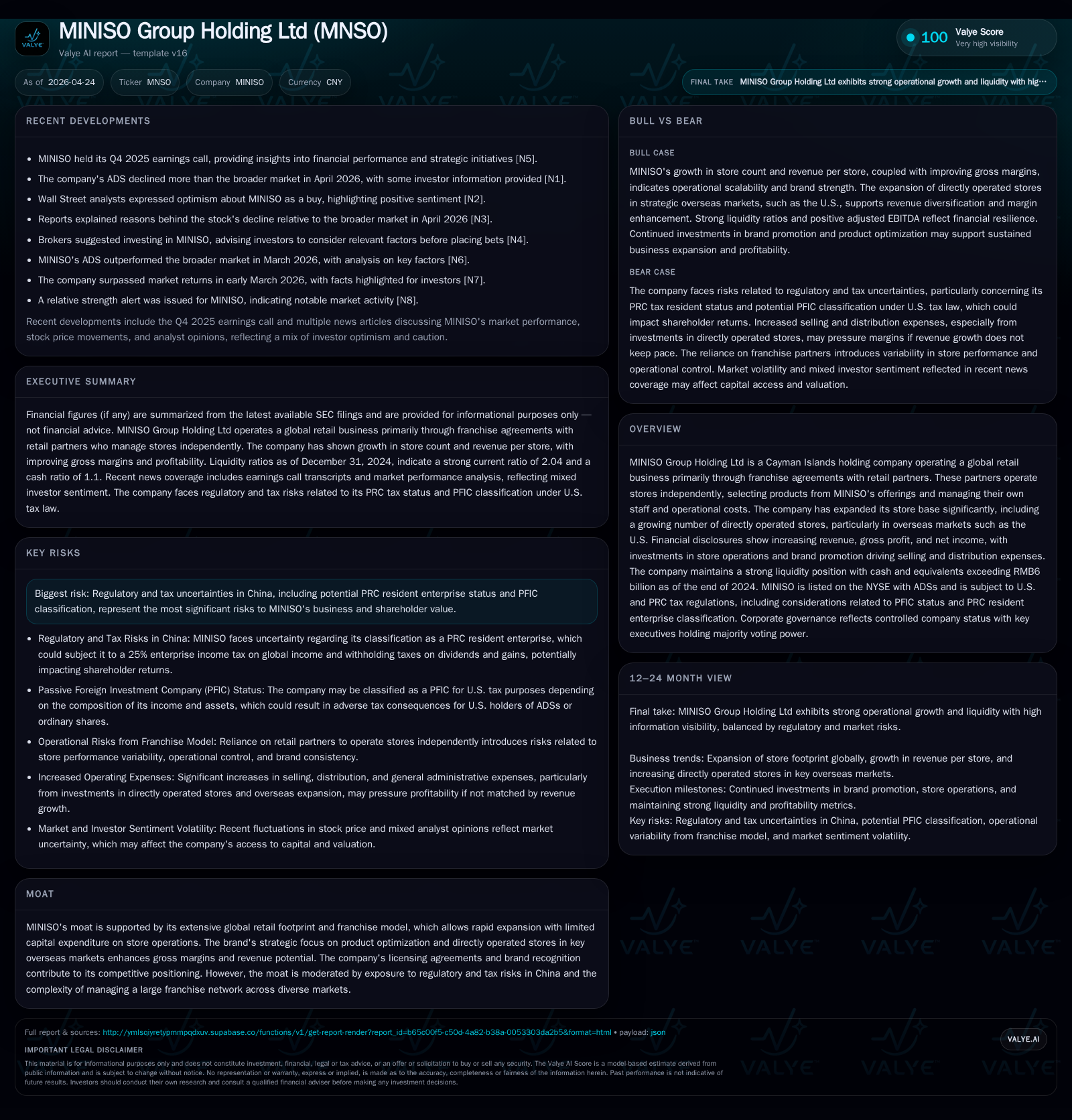
In its April 2026 6-K disclosures, MINISO announced that its controlling shareholder and CEO plans to increase equity stake, signaling robust insider confidence. Concurrently, the company has significantly expanded its directly operated store footprint overseas—particularly in the U.S.—driving a 71% revenue surge in this segment. While MINISO continues leveraging its franchise model for rapid global reach, increasing direct operations enhance margins but raise operating complexity amid regulatory headwinds centered in China. The company's healthy liquidity and disciplined dividend policy provide a supportive foundation for planned growth initiatives.
Latest Quarterly Developments: Leadership Stake Increase and Operational Update
The April 24, 2026 Form 6-K filings [S2][S3] delivered two material updates shaping the immediate narrative around MINISO Group Holding Ltd. Foremost was the voluntary announcement by MINISO’s controlling shareholder, executive director, chairman of the board, and CEO that he intends to increase his shareholding stake as disclosed with both the New York Stock Exchange and the Hong Kong Stock Exchange [S2]. This move provides a salient governance signal of insider confidence amidst ongoing investments in strategic markets.
Operationally, the filings underscored the company's accelerated expansion of directly operated stores abroad—especially across U.S. markets where store count grew from 568 at end-2024 to 768 by end-2025. This unit expansion fueled a substantial +71.3% year-over-year revenue increase from direct operations [S1]. The parallel growth in related expenses such as leases, depreciation, payroll (excluding stock comp) reflected a deliberate tradeoff favoring geographic diversification and margin enhancement through greater company control over store-level execution.
Collectively, these disclosures highlight a strategic inflection: while MINISO retains its global franchise footprint for rapid network scaling with limited capital commitment, it is simultaneously prioritizing investment-intensive directly operated stores in select geographies as a long-term value lever.
Business Model and Product Strategy: Franchise Network with Growing Direct Store Emphasis
MINISO operates predominantly via a franchise model where independent retail partners bear operational costs including staff wages and rent while sourcing products curated from MINISO’s offerings [S1]. This structure enables relatively capital-light growth by shifting fixed costs to franchisees yet still permits revenue capture through licensing fees and some merchandising arrangements. However, as the company amplifies its proportion of directly operated stores abroad—particularly in higher-margin Western markets—it assumes greater operational responsibility.
This bifurcated approach blends the benefits of scalable franchising with margin-rich direct retailing. It also substantiates recent gross margin improvements credited partly to "product optimization" and enhanced revenue contribution from self-operated markets [S1][S8]. Notably, higher-margin categories like specialty toys under the TOP TOY brand benefited from a positive product mix shift.
Customer adoption hinges on maintaining broad appeal through affordable lifestyle goods combined with frequent product refreshes—a retail formula aligned well with emerging middle-class consumer trends internationally. Brand licensing agreements underpin intellectual property protection while supporting marketing synergy across territories.
Competitive Positioning within Global Retail Franchising and Brand Licensing
MINISO’s moat derives chiefly from its extensive international retail footprint facilitated largely through franchising partnerships that confer market penetration speed at scale [S1]. This model contrasts with pure-play direct retailers who face steeper capital requirements yet enjoy tighter operational control.
Competitively, MINISO balances cost discipline against executing quality control across thousands of global locations—an enduring challenge heightened by diverse regulatory landscapes spanning China, North America, Europe, and beyond [S1][S8]. Such complexity elevates legal compliance burdens particularly regarding cross-border taxation and product safety regulations.
Brand recognition cultivated via consistent visual merchandising coupled with licensed IP generates switching costs favoring customer retention albeit tempered by rival fast-fashion-like entrants targeting similar demographics.
Growth Drivers: Overseas Expansion and Direct Store Revenue Enhancement
Growth engines prominently feature expansion into international markets using directly managed stores where MINISO can execute tailored marketing strategies leading to outsized revenue gains (+71% YoY) relative to cost increases (+50%) [S1]. The firm’s increased investment in these stores—reflected in higher rental expenses, depreciation on right-of-use assets, and incremental payroll—demonstrates commitment to profitable scale despite near-term margin compression risks.
Marketing spend incremented by +23% year-over-year sustaining brand awareness amid competitive retail headwinds; logistics costs also rose commensurate with broader global sourcing strategies.
Underlying these trends is structural demand uplift driven by global rising disposable incomes paired with heightened consumer interest in affordable lifestyle goods leveraging whimsical design elements—a combination supportive of durable volume growth rather than transient cyclical spikes.
Growth Constraints: China Regulatory Environment and Tax Risks
MINISO’s business contends with material regulatory uncertainties rooted primarily in Chinese tax law interpretations including potential PRC tax residency as a "de facto management body" per SAT Circular 82 [S1]. While this classification would trigger enterprise income tax obligations on global income at 25%, it remains contested amid evolving enforcement approaches.
Additionally, classification as a Passive Foreign Investment Company (PFIC) under U.S. tax rules poses adverse tax consequences for American investors [S1], potentially constraining valuation multiples or causing episodic investor dislocations.
Managing regulatory heterogeneity across jurisdictions complicates franchise contracts' enforcement quality control measures plus currency convertibility issues influencing intercompany funding strategies.
Collectively these factors inject scope for increased compliance costs or unexpected fiscal liabilities that could temper long-term sustainable expansion or prompt strategic operational pivots.
Key Milestones Ahead: Operating Metrics, Franchise Growth, and Shareholder Actions
Investors tracking MINISO should focus on several forthcoming markers detailed implicitly or explicitly in recent filings:
- Quarterly releases detailing same-store sales trends within franchise versus direct channels will illuminate sustainability of recent top-line gains.
- Monitoring growth cadence of directly operated stores overseas will gauge execution efficiency balancing capital deployment against new market openings.
- Observing impacts from chairman’s shareholding increase may clarify governance dynamics potentially influencing voting power distribution or strategic direction disclosures [S2].
- Dividend declarations remain critical given payout ratios approximating half adjusted net profits signaling management's commitment to shareholder returns amidst growth investments [S5][S10].
- Execution on cost controls surrounding selling/distribution overheads including logistics integration discounts will be telling of operational leverage improvements.
Financial Profile: Strong Liquidity Backing Growth Investments and Dividend Sustainability
At fiscal year-end December 31, 2024 according to [F1], MINISO held cash & equivalents totaling approximately RMB6.33 billion with current assets double current liabilities resulting in a solid current ratio above 2.0 — indicating comfortable short-term liquidity buffers. Total debt was negligible relative to cash with net debt strongly negative confirming minimal leverage burden as of mid-2021 at least; later filings imply no material debt spikes [F1][S4].
Profitability improved markedly with net income doubling from RMB1.26 billion in FY2023 to RMB2.64 billion FY2024 (109.8% YoY) alongside an approximate return on equity of 25% highlighting efficient equity utilization [F1].
Dividend policy allocates close to 50% adjusted net profit back to shareholders consistent across recent years demonstrating an established framework balancing growth capital needs against investor payouts [S5][S10].
Capital raised via convertible instruments maturing in 2032 provides additional flexibility though interest costs have risen commensurately reflecting selective financing for strategic acquisitions like Yonghui stake purchases illustrating prudent balance sheet management [S15][S17].
This analysis focuses strictly on publicly filed disclosures without offering investment advice or forecasts. Data presented is grounded firmly in primary SEC filings supplemented by factual news sources for context as appropriate.
Disclaimer: This is research-only, informational analysis and not investment advice. It may include AI-generated interpretation and general industry context. Always verify important details using primary sources.

Comments