
Polibeli Group’s Global Digital Supply Chain Platform: Growth Bottlenecks and Liquidity Risks
Recent SPAC combination completion and liquidity pressures frame Polibeli's complex global supply chain trading business.
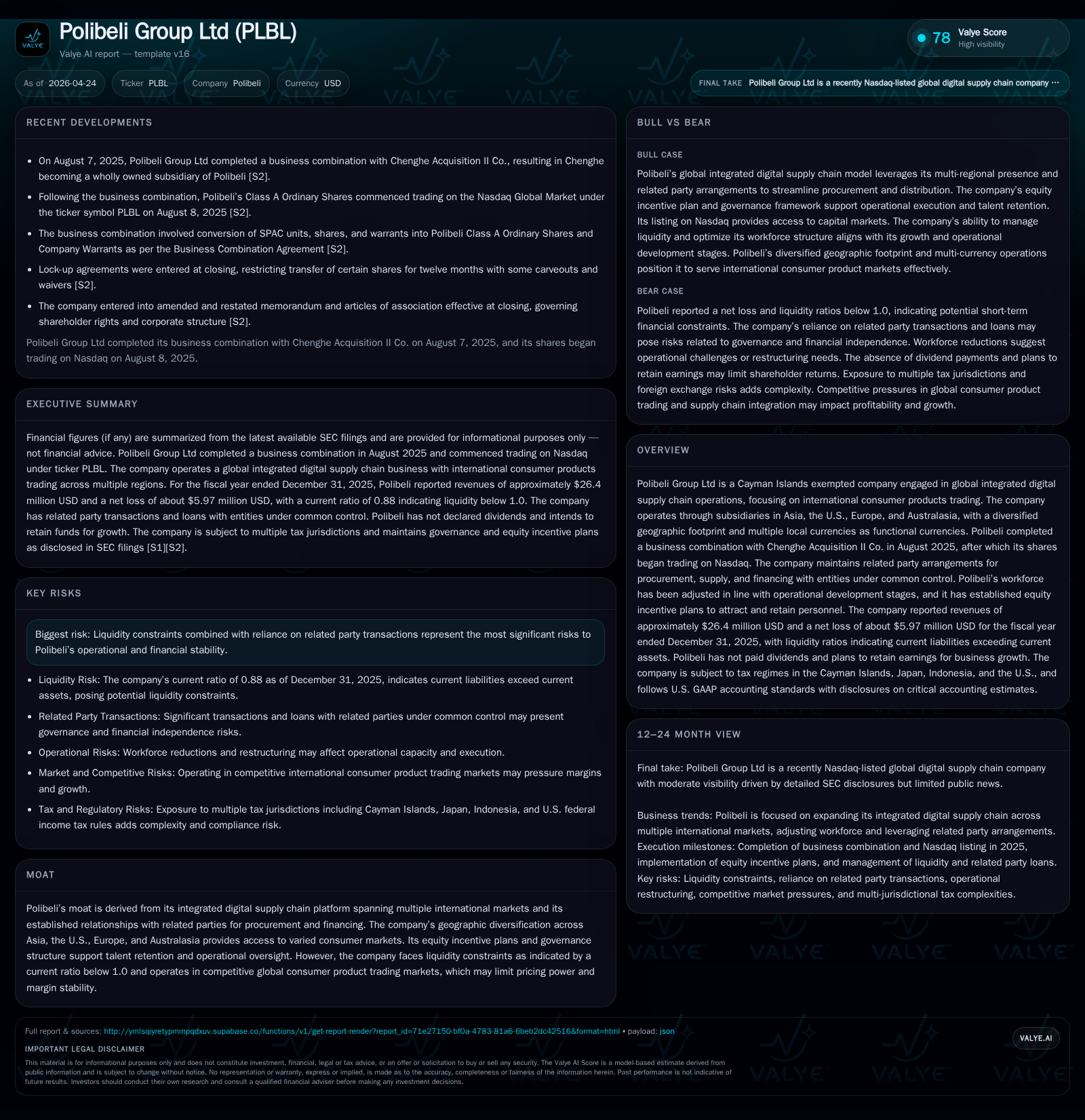
Polibeli Group Ltd recently completed a transformative SPAC business combination, marking its Nasdaq debut and establishing a new capital structure governed by registration rights agreements. The company's business model centers on an integrated digital supply chain platform facilitating international consumer product trading across Asia, the U.S., Europe, and Australasia. Despite geographic diversification and operational streamlining—including workforce reductions aligned with development stages—Polibeli faces significant liquidity constraints as its current ratio remains below 1.0. Additionally, heavy reliance on related-party procurement and financing arrangements, combined with rising inflationary pressures and competitive margin compression, present meaningful challenges to sustainable growth.
Recent Operating Developments and Their Strategic Implications In August 2025, Polibeli Group Ltd finalized its business combination with Chenghe Acquisition II Co., signifying a pivotal corporate milestone that transitioned it into a publicly traded entity on Nasdaq under the ticker PLBL [S2]. This closing consummated the transfer of units, shares, and warrants into the company’s Class A Ordinary Shares framework. Alongside this transaction, a Registration Rights Agreement was executed, imposing resale shelf registration obligations under the Securities Act and granting certain shareholders customary demand and piggyback registration privileges [S2]. These arrangements play a crucial role in shaping secondary market liquidity and shareholder capital structures post-SPAC. This post-SPAC phase establishes Polibeli’s foundational governance contours and market positioning while opening access to broader capital markets. However, the integration also introduces execution expectations tied to enhanced disclosure obligations and investor relations dynamics. ## Business Model Overview: Integrated Digital Supply Chain and Product Offering Polibeli operates a global integrated digital supply chain platform engaged primarily in international trading of consumer products [S1]. Its operational footprint spans subsidiaries across Asia (notably Indonesia), the U.S., Europe, and Australasia—a geographic dispersion that diversifies end-market exposure but introduces currency complexities managed through multiple functional currencies including JPY, IDR, SGD, KRW, EUR, HKD, and USD [S1], [F1]. Revenue is generated mainly through trading activities facilitated by related-party procurement arrangements under common control entities specializing in sourcing goods and financing operations [S1]. These related-party transactions enable operational fluidity but impose constraints on pricing autonomy, limiting margin expansion opportunities amid intensified competition. The interplay between supply chain digitization benefits—such as greater transparency and efficiency—and price competitiveness defines Polibeli’s strategic positioning. The company’s approach reflects a balance between leveraging established internal supply networks for cost advantages versus facing margin pressure due to inherent conflicts or favorable pricing to related entities. Operational evolution is evidenced by workforce realignment from 291 full-time employees at end-2023 to just 91 by end-2025 [S1]. This sizeable reduction coincides with the maturation of distribution channels predominantly in Indonesia where initial sales team expansion gave way to streamlined staffing after channel establishment. This adaptive talent scaling indicates prudent cost management aligned with business phases. ## Industry Context and Competitive Positioning The industry landscape Polibeli inhabits is characterized by highly fragmented global consumer product trading markets featuring numerous intermediaries vying for limited pricing premiums [S1], [F1]. Despite broad geographic reach providing access to varied consumer bases across developed and emerging markets, this diffusion does not confer sizable defensible moats given competitive ubiquity. Pricing power is inherently limited as consumers generally seek comparable commodities across providers with minimal switching barriers. Logistics capacity constraints exist but are increasingly addressed by digital integration efforts industry-wide; thus, differentiation often stems from platform efficiency rather than exclusive supply sources. Additionally, regulatory regimes across jurisdictions imply compliance overheads influencing operational models. While no material adverse trends are currently evident per company disclosures [S1], evolving trade policies or tariffs can pose intermittent headwinds. ## Growth Catalysts and Operational Constraints Growth drivers include accelerated penetration into emerging Asian consumer segments leveraging digital channels alongside scalability of the underlying supply chain technology platform [S1]. The company’s ability to convert existing relationships into broader regional trade flows remains a critical vector for revenue improvement. However, persistent inflationary pressures—specifically increases in raw material prices, labor costs, and overhead—pose risks to gross margin sustainability unless matched by commensurate revenue uplift [S1]. The company explicitly notes that high future inflation rates may impair operating results if cost pass-through is unachievable. Liquidity constraints represent another operational bottleneck. As of December 31, 2025, Polibeli reported current assets valued at approximately $16.65 million against liabilities near $19 million—a current ratio of 0.88 indicating potential short-term funding challenges [F1]. Despite minimal total debt ($17.8 thousand as of end-2024), net losses totaling around $6 million highlight ongoing cash flow pressures requiring careful capital management [F1]. Credit risk mitigation efforts include allowance provisions for expected credit losses which notably increased in 2025 to $2.74 million from prior years reflecting heightened receivables risk possibly linked to inventory or customer payment delays [S1]. This figure underscores potential working capital volatility contemporaneous with broader liquidity fragility. Reliance on related parties for both financing lines underpins access to short-term funds though introduces concentration risks that merit close monitoring [S3]. ## Talent Strategy and Workforce Optimization Polibeli’s workforce contraction from 291 employees in 2023 down to 91 by December 2025 reveals aggressive rationalization consistent with scaling maturity stages post-expansion into Indonesia's market [S1]. This downsizing predominantly targeted sales personnel following distribution channel establishment—indicating an optimized lean operating model minimizing fixed labor costs while preserving essential capabilities. To sustain organizational capabilities amidst competitive talent markets globally, the company has deployed equity incentive plans formalized through the 2024 Equity Incentive Plan adopted in August 2025 aiming to attract and retain key personnel via stock options, restricted shares/units, and local awards [S1]. Offering these long-term incentives aligns management interests with shareholder value creation but also imposes accounting expenses diluting near-term earnings margins. Robust employee relations have reportedly been maintained without stoppages or labor disputes despite these transitions [S1], reinforcing operational stability during restructuring phases. ## Liquidity Profile and Financial Health as Supportive Evidence Financially, Polibeli reflects typical early-stage public company dynamics balancing top-line growth ambitions against structural losses in nascent scale-up periods. Reported revenues approached $26.4 million for fiscal year ended December 31, 2025 but translated into operating losses about $7.56 million and net losses nearing $6 million [F1]. Balance sheet scrutiny shows constrained liquidity indicated by a sub-1 current ratio (0.88) stemming from current liabilities slightly exceeding current assets as of year-end 2025 [F1]. The modest debt level ($17.8 thousand reported end-2024) suggests low financial leverage enabling some borrowing flexibility though offset partly by reliance on related-party loans extended for both operational funding and business combination expenses under relatively low fixed interest rates near ~4% [S3], [S6], [S11]. Provisioning for credit losses surged significantly in 2025 ($2.74 million versus ~$0.5 million prior years), highlighting elevated risk within receivables or other current assets portfolios demanding vigilant recovery management efforts [S10]. Inventory write-downs remained stable but indicative of prudence addressing slow-moving inventory risks. Overall financial health underscores immediate medium-term risk profiles centered on managing working capital volatility alongside scaled operating losses requiring execution discipline toward profitable scale attainment. ## Key Milestones and Forward-Looking Considerations Looking ahead, Polibeli’s trajectory depends critically on several metrics: successful leverage of the recent Nasdaq listing to access incremental growth capital; capacity expansion within emerging regional consumer base penetration; efficacy of equity-based talent retention schemes sustaining operational excellence; improvement in working capital efficiency; resilience against inflationary cost hikes;
and ongoing compliance with governance enhancements such as insider trading policies introduced contemporaneously with public listing enhancing investor confidence [S2], [S1]. Registration rights agreements governing share resale shelf registrations emphasize shareholder liquidity safeguards but necessitate active capital markets engagement to mitigate dilution effects over time [S2]. Potential catalysts include securing new distribution partnerships or expanding product categories within Asia-Pacific markets where digital consumer adoption trends remain robust though highly competitive. No material adverse trends were flagged recently by management reporting assertions signaling cautious optimism amidst structural headwinds cited earlier [S1]. Execution monitoring points will heavily focus on quarterly progress updates regarding revenue scaling trajectories versus cost containment effectiveness informing profitability inflection timing. ----- Disclaimer: This analysis is for informational purposes only based on publicly filed documents as of April 24, 2026. It does not constitute investment advice or recommendations.
Disclaimer: This is research-only, informational analysis and not investment advice. It may include AI-generated interpretation and general industry context. Always verify important details using primary sources.

Comments