
Huize Holding’s 2025 Growth Balances Regulatory Risks and Platform Efficiency
Strong 2025 revenue gains underscore Huize's scalable brokerage model, yet regulatory headwinds and management shifts pose challenges.
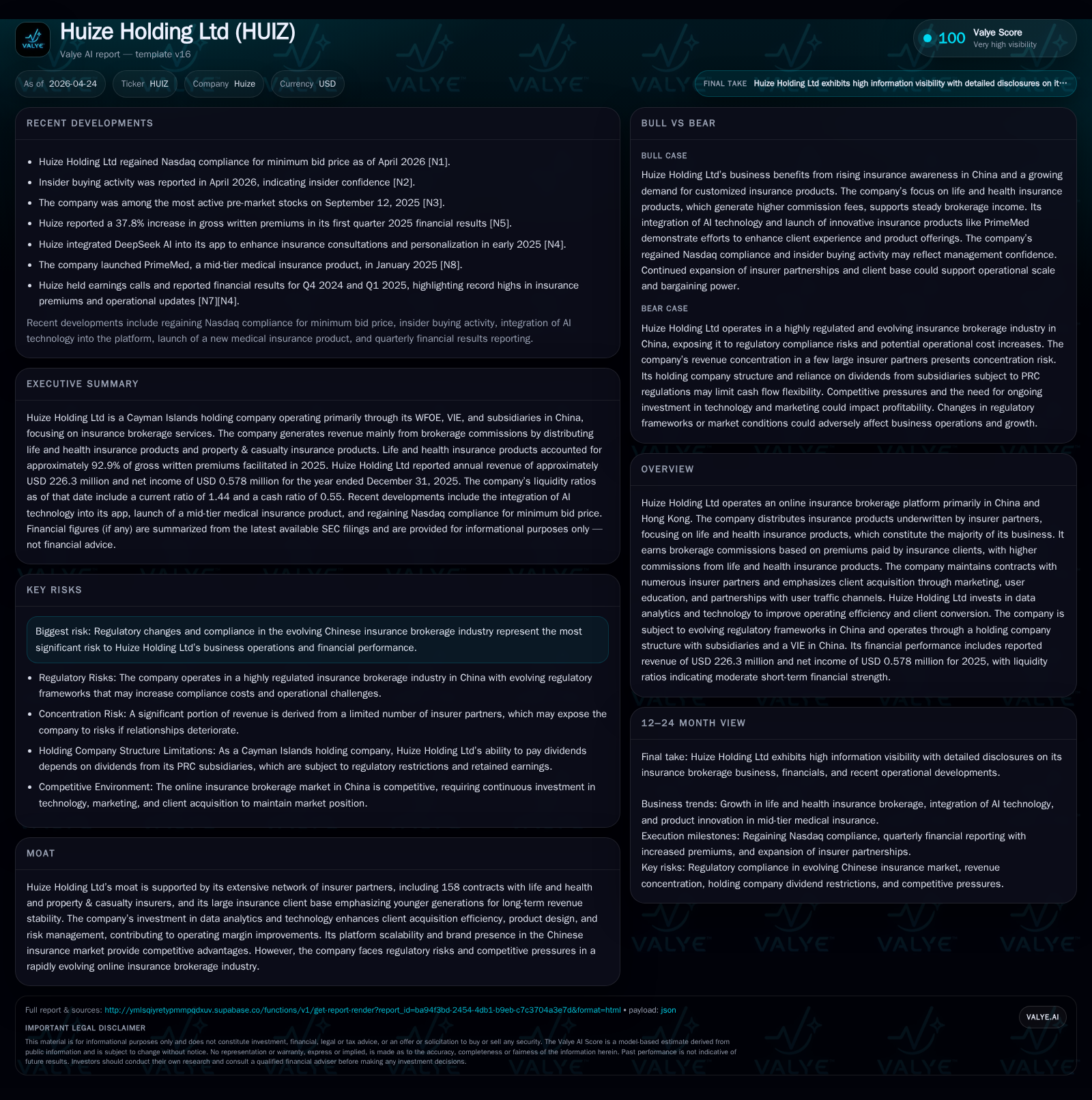
Huize Holding Ltd reported solid revenue growth in 2025 driven by increased brokerage income from life and health insurance products, which remain its core offering. The company continues to leverage data analytics and partnerships to enhance client acquisition efficiency amid a complex and evolving regulatory environment in China. Regulatory compliance updates—including management changes—signal ongoing challenges in navigating the online insurance brokerage landscape. Financially, Huize returned to profitability with improved operating margins supported by operating leverage and cost controls. Key risks remain centered on regulatory scrutiny and reliance on insurer partner cooperation.
Recent Operating Update
Huize Holding Ltd filed its most recent quarterly disclosure on March 27, 2026 [S2], reaffirming its status as a Nasdaq-listed foreign private issuer. While no detailed operational metrics were included in the latest interim filing, the notable executive change in early March—the resignation of COO Li Jiang effective March 13, 2026 for personal reasons [S3]—introduces some near-term uncertainty in management continuity. The company ensured a smooth transition plan is underway.
The annual report filed on April 24, 2026 [S1] offers comprehensive insight into Huize's full-year 2025 results and strategic context. As of December 31, 2025, Huize recorded $226.3 million in revenue representing a strong year-over-year increase of over 32%, led primarily by brokerage fees from life and health insurance products that constitute roughly 93% of the GWP facilitated on its platform. This growth marks a rebound from prior years where profitability was challenged due to market and regulatory headwinds.
Business Model Analysis
Huize operates an online insurance brokerage platform predominantly servicing the Chinese market alongside Hong Kong exposures. Its primary value proposition lies in distributing tailored insurance solutions crafted with insurer partners through a digital ecosystem that enhances client outreach, education, and conversion.
Revenue generation is almost exclusively commission-based—derived from insurer partners paying a share of premiums collected via Huize’s platform. Life and health insurances stand out due to their longer premium payment cycles (3-30 years) and higher commission rates compared to property & casualty lines [S1]. The recurring premium structure fosters a multi-year revenue stream as commissions accrue not only on first-year premiums but also on renewals typically spanning one to four subsequent years.
Strategically, Huize invests significantly in data analytics capabilities—interpreting multi-dimensional client profiles—to refine marketing targeting, optimize product mix design with insurers, and manage underwriting risk more effectively [S1]. The company also maintains diversified client acquisition avenues:
- Direct marketing campaigns including brand advertising.
- Education initiatives boosting insurance awareness.
- Partnerships with influential third-party user traffic channels (e.g., portals influencing purchase decisions), although these face continuous regulatory scrutiny limiting channel access [S10].
Moreover, Huize emphasizes retaining younger demographics within its client base for long-term lifetime value given the nature of recurring premiums [S11].
Industry Structure and Competitive Position
Within China’s fragmented but rapidly digitizing insurance brokerage sector, Huize is among leading platforms leveraging technology and an extensive network of insurer partnerships—reporting formal contracts with 158 insurers as of end-2025 (89 life & health; 69 property & casualty) [S15]. This breadth fortifies resilience against concentration risk although top five insurer partners still account for approximately one-third of revenues.
The company benefits from scalable platform infrastructure which underpins growth without proportionate increases in personnel costs—a critical competitive moat enabling margin improvements through operating leverage [S11]. However, the Chinese regulators impose stringent requirements:
- Online sales must be conducted via licensed insurance institutions; non-licensed user traffic channels face operational restrictions or termination risks.
- Brokers must ensure all distribution intermediaries hold appropriate registrations before receiving commissions.
Compliance demands have necessitated business model adjustments including terminating or vetting cooperating channels to avoid penalties or contract breaches with insurer partners [S10]. Effectively navigating this evolving regulation remains an ongoing challenge differentiating compliant platforms from less disciplined competitors.
Growth Drivers and Constraints
Drivers:
- Rising insurance penetration in China propelled by increasing economic affluence and expanding middle class disposable incomes drives demand for customized protection products.
- Continued shift from offline to online insurance sales bolsters client acquisition scale.
- Enhanced data-driven marketing reduces customer acquisition costs improving unit economics over time.
- Expansion into new tailor-made product offerings designed jointly with insurer partners appeals to personalized client protection needs.
- Platform maturity allows better cross-sell opportunities especially across life-health-product suites.
Constraints:
- Regulatory tightening around intermediary conduct could constrain user traffic channel sourcing options,
- Dependence on insurer partners’ policy pricing strategies limits direct pricing power;
- Competition intensifying among online brokers constrains commission rates;
- Potential regulatory caps on broker fees could compress margins;
- Market sensitivity to economic fluctuations influencing renewal rates.
What to Watch Next
Important upcoming metrics include:
- Quarterly GWP growth trends generated via Huize’s platform to monitor sustained demand momentum,
- Updates from new or existing insurer partnerships signaling broadening or concentration risks,
- Management commentary around post-COO transition impacts on execution,
- Regulatory announcements affecting permissible distribution practices or fee structures,
- Platform operating efficiencies measured through client acquisition cost improvements versus marketing spend disclosures,
- Margins trajectory reflecting balance between revenue growth and operating cost control,
- Cash flow generation trends relative to capital investment plans indicating financial flexibility.
Financial Profile Overview
Historical performance (annual)
| FY | Rev ($mm) | Net ($mm) | CFO ($mm) | OpInc ($mm) | Rev YoY | Net YoY |
|---|---|---|---|---|---|---|
| 2025 | 226 | 1 | 3 | 1 | +32.2% | +749.4% |
| 2024 | 171 | 0 | -3 | -3 | +1.6% | -100.9% |
| 2023 | 168 | 10 | 19 | 7 | +0.3% | +318.6% |
| 2022 | 168 | -5 | -12 | -6 |
Source: SEC companyfacts cache [F1].
Capital returns and efficiency (annual)
| FY | Buybacks ($) | FCF ($mm) | ROE% |
|---|---|---|---|
| 2025 | 0 | 1 | 1.0 |
| 2024 | 11000 | -3 | -0.2 |
| 2023 | 1886000 | 15 | 17.3 |
| 2022 | 965000 | -15 | -9.1 |
Source: SEC companyfacts cache [F1].
Huize Holding achieved $226.3 million revenue for full-year 2025 up sharply from $171.1 million in 2024 ([F1]) delivering a turnaround to positive operating income of $0.95 million from a negative $2.87 million a year earlier. Net income similarly improved to $0.58 million [F1]. Operating income margin remains constrained below 1%, reflecting incremental costs associated with scaling marketing efforts ($31.5M selling expenses) while administrative expenses declined slightly due to lower rental/utilities outlays [S23].
Operating cash flow returned positive at $2.56 million after a negative flow in prior year although still modest relative to net income indicating working capital fluctuations [F1]. Capital expenditure tripled somewhat to nearly $1.2 million as the company invested further in technology infrastructure while maintaining cost discipline [F1].
Balance sheet liquidity is intact with cash & equivalents around $35.9 million end-2025 vs current liabilities about $65.6 million yielding a current ratio of approximately 1.44 indicating moderate short-term liquidity cushion [F1]. Reported total debt stood at ~20 million CNY but exact currency translation limits direct comparability; however net debt is estimated negative suggesting net cash position as supported by filings [F1]. The holding company structure funneling operational cash from PRC subsidiaries through contractual VIE arrangements introduces some dividend repatriation risk attributable to PRC tax withholding policies and foreign exchange controls [S22].
Huize currently pays no dividends intending to retain earnings for reinvestment [S13]. Share repurchases were negligible in latest fiscal periods ([F1]). Given tight margins and regulatory risks, conservative capital stewardship is evident.
Summary Disclaimer
This analysis integrates latest SEC filings through early 2026 together with historical financials through year-end 2025 for Huize Holding Ltd. It aims solely at providing an informed industrial perspective without investment guidance or valuation considerations. Financial figures are sourced directly from public filings ([F1], [S#]) without conjecture beyond documented facts. Key risks center around regulatory uncertainty inherent in China’s evolving insurance distribution regulations potentially impacting revenue streams and operational costs materially.
Disclaimer: This is research-only, informational analysis and not investment advice. It may include AI-generated interpretation and general industry context. Always verify important details using primary sources.

Comments