
KE Holdings Strengthens Technology Integration While Managing Regulatory and Market Challenges
The latest quarterly disclosures underline KE Holdings’ continued focus on platform innovation and ecosystem expansion amid moderating transaction growth and regulatory complexities in China’s real estate sector.
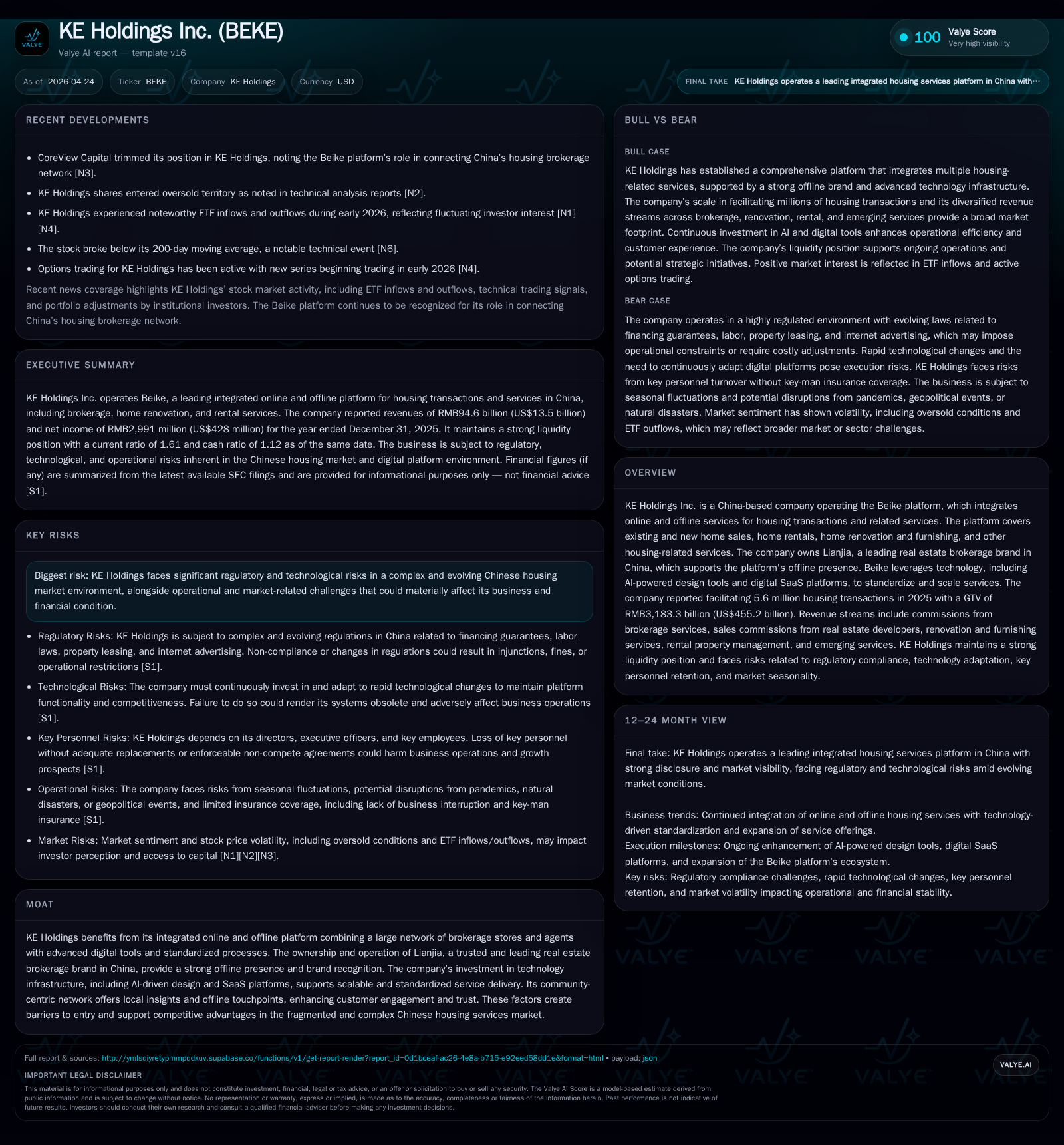
In its most recent filings, KE Holdings Inc. (BEKE) reported sustained revenue growth but highlighted pressure on net income and operating cash flow due to slower transaction volumes and increased investment in technology and service standardization. The company’s integrated online-offline platform, anchored by Lianjia brokerage stores and an expanding agent network, leverages AI and SaaS tools to drive efficiencies in China’s fragmented housing marketplace. KE Holdings faces structural challenges from evolving regulations, cyclical property market dynamics, and collection risk on developer receivables. Its path to growth depends on scaling home renovation, rental services, and Beihaojia C2M product solutions while maintaining operational discipline.
Recent Operating Update: 2026 Q1–FY2025 Results KE Holdings’ latest filings as of April 24, 2026 ([S2], [S3]) provide the most current insight into the company’s operational trajectory through 2025. The company reported facilitating approximately 5.6 million housing transactions in 2025 with gross transaction value (GTV) reaching RMB3,183 billion (~US$455 billion) [S1]. While total revenues grew slightly by 1.2% year-over-year to RMB94.6 billion (US$13.5 billion), this represents a deceleration following strong double-digit growth in prior years. Profitability metrics reflected more pressure: net income declined by about 23% YoY to US$428 million in 2025 [F1], while operating cash flow swung negative by US$53.8 million compared to positive operating cash flows exceeding US$1 billion in previous years [F1]. This divergence between accounting earnings and cash flow primarily stems from working capital demands affecting new home transaction revenue collections amid a cooling property market ([S1], [S24]). KE Holdings continues investing significantly in technology infrastructure, including AI-powered design systems and SaaS platforms that support scalability of its offline agent network as well as new service verticals such as home renovation and rental management ([S7], [S16], [S21]). These initiatives are critical given the cyclical pressures on core brokerage services. ## Business Model: An Integrated Online-Offline Housing Services Ecosystem At its core, KE Holdings operates the Beike platform — a vertically integrated ecosystem combining digital technology with an extensive offline brokerage network anchored by its wholly-owned Lianjia brand ([S1], [S16]). The business model is hybrid: - Commission-based brokerage for existing home sales and rentals through its own agents and those affiliated with third-party brokerages on the platform.
- Sales commissions from developers for new home deals.
- Home renovation and furnishing services, leveraging AI-enhanced BIM tools for standardized designs delivered nationally via Home SaaS ([S16], [S21]).
- Rental property management, blending digital platforms with localized offline service teams employing AI-driven task automation ([S24]).
- Emerging segments like Beihaojia’s C2M product solutions that provide data-enabled marketing and supply chain integration for developers ([S24]). This diversified revenue base aims to capture multiple touchpoints across the housing lifecycle — from purchase or rental decision through living experience enhancements — addressing historical fragmentation in China’s property services industry. ## Industry Structure & Competitive Position China’s real estate brokerage sector is famously fragmented with numerous local players. KE Holdings leverages scale advantages via Beike’s broad agent network (~445k active agents; >58k brokerage stores) combined with sophisticated technology adoption that creates switching costs and differentiates user experience ([S1], [S16]). Lianjia's trusted brand name provides strong offline customer traction which enhances lead generation quality for its digital platform counterpart. Meanwhile, KE’s integrated SaaS systems standardize operations across geography, improving operational efficiency relative to small brokers reliant on manual processes ([S7], [S21]). The evolving regulatory environment introduces complexity; however, KE has remained compliant thus far ([S29]), though ongoing oversight around offshore offerings and financing guarantees creates execution risk. ## Growth Drivers & Constraints ### Growth Drivers:
- Expansion of non-brokerage verticals: Home renovation/furnishing scaled rapidly using AI-based BIM design tools reducing costs/time while improving quality consistency ([S21]).
- Rental Services Scale: Process digitization coupled with AI-assisted customer support elevates service levels essential for operating large-scale rental management efficiently ([S24]).
- Beihaojia C2M Solutions: Becoming a critical upstream partner for developers with data-driven product optimization strengthens long-term strategic relations ([S24]).
- Technology Innovation: Continuous R&D investment (~RMB2.58 billion in 2025) supports ongoing platform improvements critical to maintain competitive edges ([S6], [S7]). ### Growth Constraints:
- Regulatory Uncertainty: Complex PRC regulations around capital markets access, licensing requirements for financing guarantees, plus tightening policies on real estate pose risk (see also HFCAA-related audit inspection status) ([S29], [S1]).
- Market Cyclicality: Slowing macroeconomic trends impacting residential property transactions reduce commission volume potential (1% revenue growth reflects this dynamic). Current ratio remains healthy at ~1.61 ([F1]). ## What to Watch Next - Transaction Volume Trends: Continued monitoring of housing transaction count trajectory amid changing macroeconomic conditions will be critical.
- Expansion & Monetization of Renovation/Rental Units: Measuring how well investments in digital tools translate into margin improvement or scale economics.
- Regulatory Developments: Tracking PRC regulatory updates affecting offshore listings or financial licensing could materially impact strategic flexibility.
- Receivables Quality & Collection Efficiency: Shifts here will indicate risk profile changes tied to developer liquidity stress.
- Quarterly Profitability & Cash Flow Performance: Any stabilization or further deterioration may guide near-term capital allocation strategies including share buybacks or dividend policy adjustments. ## Financial Profile Summary ### Historical performance (annual) | FY | Net ($mm) | CFO ($mm) | OpInc ($mm) | Capex ($mm) | Net YoY | | --- | :---: | :---: | :---: | :---: | :---: | | 2025 | 428 | -54 | 302 | 87 | -23.1% | | 2024 | 557 | 1294 | 516 | 142 | -32.8% | | 2023 | 829 | 1572 | 676 | 123 | +512.3% | | 2022 | -201 | 1227 | -121 | 115 | | Source: SEC companyfacts cache [F1]. ### Capital returns and efficiency (annual) | FY | Buybacks ($mm) | FCF ($mm) | ROE% | | --- | :---: | :---: | :---: | | 2025 | 941 | -141 | 4.5 | | 2024 | 699 | 1152 | 5.7 | | 2023 | 725 | 1448 | 8.2 | | 2022 | 191 | 1112 | -2.0 | Source: SEC companyfacts cache [F1]. While the top line grew modestly in the latest year after robust prior growth, operating income contracted sharply (-41.5%) reflecting margin compression likely related to slowing volume growth combined with investments in tech and service standardization costs ([F1]). Net income similarly fell by about one-quarter despite positive net income generation maintained at ~$428 million. Operating cash flow volatility (-104% YoY change) positions KE Holdings into a near-term liquidity watch zone despite strong absolute cash balances (>US$1 billion) supported by prudent liability management (total debt roughly RMB183 million vs net cash position) keeping net leverage effectively negative at year-end [F1]. Capex spending declined by nearly 40%, signaling cautious discretionary spending despite elevated R&D investment levels highlighted earlier. Share repurchases expanded notably in absolute terms during FY2025 indicating management confidence or shareholder return prioritization even as profitability contracted [F1]. Future capital deployment will merit scrutiny relative to underlying business momentum. ## Conclusion KE Holdings stands out as a preeminent integrated player navigating China's evolving housing services landscape through a distinctive combination of offline brand equity (Lianjia), expansive broker-agent network scale, and forward-looking technology investment focused on efficiency gains across brokerage, rental, renovation, and developer solutions. Nonetheless, cyclical softness in China's property market along with regulatory complexity cloud visibility on near-term volumetric growth metrics—reflected in slowing revenue expansion alongside compressing operating margins—in turn influencing free cash flow generation patterns. The firm’s ongoing success hinges upon scaling non-core verticals profitably while managing receivable risk prudently and adapting strategically amid tightening government oversight—a complex balancing act that increasingly defines the outlook for Chinese real estate service platforms today. --- This analysis is based solely on publicly available filings up to April 24, 2026 and is for informational purposes only without investment recommendations.
Disclaimer: This is research-only, informational analysis and not investment advice. It may include AI-generated interpretation and general industry context. Always verify important details using primary sources.

Comments