
Medicure Inc Advances Amid Customer Concentration and Supply Risks
Medicure’s latest quarterly filing confirms operational stability amidst concentrated customer revenues and dependency on third-party manufacturing.
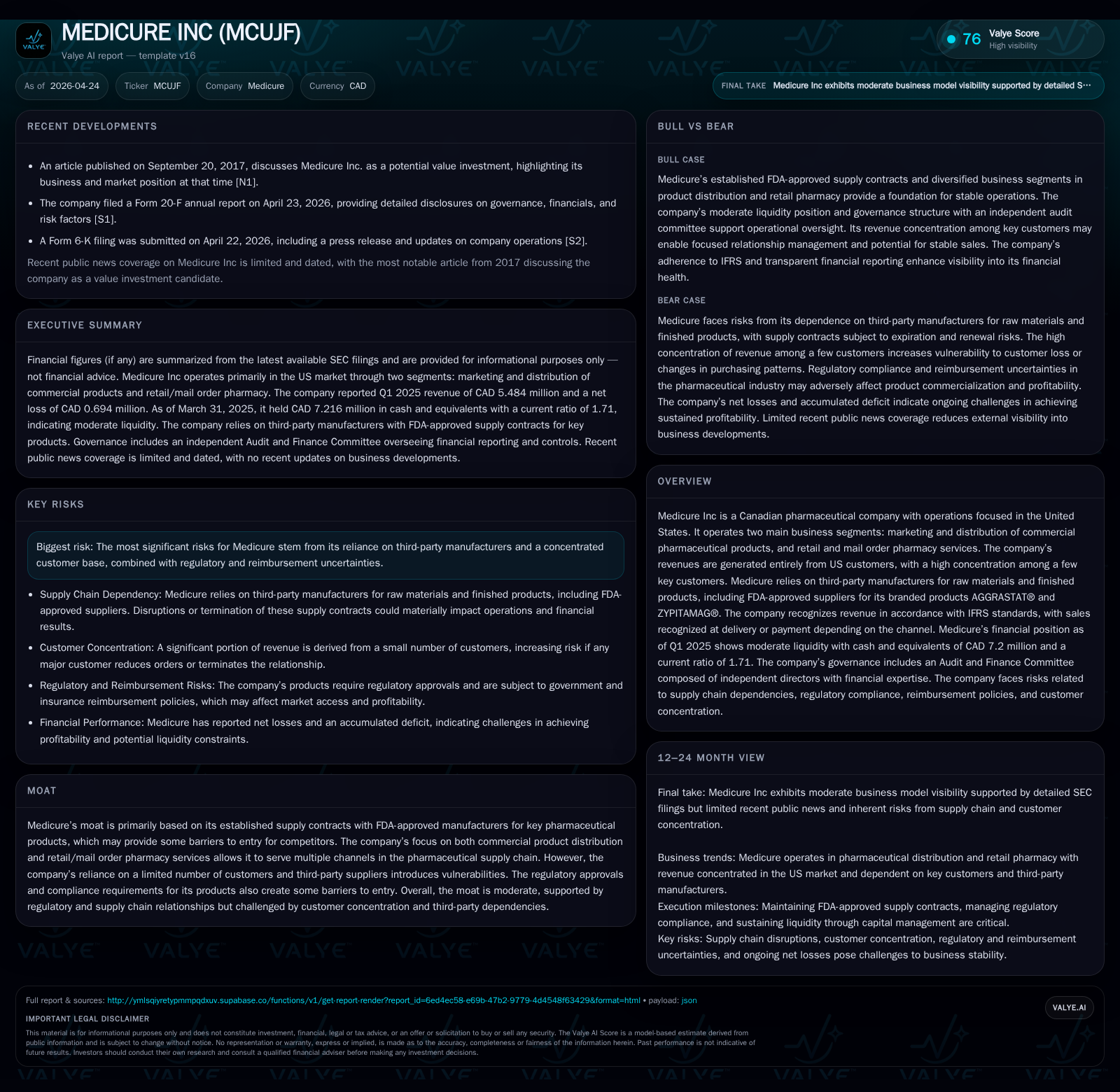
Medicure Inc’s 2026 first-quarter update signals steady operations with no major shifts in financial or operating metrics, reinforcing the company’s reliance on a few major US customers and outsourced manufacturing partners. Its business model splits between pharmaceutical product distribution, anchored by AGGRASTAT® and ZYPITAMAG®, and retail plus mail order pharmacy services. The company faces growth constraints primarily from customer concentration risks, regulatory complexities, and supply chain dependencies. While patents and FDA approvals provide moderate barriers to entry, these advantages are offset by vulnerabilities related to limited internal manufacturing and heavy reliance on a narrow customer base.
Latest Quarterly Operating Update: What Changed? Medicure Inc's Form 6-K dated April 23, 2026 [S2] offers a window into its ongoing operational status without signaling major deviations from prior periods. The report confirms that Medicure continues to file under Form 20-F annually but did not disclose new material events or significant changes in its commercial or financial performance within this quarterly disclosure. Its liquidity posture remains solid at quarter-end March 31, 2025, with cash and equivalents standing at CAD 7.2 million and a current ratio of 1.71 according to latest available data [F1]. This stability supports ongoing operations particularly given the company’s exposure to supply chain complexities. While the quarterly report does not divulge updated revenue or profitability figures, it effectively anchors near-term expectations that Medicure’s dual-segment operations—pharmaceutical distribution plus retail/mail order pharmacy—maintain established patterns without operational disruptions or unexpected volatility [S2]. The absence of fresh guidance underscores a cautious approach during continuing industry headwinds such as regulatory uncertainty and customer dependency. ## Business Model Overview: Revenue Streams and Product Offerings Medicure operates with a bifurcated revenue model focused predominantly on the US pharmaceutical market despite its Canadian headquarters [S1][S5]. The company's revenue streams flow through: - Marketing and distribution of commercial pharmaceutical products: This segment features sales of branded products including AGGRASTAT® (an intravenous platelet aggregation inhibitor) and ZYPITAMAG® (a statin drug), both covered under active U.S. patents granting moderate exclusivity [S1]. These patents stem from acquisitions completed in mid-2000s and provide protective barriers around core technologies related to cardiovascular therapeutics. - Retail and mail order pharmacy services: Operating through established chains such as Marley Drug, Gateway Pharmacy, and West Olympia Pharmacy, Medicure supports direct patient access routes complementing its distribution business [S5]. This segment contributes the majority share of total revenues (~70%) but also entails high operational expenditures given retail complexities. All revenue recognition conforms to IFRS standards whereby product sales are recognized at delivery or receipt of payment depending on channel-specific terms. Importantly, Medicure’s revenue concentration is substantial; historical data show that top three customers constitute roughly 90%+ of total sales volume with Customer C alone accounting for nearly half the revenue base [S5][F1]. This creates heightened counterparty risk should any client relationship deteriorate. The company outsources manufacturing entirely to third-party vendors who must meet stringent FDA requirements for raw materials and finished goods production—including for AGGRASTAT® and ZYPITAMAG®—highlighting limited vertical integration yet reliance on regulated supply quality control [S1][S4]. ## Competitive Positioning and Industry Structure Medicure's competitive moat can best be described as moderate—anchored in intellectual property rights for their flagship drugs coupled with secured supply agreements with FDA-approved contract manufacturers [S1][S7]. These elements erect entry barriers for new competitors seeking to replicate or supplant Medicure’s therapeutic offerings. However, this advantage is tempered by several structural vulnerabilities: - Customer Concentration: Dependence on very few large customers challenges bargaining power dynamics. Loss or repricing pressure from any major client could materially impact revenue flows [S5]. - Third-party Manufacturing Risks: Outsourcing inherently subjects Medicure to operational risks including regulatory compliance delays, production bottlenecks, or quality failures which can disrupt supply continuity [S4][S12]. - Regulatory Complexity: Navigating FDA approvals–for both marketed products and those potentially in development or acquisition pipelines–imposes costly timelines and risk of non-approval outright [S1][S21]. Furthermore, competition arises not only from branded pharmaceutical firms but increasingly from generic entrants employing strategies such as authorized generics or patent challenges to erode market exclusivity post-patent expiry, further pressuring Medicure’s growth prospects [S16]. ## Growth Drivers and Constraints for Medicure Growth prospects hinge on several interlinked drivers yet face notable impediments: Drivers:
- Continued commercial penetration of AGGRASTAT® and expansion of ZYPITAMAG® sales could underpin revenue gains if successfully marketed within existing clinical niches.
- Expansion opportunities in the Pharmacy Business Segment through tactical acquisitions or organic growth could broaden retail footprint [S5][S21].
- Potential licensing deals or future patents may incrementally enhance product pipeline relevance although recent filings indicate R&D efforts specifically related to MC-1 have ceased in favor of royalty arrangements via subsidiaries [S1]. Constraints:
- High customer concentration increases vulnerability to demand shocks or unfavorable contract renegotiations.
- Regulatory hurdles remain an ever-present barrier limiting speed to market for new products or formulation enhancements; reimbursement uncertainties further complicate pricing strategies in public/private payer dynamics [S4].
- Outsourced manufacturing limits control over cost structures and responsiveness amid volatile supply chain conditions.
- Competition from generics pressures price points potentially squeezing margins in both branded drug sales and retail pharmacy offerings.
- Limited internal scientific research resources stymie proprietary innovation capacity necessitating reliance on acquisitions/licensing in an intensely competitive arena [S21]. ## Key Risks: Customer Concentration, Supplier Dependencies, and Regulatory Environment Medicure's risk profile reflects systemic industry challenges compounded by company-specific dependencies: - Customer Risk: More than 90% of annual revenues derive from only three customers—disproportionately weighing the impact of any loss or reduced purchases by these accounts [S5][F1]. Such concentration impairs negotiating leverage while increasing downside exposure. - Supplier Risk: Reliance on third-party manufacturers necessitates rigorous oversight since lapses could cause production delays, regulatory non-compliance penalties, or recalls adversely affecting product availability and reputation [S4][S12]. - Regulatory Risk: Adherence failures to complex FDA standards for approval processes as well as ongoing manufacturing practices could lead to injunctions or licensing withdrawals. Legal exposures from patent infringement litigation exist alongside environmental compliance obligations typical to pharmaceutical production facilities [S7][S13]. - Pricing/Reimbursement Uncertainty: Changes in government healthcare reimbursement frameworks or insurance coverage policies significantly influence Medicure’s capacity to achieve sustainable returns on marketed products—a factor critical in the highly regulated US healthcare landscape where Medicare/Medicaid coverage decisions play a defining role [S4][S8]. ## Looking Ahead: Milestones and Execution Criteria Absent explicit forward guidance in the latest quarterly report ([S2]), focus shifts toward identifiable strategic execution points: - Monitoring evolution in regulatory approvals for existing products remains crucial given historic sensitivity around approvals impacting commercial viability.
- Securing renewal or initiation of supply contracts with FDA-compliant manufacturers will dictate uninterrupted product availability.
- Sustainment or growth in market share among key customers will serve as a bellwether for ongoing commercial health given concentrated revenue sources.
- Expansion initiatives within retail/mail order pharmacy operations offer tactical avenues but require integration discipline.
- Licensing new patents or acquiring pharmaceutical businesses could revitalize product pipeline though financial capacity constraints limit scope without external funding sources. Investors should watch periodic disclosures around earnings trends particularly relative to margin improvements; updates on litigation outcomes that may affect intellectual property protections; marketing success metrics especially surrounding AGGRASTAT®; developments around reimbursement eligibility; alongside operational stability indicators linked to supply chain resilience. ## Financial Snapshot: Liquidity, Profitability, and Capital Structure The financial profile corroborates operating conclusions pointing toward persistence rather than breakthrough achievements: ### Historical performance (annual) | FY | Rev ($mm) | Net ($) | Rev YoY | Net YoY | | --- | :---: | :---: | :---: | :---: | | 2024 | 22 | -1039000 | +1.0% | -12.7% | | 2023 | 22 | -922000 | -5.9% | -167.5% | | 2022 | 23 | 1365000 | +6.1% | +287.8% | | 2021 | 22 | -727000 | | | Source: SEC companyfacts cache [F1]. ### Capital returns and efficiency (annual) | FY | ROE% | | --- | :---: | | 2024 | -5.0 | | 2023 | -4.6 | | 2022 | 6.5 | | 2021 | -3.9 | Source: SEC companyfacts cache [F1]. Despite modest top-line growth of approximately +1% year-over-year between FY2023–FY2024 [F1], net losses have deepened by nearly -12.7%, reflecting ongoing challenges achieving sustainable profitability. Capital management policies emphasize maintaining going concern status while retaining flexibility via equity issuance or debt instruments if required; dividends remain suspended focusing resources on development/commercialization priorities [S3][S9]. --- This analysis is based solely on publicly available SEC filings up to April 24th, 2026 ([S1], [S2], et al.) combined with companyfacts reported financials ([F1]). It does not constitute investment advice but aims to contextualize Medicure Inc’s operational positioning within its competitive environment amid evolving industry dynamics.
Disclaimer: This is research-only, informational analysis and not investment advice. It may include AI-generated interpretation and general industry context. Always verify important details using primary sources.

Comments