
Jianpu Technology Inc. Evolves Leadership as It Balances Regulatory Complexity and Growth Ambitions
A recent CEO transition at Jianpu Technology highlights continuity amid regulatory and operational challenges in the China fintech sector.
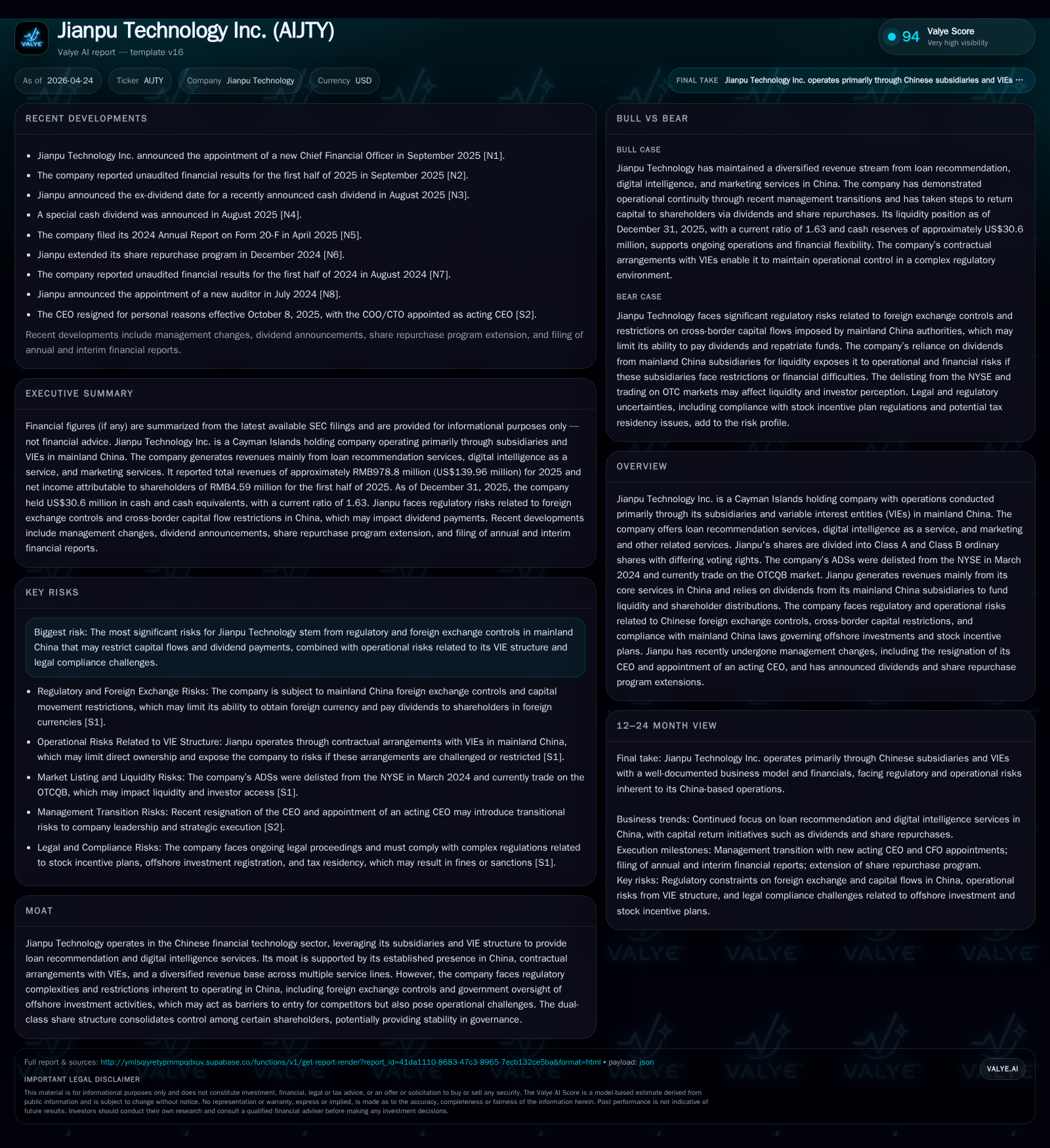
Jianpu Technology Inc. announced a leadership change in late 2025 with CEO David Ye stepping down after 14 years, succeeded by acting CEO Caofeng Liu. Operating primarily through VIE structures in China, Jianpu offers loan recommendation and digital intelligence services in a regulated environment that restricts capital flows and dividend payments. The company leverages its technology platform and data ecosystem to sustain competitive positioning amid industry headwinds. Investors should monitor management stability, regulatory compliance, and operational metrics. Financially, Jianpu reported modest profitability and strong operating cash flow with solid liquidity at year-end 2025.
Leadership Transition Reflects Strategic Continuity Amid Change
In September 2025, Jianpu Technology Inc.'s board announced the resignation of long-serving CEO Daqing (David) Ye effective October 8, coinciding with the company's 14th anniversary of operations [S2]. Mr. Ye had served as CEO since October 2017 and continues as chairman of the board to provide strategic guidance during this leadership transition [S1].
Caofeng Liu, previously Chief Operating Officer and Chief Technology Officer since early 2025, was appointed acting CEO [S2,S1]. As a co-founder with deep involvement in Jianpu’s technology architecture and operations, Liu’s elevation signals continuity combined with an emphasis on innovation to address market pressures.
Core Business Model: Loan Recommendation & Digital Intelligence Services
Jianpu operates primarily through variable interest entity (VIE) arrangements controlling subsidiaries in mainland China engaged in consumer financial services [S1]. The company’s offerings focus on loan recommendation platforms generating commissions from financial institutions alongside digital intelligence services providing data analytics to optimize client decision-making.
Marketing solutions further diversify revenue streams by monetizing user engagement related to financial products. This integrated approach benefits from proprietary user data sets and internally developed risk assessment algorithms overseen by CTO Liu — enabling scalable service expansion at relatively low incremental cost.
Operating Environment: Navigating China’s Regulatory & Capital Controls
The company’s VIE structure subjects it to significant regulatory constraints including foreign exchange controls enforced by the State Administration of Foreign Exchange (SAFE), limiting cross-border capital flows such as dividend remittances [S1,S13]. Statutory reserves required within mainland subsidiaries amounted to approximately RMB66.8 million (USD 9.6 million) at year-end 2025 restricting available distributable cash [S7].
Cross-border funding requires government approvals or registrations adding complexity to liquidity management [S1]. Noncompliance risks related to shareholder SAFE registration may impede profit distributions or trigger enforcement actions [S13]. These factors create operational challenges but also raise barriers for potential new entrants.
Competitive Position Within Chinese Fintech Landscape
Jianpu competes against well-capitalized domestic fintech firms leveraging extensive big-data ecosystems and AI for credit risk modeling. Its entrenched VIE structure and diversified offerings provide structural moats protecting market share despite margin pressure from scale competition and rising compliance costs.
Customer switching costs arise from integration of data intelligence platforms with institutional lenders’ underwriting systems enhancing retention but necessitating ongoing innovation investment.
Pricing power is moderate; commoditization affects baseline services while premium enterprise-level analytics preserve differentiated value propositions.
Growth Catalysts & Operational Constraints
Growth opportunities stem from increasing fintech adoption among China’s expanding middle class seeking AI-enhanced personalized credit products led by acting CEO Liu’s technology focus [S2,S1]. Upselling value-added marketing services based on accumulated consumer insights offers cross-selling synergies.
However, macroeconomic uncertainties coupled with intensified regulatory supervision over fintech lending and capital flows pose growth ceilings . Credit quality trends linked to economic cycles could impact referral volumes or fee realization.
Execution discipline in cost control alongside sustained product innovation will be critical to maintaining competitiveness amid external headwinds.
What Investors Should Monitor Next
Key areas for investor focus include updates on leadership team stabilization post-CEO transition including confirmation of Caofeng Liu’s permanent role [S2], dividend distribution capacity under evolving SAFE interpretations, and SAFE registration compliance progress.
Monitoring quarterly KPIs such as loan recommendation volumes, client acquisition rates, retention within digital intelligence services, and regulatory disclosures remains essential [S1,S2].
Financial Overview: Stability Amid Operational Challenges
For fiscal year 2025, Jianpu reported operating income of approximately $3.08 million and net income near $4.59 million — declines from prior-year levels but indicative of operational stabilization following previous loss periods [F1].
Operating cash flow was strong at about $15.11 million despite margin pressures; capital expenditures were significantly reduced to $47 thousand reflecting a conservative investment stance prioritizing efficiency over expansion [F1].
The firm’s balance sheet shows cash & equivalents near $30.6 million and current liabilities around $40 million, yielding a current ratio of approximately 1.63 based on the latest available data [F1].
The company’s net debt position is modestly negative (net debt approximately negative $2.9 million) indicating a net cash position that may provide flexibility for selective strategic initiatives amid industry consolidation or innovation waves [F1].
Historical performance (annual)
| FY | Net ($mm) | CFO ($mm) | OpInc ($mm) | Capex ($) | Net YoY |
|---|---|---|---|---|---|
| 2025 | 5 | 15 | 3 | 47000 | -68.4% |
| 2024 | 15 | 11 | 7 | 985000 | +485.4% |
| 2023 | -4 | 1 | -7 | 290000 | +79.1% |
| 2022 | -18 | -22 | -22 | 262000 |
Source: SEC companyfacts cache [F1].
Capital returns and efficiency (annual)
| FY | Buybacks ($) | FCF ($mm) | ROE% |
|---|---|---|---|
| 2025 | 1000 | 15 | 10.9 |
| 2024 | 1543000 | 10 | 20.4 |
| 2023 | 0 | -6.4 | |
| 2022 | -23 | -28.9 |
Source: SEC companyfacts cache [F1].
Note: Revenue metrics are not available from provided data.
In sum, Jianpu Technology stands at a strategic inflection point where experienced leadership evolution intersects with complex regulatory dynamics shaping its fintech business model amid recovering but cautious financial performance.
Disclaimer: This analysis is based solely on publicly available SEC filings and does not constitute investment advice or recommendations regarding Jianpu Technology Inc.
Disclaimer: This is research-only, informational analysis and not investment advice. It may include AI-generated interpretation and general industry context. Always verify important details using primary sources.

Comments