
Sunlands Technology Group Drives Stable Cash Flow with Diverse Adult Education Offerings
Sunlands maintains operational stability and a strong cash flow profile through a wide range of online adult education services despite enrollment softness and regulatory challenges.
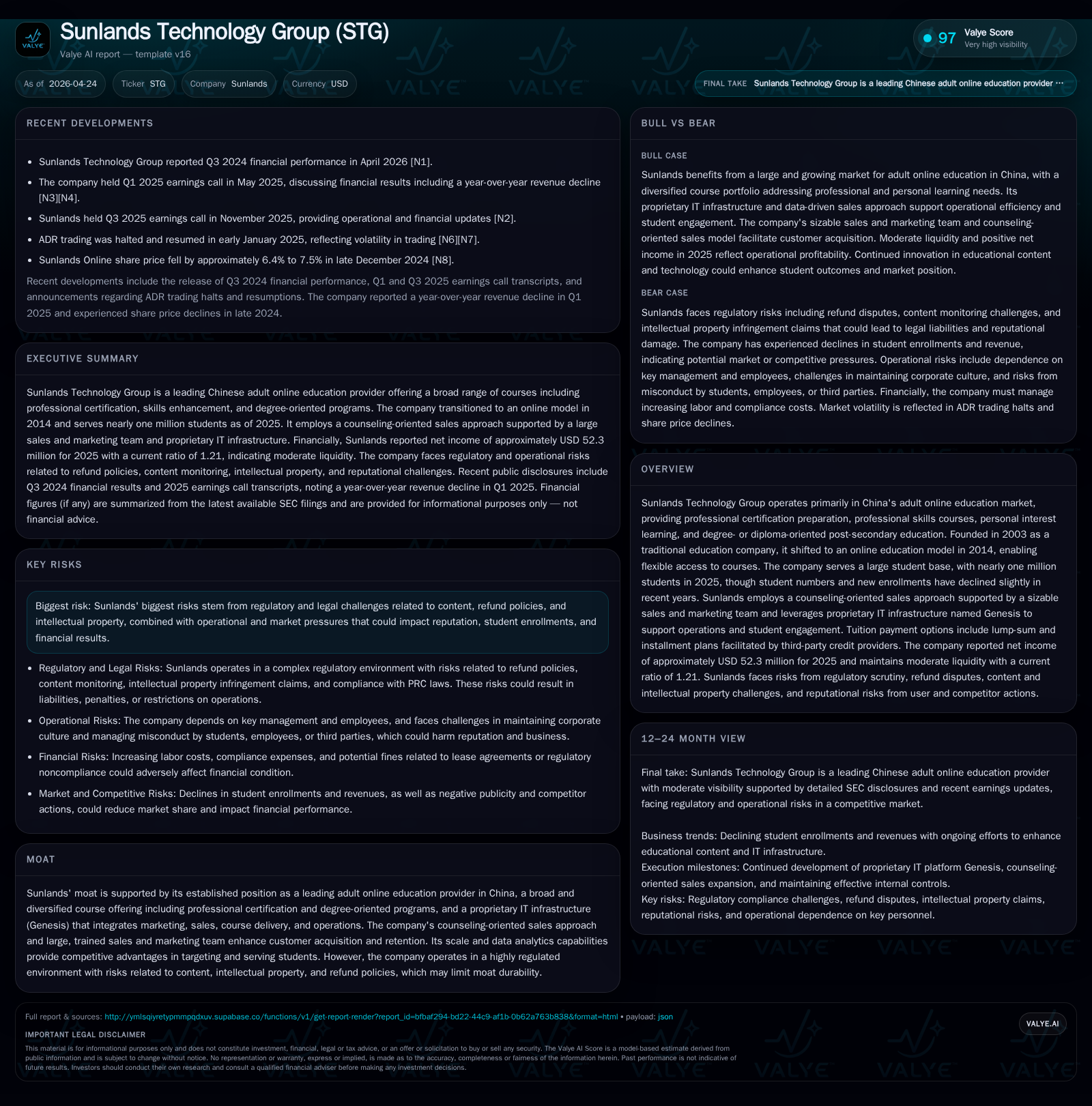
In its latest quarterly filing as of April 2026, Sunlands Technology Group demonstrated stable operating cash flow of RMB146.8 million (US$21.0 million) amid modest declines in new enrollments, reflecting resilient demand in its adult online education offerings. The company’s integrated business model leverages its proprietary Genesis IT infrastructure and counseling-oriented sales to serve nearly one million students, focusing on professional certifications and post-secondary degrees. While regulatory restrictions on content and refund policies pose ongoing risks within China’s strict ed-tech environment, Sunlands' scale, diversified course portfolio, and data-driven approach support competitive positioning and potential steadiness in a softening market. Financially, Sunlands shows improving operating income (+32% YoY) and net income growth (+12% YoY) with no debt burden and ample liquidity that underpin operational resilience.
Latest Quarterly Operating Update: Stability amid Enrollment Fluctuations
Sunlands Technology Group’s most recent quarterly disclosure ([S2], [S3]) confirms continued positive operating cash generation of RMB146.8 million (US$21.0 million) for fiscal year 2025 despite observable softness in new student enrollments compared to prior years. The company attributes the gap between reported net income of RMB365.6 million (US$52.3 million) and operating cash flow mainly to decreases in deferred revenue — tuition paid upfront but recognized over time — signaling moderation in upfront tuition payments relative to prior years ([S1], [S7]). This marks a transition from the stronger net cash read-through in 2024 (RMB195.5 million), demonstrating how shifts in payment timing affect liquidity.
Notably, Sunlands does not face material debt refinancing pressures or leverage constraints ([F1]); it finished 2025 with zero total debt alongside substantial cash reserves (~$82M USD) ([F1]), providing operational flexibility amid sector uncertainties. The operating environment remains challenging but manageable.
Sunlands’ Business Model: Integrated Adult Online Education with Proprietary Platforms
Founded originally in 2003 as a traditional educator before pivoting exclusively online by 2014 ([S1], [S18]), Sunlands focuses on China’s adult education market offering professional certification preparation, post-secondary diplomas/degrees, professional skills, and personal interest courses. Monetization is predominantly via tuition fees collected upon enrollment either upfront lump sum or through installment plans facilitated by third-party credit providers, injecting some financing flexibility for learners.
Central to Sunlands’ operational efficiency is its proprietary Genesis platform — an integrated IT infrastructure supporting end-to-end processes including marketing outreach, counseling-driven sales execution, course delivery via mobile/web apps, student engagement analytics, and administrative operations ([S18], [S24]).
Customer acquisition hinges on a large trained counseling team deploying data-analytics insights to tailor recommendations aligning course offerings with prospective students’ goals. This consultative approach targets higher conversion rates on leads generated through digital advertising campaigns placed on Baidu search engine and social media platforms like Weixin/WeChat ([S18]).
The scale benefits are significant: nearly one million active students as of end-2025 suggest network effects enabling refined data models to optimize targeting attention span retention ([S1]). Nevertheless, diversification between degree-oriented programs with longer completion horizons versus shorter-term certification courses aids revenue mixture balance but requires careful management of deferred revenue recognition timings.
Competitive Positioning within China’s Adult Ed-Tech Sector
Sunlands occupies a leading position among China’s adult ed-tech providers largely due to its expansive course catalog spanning both professional certifications such as accounting or healthcare licenses and longer-duration academic credentials ([S1], [S19]). Proprietary technology investments through Genesis reinforce defensibility by tightly coupling student lifecycle management—from awareness to engagement—into a single data-powered system difficult for smaller competitors to replicate.
That said, industry regulation remains stringent: content licensing enforcement continues to impose legal risks related to intellectual property allegations or inappropriate content flagged by regulators ([S6], [S8], [S20]). Moreover, refund policies periodically pose financial risks; refund requests associated with dissatisfaction or dispute resolution generate potential reputational damage given negative publicity has historically affected brand perception ([S1]).
Pricing power is further constrained given regulatory caps on tuition increases plus competitive pressure from an expanding roster of market participants including generalist MOOCs and degree programs offered by state-run entities ([S6]). However, Sunlands’ counseling-sales emphasis supports moderate switching costs by embedding personalized service into enrollment decisions.
Key Growth Drivers and Headwinds: Demand Trends, Regulatory Environment, and Technology
Demand drivers remain fundamentally structural: the professional certification market in China continues expanding as workforce credentialing gains importance for career advancement amid economic transformation. Additionally, online education adoption has incrementally risen post-pandemic owing to convenience preferences and technological ubiquity across tier-2/3 cities where physical program access is limited ().
Conversely, stricter PRC regulatory oversight since 2020 curbs certain promotional activities limiting aggressive discounting or marketing claims that once fueled rapid user acquisition blitzes ([S20], [S25]). The refund dispute friction also occasionally escalates investor caution given associated financial liabilities.
From a technology angle, continual enhancements of the Genesis platform contribute competitive differentiation as realtime data collection enables predictive analytics optimizing student outcomes thus fostering retention—an increasingly crucial metric amid slowing growth trends ([S18], [S24]).
Monitoring Indicators: Enrollment Metrics, Refund Trends, and Regulatory Developments
Investors should focus on enrollment trajectory messages forthcoming from subsequent quarterly disclosures following Q1-Q2 periods where seasonal variations typically manifest strongly ([N1]). A stable or improving conversion rate from leads to paying students would signal resilience above cyclical soft spots.
Refund requests frequency relative to billings also acts as an early signal balancing customer satisfaction against aggressive sales tactics which might backfire financially or publicly ([S1]). Lastly, any shifts in government policies regarding tuition caps or licensing regimes could structurally re-shape addressable market size or compliance burden unpredictably.
Marketing campaign effectiveness leveraging Genesis analytics should be scrutinized carefully—incremental cost efficiencies or lead-volume upticks could offset macro headwinds.
Financial Overview: Robust Liquidity and Improving Profitability Support Operational Resilience
Sunlands’ annual financials for FY2025 confirm rebound momentum: revenue increased about 32% year-over-year while operating income grew roughly 32%, reaching $53.8 million USD; net income advanced roughly 11.6% reaching $52.3 million USD ([F1]). Operating cash flow declined modestly by 21.6% largely due to the decrease in deferred revenue reflecting softer upfront tuition collections discussed earlier but remains positive at ~$21M USD indicating healthy core earning quality.
Balance sheet status remains strong with zero total debt recorded as of end-2025 accompanied by $82M USD cash & equivalents generating comfortable liquidity buffer measured by current ratio at 1.21x ([F1]). Capital expenditures remain minimal around US$30K annually focused primarily on maintaining critical IT infrastructure rather than expansionary spend.
Dividend payouts are currently suspended reflecting prioritization of reinvestment into business growth areas alongside cautious capital preservation amid regulatory uncertainties ([F1], [S15]). Share repurchases have been modest but consistent suggesting board confidence without overstressing liquidity positions.
Historical performance (annual)
| FY | Net ($mm) | CFO ($mm) | OpInc ($mm) | Capex ($) | Net YoY |
|---|---|---|---|---|---|
| 2025 | 52 | 21 | 54 | 30000 | +11.6% |
| 2024 | 47 | 27 | 41 | 35000 | -48.1% |
| 2023 | 90 | 20 | 81 | 812000 | -3.3% |
| 2022 | 93 | 1 | 89 | 470000 |
Source: SEC companyfacts cache [F1].
Capital returns and efficiency (annual)
| FY | Div ($mm) | Buybacks ($) | FCF ($mm) |
|---|---|---|---|
| 2025 | 0 | 882000 | 21 |
| 2024 | 1500000 | 27 | |
| 2023 | 4 | 669000 | 19 |
| 2022 | 5 | 977000 | 1 |
Source: SEC companyfacts cache [F1].
The combined picture suggests Sunlands leverages its diverse adult education portfolio underpinned by proprietary technology and counseling-driven sales methodology to sustain stable cash flow generation despite near-term softness in demand attributable partly to macro-regulatory shocks rather than structural weakening.
Disclaimer: This analysis is based solely on disclosed SEC filings dated up to April 24, 2026, company factual datasets corresponding thereto, and publicly available news sources cited herein; it does not constitute investment advice or recommendations.
Disclaimer: This is research-only, informational analysis and not investment advice. It may include AI-generated interpretation and general industry context. Always verify important details using primary sources.

Comments