
Zepp Health Corp Confronts Supply Chain and Competitive Challenges with Integrated Wearable Ecosystem
Latest quarterly results underscore operational resilience amid intensifying supply chain pressures and market competition.
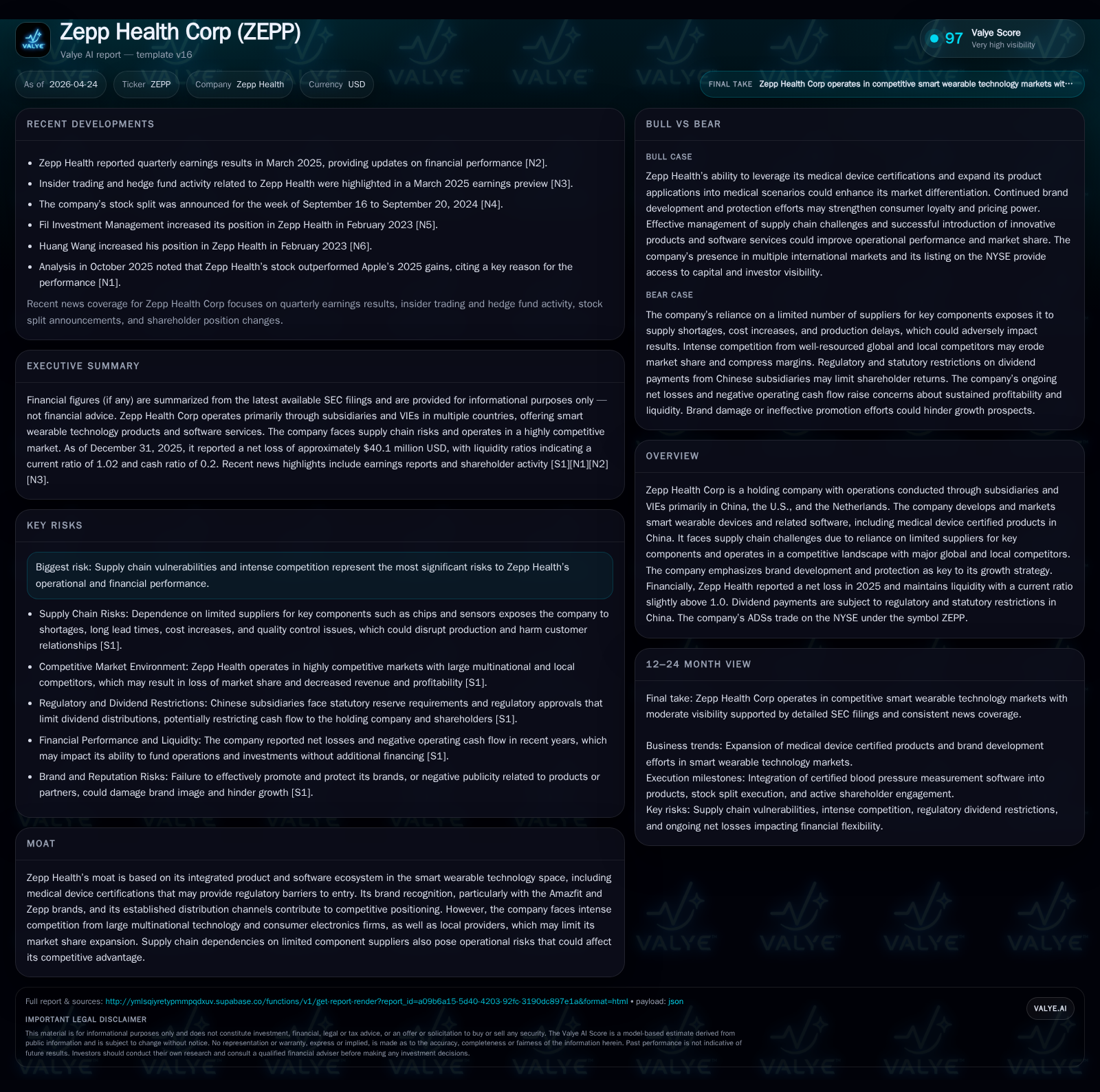
Zepp Health’s Q1 2026 SEC 6-K filing confirms ongoing business stability without major adverse changes, anchoring its near-term outlook. The company’s integrated wearable device and software ecosystem, coupled with medical-device certifications in China, underpin its distinctive business model. However, supply chain vulnerabilities, concentrated component sourcing, and fierce competition from global and local players impose persistent growth constraints. Key growth drivers include brand development and expansion into certified medical wearables, while financial results reveal narrowing losses but continued negative cash flow.
Latest Quarterly Operating Highlights: What Changed in Q1 2026
Zepp Health’s recently filed Form 6-K on March 16, 2026 [S2] serves as the immediate operational touchpoint. This filing primarily reaffirms procedural compliance under the Securities Exchange Act of 1934 without flagging any material adverse changes since the prior annual report. The company confirms intent to continue filing under Form 20-F and remains current on disclosures. Although explicit financial or operational detail in the filing is minimal, absence of negative commentary implies steady-state conditions. Past seasonality in operating cash flows—typically marked by outflows early in the year partially offset later—likely continues but is not explicitly updated.
Zepp Health’s Business Model: Ecosystem Integration and Product Differentiation
Per the comprehensive 20-F filing dated April 24, 2026 [S1], Zepp Health Corp operates as a holding company principally executing business through subsidiaries and VIEs in China, the U.S., and the Netherlands. Its core value proposition centers on smart wearable technology encompassing hardware devices such as fitness trackers, smartwatches, and medical-grade monitors alongside a proprietary software ecosystem.
The company distinguishes itself by securing medical device certifications within China for select products, reinforcing regulatory barriers to entry [S1], [S17]. Revenue recognition hinges largely on product sales recorded at net transaction price including estimation of variable consideration linked to cooperation agreements with key customers [S23]. The standalone selling price methodology integrates expected cost plus margins within a sophisticated internal pricing model influenced by consumer behavior analytics [S4].
Integration across hardware sales drives recurring user engagement through software updates and health monitoring services embedded in devices; this fosters user retention crucial to sustaining revenue streams despite competitive pressures.
Competitive Landscape and Industry Structure Within Smart Wearables
Zepp Health navigates an intensely competitive smart wearables market populated by multinational giants like Apple and Xiaomi as well as specialized firms such as Garmin and Fitbit [S9]. These competitors benefit from scale advantages, broader ecosystems (e.g., Apple’s iOS integration), or entrenched brand loyalty. Zepp mitigates this by emphasizing its Amazfit and Zepp brands targeting mid-to-high-end segments [S17], aiming to carve out distinct niches particularly with medical-device validated offerings.
However, supplier concentration for critical components like BLE system-on-chip products, memory modules, main control chips, and sensors presents operational headwinds [S9]. Industry-wide chip shortages exacerbated by geopolitical tensions and pandemic-related disruptions create procurement challenges that risk production bottlenecks.
Brand protection efforts including intellectual property enforcement against counterfeiting remain vital given frequent quality dilution risks associated with knock-offs that could erode consumer trust [S13].
Growth Opportunities and Constraints: Navigating Demand, Margins, and Market Pressures
Growth vectors for Zepp Health concentrate on expanding brand recognition internationally while deepening penetration within China’s burgeoning medical wearable segment. Regulatory clearance like CE marking in Europe and compliance with HIPAA in the U.S. unlock pathways for new customer acquisition but entail elevated compliance costs [S17].
R&D investment remains a core pillar supporting continuous product innovation though capital expenditure moderates reflecting cautious capex management at $516K USD for full-year 2025 [F1], [S12]. While penetration of wearables overall is structural growth driven by health awareness trends globally, margins face contraction risks due to component cost inflation combined with intensified pricing competition , [S4].
Geographic diversification via subsidiaries in three jurisdictions constitutes a structural advantage by tapping multiple markets but also imposes complexity regarding governance especially given statutory restrictions on dividend repatriation from PRC subsidiaries contingent on retained earnings [S1], [S15].
Key Risks Spotlight: Supply Chain Dependencies and Market Rivalry
Concentration risk on limited suppliers for electronic components remains critical; shifting supplier relationships toward competitors or demand surges causing allocation shortfalls could disrupt manufacturing schedules harming relationships with end customers [S9], .
Data privacy regulations present additional risk vectors as Zepp collects sensitive health data necessitating compliance with evolving Chinese cybersecurity rules alongside stringent U.S. HIPAA standards. Non-compliance could result in fines or reputational damage undermining user base trust [S16], [S17].
Moreover, reliance on contractual arrangements with VIEs rather than direct ownership introduces legal uncertainty should PRC regulatory interpretations shift adversely impacting operational control or forcing restructuring measures [S16].
Next Steps to Monitor: Guidance, Milestones, and Execution Signals
Future monitoring should prioritize quarterly filings for signs of shifts in working capital that might reflect inventory buildup or receivable collection issues consistent with historical seasonal patterns noted through past annual statements [S2], [S1]. Tracking announcements related to regulatory approvals or challenges remains crucial given their material impact on market access especially for medical certification.
Execution on R&D initiatives can be gauged through patent filings or product launches expanding differentiated offerings that potentially offer improved unit economics amid pricing pressures noted previously [S4], [S12]. Also important will be scrutiny of debt maturity management given recent refinancing activity aimed at extending maturities as disclosed during the first quarter of 2026 though not detailed explicitly here [S3].
Financial Review: Liquidity, Profitability, and Capital Structure in Context
Historical performance (annual)
| FY | Rev ($bn) | Net ($mm) | CFO ($mm) | OpInc ($mm) | Rev YoY | Net YoY |
|---|---|---|---|---|---|---|
| 2025 | -40 | -26 | -29 | +47.1% | ||
| 2024 | -76 | -24 | -47 | -153.5% | ||
| 2023 | 2.5 | -30 | 42 | -29 | -39.8% | +28.5% |
| 2022 | 4.1 | -42 | -114 | -59 | -33.7% |
Source: SEC companyfacts cache [F1].
Capital returns and efficiency (annual)
| FY | Div ($mm) | Buybacks ($mm) | FCF ($mm) |
|---|---|---|---|
| 2025 | 1 | -26 | |
| 2024 | 6 | 2 | -26 |
| 2023 | 3 | 40 | |
| 2022 | 6 | 8 | -115 |
Source: SEC companyfacts cache [F1].
Anchoring with full-year fiscal data ending December 31, 2025 from [F1] corroborated by disclosures in the annual report:
- Revenue declined sharply by approximately 39.8% year-over-year (translated from reported CNY figures), reflecting macroeconomic pressures or possible market share contraction.
- Operating income loss narrowed moderately to -$29.2 million USD from -$47.3 million USD in 2024 indicating incremental operational improvements.
- Net loss stood at -$40.1 million USD improving versus prior year -$75.7 million USD yet underscoring persistent unprofitability.
- Operating cash flow remained negative at -$25.7 million USD consistent with prior year outflows underscoring ongoing cash burn pressures.
- Capex was tightly controlled at just over half a million dollars USD demonstrating capitalization discipline amid uncertain demand.
- Total debt approximates $59.5 million USD against cash equivalents near $57 million USD yielding net debt around $2.4 million USD; current ratio of ~1.02 suggests liquidity stability without excessive leverage.
- Share repurchases continue at modest levels (~$1.2 million USD annually) indicating measured capital return relative to available resources.
Financially, Zepp Health exhibits stabilization tendencies but continues grappling with expanded losses vis-à-vis revenue contraction indicative of underlying structural challenges amidst volatile component costs and competitive discounting trades.
This analysis relies strictly on SEC filings up to Q1/2026 supplemented by validated corporate data without speculative assumptions beyond documented disclosures; it avoids investment recommendations or forecasts per policy mandates.
Disclaimer: This is research-only, informational analysis and not investment advice. It may include AI-generated interpretation and general industry context. Always verify important details using primary sources.

Comments