
Texas Instruments Strengthens Growth Momentum in Q1 Amid Industry Shifts
TI's Q1 2026 results highlight resilience and growth in analog semiconductors amid volatile market conditions and strategic expansion.
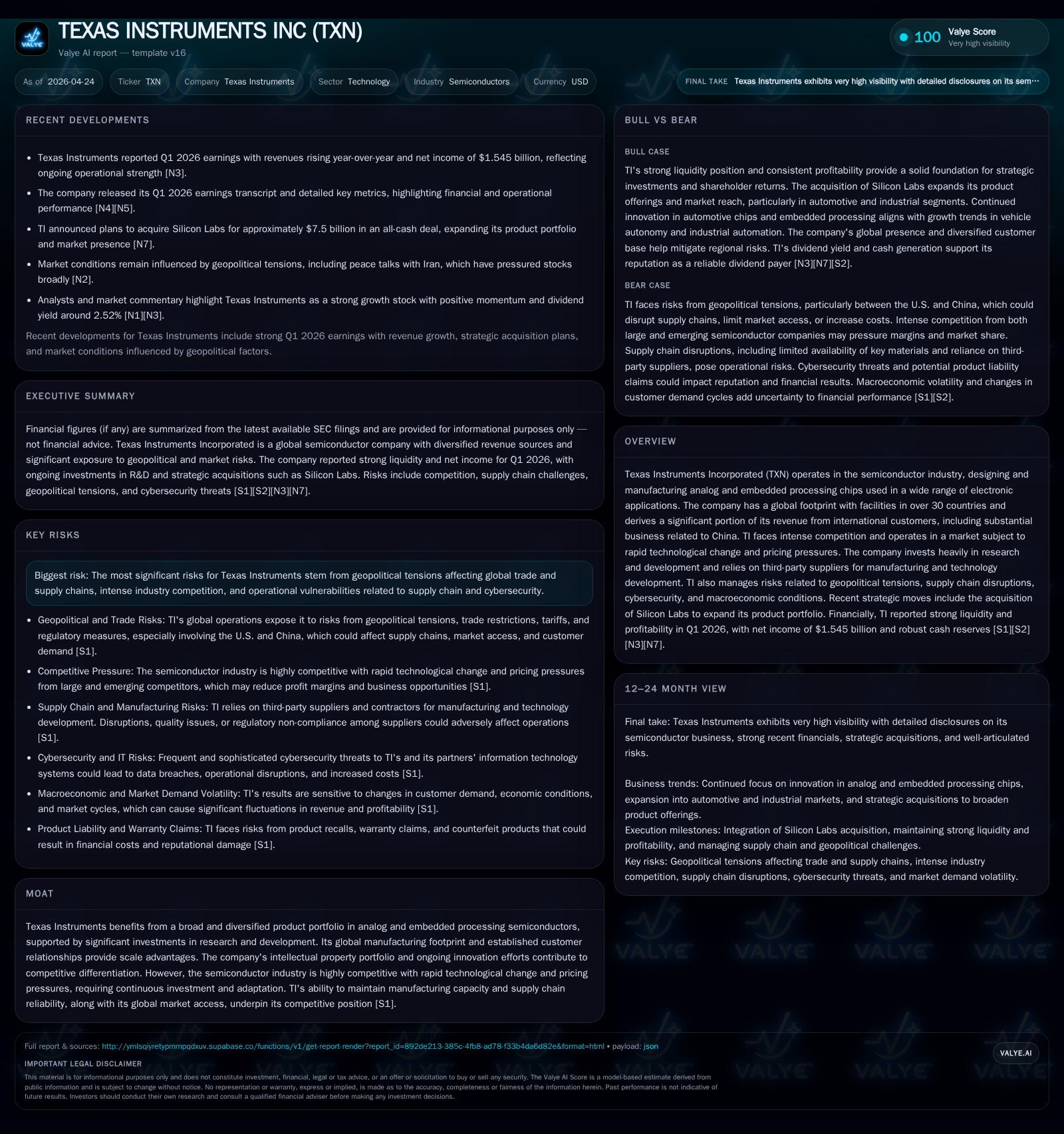
Texas Instruments (TI) delivered a robust Q1 2026 performance, exceeding revenue estimates with strong analog segment demand and margin improvement supported by operational leverage. The company's broad analog and embedded processing portfolio, bolstered by the strategic Silicon Labs acquisition, positions it well against rising geopolitical and competitive pressures. Key growth drivers include industrial automation and automotive electrification, while supply chain dynamics and geopolitical risks require continued vigilance. TI's solid liquidity and disciplined capital allocation underpin its capacity to invest in growth and return capital to shareholders.
Latest Quarterly Results Spotlight Strong Execution
In its latest Q1 2026 disclosure [S2], Texas Instruments reported revenue that surpassed consensus expectations, reflecting resilient end-market demand for its analog semiconductor products during ongoing industry challenges. Management highlighted strength in industrial end markets and automotive applications where electrification drives sustained component demand [N2][N3]. The company noted that factory utilization rates improved quarter-over-quarter, helping expand gross margins despite typical pricing pressures inherent to the semiconductor industry.
Operating income demonstrated operating leverage benefits via SKU rationalization and improved product mix favoring higher-margin offerings. Free cash flow remained robust, underpinning TI's disciplined capital allocation strategy that balances R&D investment with shareholder returns through dividends and buybacks [S3][S7]. Supply chain conditions showed gradual stabilization, a notable development given prior industry-wide disruptions.
Business Model and Product Portfolio Deep Dive
Texas Instruments generates revenue primarily through the design and manufacture of analog chips—components crucial for converting real-world signals into digital data—and embedded processors tailored for various control applications [S1]. The durability of its business model stems from lengthy product life cycles typical of analog devices which foster customer switching costs and steady replacement demand. Proprietary intellectual property assets further differentiate TI’s offerings in an intensely competitive sector.
The company's manufacturing model combines owned fabrication facilities with subcontracted wafer foundries, enabling capacity flexibility paired with control over critical processes. Its recent acquisition of Silicon Labs expands TI’s footprint in the industrial IoT space by adding complementary microcontroller units and wireless connectivity products . This strategic move enhances the company’s addressable market in automated factories and smart infrastructure applications.
Competitive Positioning within the Semiconductor Sphere
TI positions itself among the leading global suppliers of analog semiconductors alongside prominent competitors like Analog Devices, Maxim Integrated (now part of ADI), Infineon Technologies, and STMicroelectronics [S10]. While TI's scale provides cost advantages, competition remains fierce as emerging Asian players driven by state subsidies aggressively develop capabilities to challenge incumbents on pricing.
The company faces continuous pressure to innovate rapidly while maintaining cost efficiencies—challenges exemplified by accelerated consolidation trends across semiconductor vendors aiming to achieve competitive scale. Despite this, TI’s extensive portfolio breadth allows it to serve diverse customer segments with specialized solutions that command relative pricing power within niche industrial sectors.
Industry Dynamics Influencing Market Position
TI operates within a semiconductor ecosystem shaped by complex global supply chains vulnerable to geopolitical disruptions—especially US-China tensions impacting tariffs, export controls, and investment restrictions [S1][S18]. Approximately half of TI’s revenue involves shipments into China, underscoring exposure to evolving trade policies [S5]. Currency fluctuations across more than 30 operational countries add another layer of complexity.
Regulatory scrutiny has intensified globally around materials sourcing, environmental regulations, and cybersecurity compliance—factors that could influence manufacturing costs or introduce operational constraints [S9][S18]. Meanwhile, accelerated adoption of analog components is catalyzed by broader technology trends including industrial automation upgrades, increasing electric vehicle production requiring sophisticated power management chips, and expanding smart device ecosystems embedding sensor technologies.
Key Growth Drivers and Potential Headwinds
Secular growth drivers for Texas Instruments continue to reflect structural rather than cyclical demand trends. Industrial automation's accelerating pace demands increasingly complex analog functionality for robotics, factory monitoring systems, and feedback controls. Concurrently, automotive electrification heightens the need for power-efficient analog chips supporting battery management systems, motor controls, and safety subsystems.
The Silicon Labs acquisition enhances TI's ability to capture incremental market share in IoT sectors by integrating wireless communication protocols with existing analog solutions. However, macroeconomic uncertainties such as fluctuating capital expenditure patterns among customers could introduce periodic volatility. Pricing pressures remain an ongoing headwind given competitor discounting tactics and component commoditization risks.
Supply chain constraints related to rare earths or specialty substrates may limit short-term capacity expansion plans despite the company's ongoing capital investments targeting optimized factory throughput [S21]. Geopolitical risks could also affect market access or increase compliance costs resulting from tariffs or export restrictions.
Upcoming Catalysts and Risks to Monitor
Investors will closely watch management’s next quarterly earnings call for updated guidance reflecting evolving demand conditions post-Q1 [N3]. Key execution milestones include the seamless integration of Silicon Labs' product lines which is expected to begin realizing synergy benefits later this year.
Supply chain normalization efforts remain critical; progress here could improve delivery timelines while mitigating input cost inflation risks. Furthermore, potential shifts in US-China relations or regulatory changes targeting cybersecurity standards within semiconductor products may alter TI’s competitive landscape or compliance requirements rapidly [S4][S18].
Competitive dynamics warrant vigilance regarding moves among regional players backed by aggressive government incentives fostering indigenous analog capabilities that could chip away at TI’s market share over time.
Financial Overview Supporting Strategic Narrative
Supporting its strategic positioning is a solid financial foundation evidenced as of Q1 2026: cash & equivalents stood at approximately $3.55 billion with total debt around $14.15 billion yielding net debt near $10.6 billion—a level comfortably managed given TI’s strong free cash flow generation capacity [F1][S2][S3].
Annual metrics reflect a trajectory of sustained growth with FY2025 revenues up nearly 9.8% year-over-year accompanied by over 10% operating income growth showing disciplined margin management amidst revenue expansion [F1]. Operating cash flow rose over 13%, outpacing modest capex reductions indicative of efficiency gains.
Capital allocation has struck a balance between maintaining R&D commitments critical for long-term innovation while returning substantial value to shareholders via dividends (approaching $5 billion annually) complemented by escalating share repurchases evidencing confidence in intrinsic business strength [F1][S16].
Historical performance (annual)
| FY | Net ($bn) | CFO ($bn) | OpInc ($bn) | Capex ($bn) | Net YoY |
|---|---|---|---|---|---|
| 2025 | 5.0 | 7.2 | 6.0 | 4.5 | +4.2% |
| 2024 | 4.8 | 6.3 | 5.5 | 4.8 | -26.3% |
| 2023 | 6.5 | 6.4 | 7.3 | 5.1 | -25.6% |
| 2022 | 8.7 | 8.7 | 10.1 | 2.8 |
Source: SEC companyfacts cache [F1].
Capital returns and efficiency (annual)
| FY | Div ($bn) | Buybacks ($bn) | FCF ($bn) |
|---|---|---|---|
| 2025 | 5.0 | 1.5 | 2.6 |
| 2024 | 4.8 | 0.9 | 1.5 |
| 2023 | 4.6 | 0.3 | 1.3 |
| 2022 | 4.3 | 3.6 | 5.9 |
Source: SEC companyfacts cache [F1].
This financial profile underpins Texas Instruments’ capability to sustain competitive investments while navigating sector cyclicality and structural shifts.
Disclaimer: This report is for informational purposes only; it does not constitute investment advice or recommendations.
Disclaimer: This is research-only, informational analysis and not investment advice. It may include AI-generated interpretation and general industry context. Always verify important details using primary sources.

Comments