
Dingdong (Cayman) Ltd Advances with Fulfillment Scale and Private Labels Despite Margin Pressure
Latest quarterly shareholder meeting confirms strategic continuity amid intensifying competition in China's fresh grocery e-commerce sector.
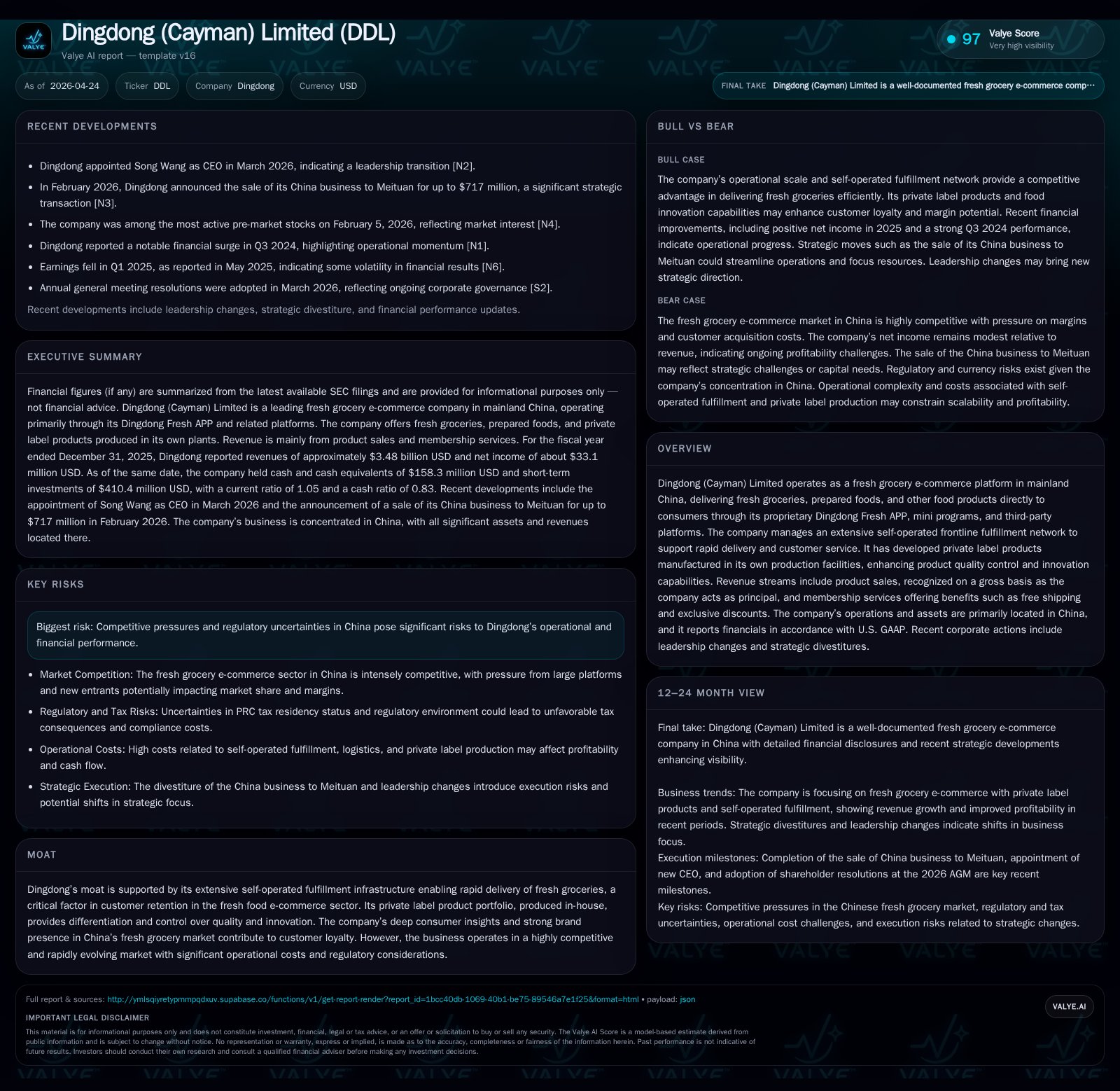
Dingdong (Cayman) Ltd’s 2026 annual general meeting ratified key resolutions reinforcing its operational strategy centered on rapid delivery and private label innovation. The company leverages an extensive self-operated fulfillment network and in-house production of private label products to differentiate itself within China’s crowded fresh grocery e-commerce market. While revenue grew over 10% in 2025 to $3.48 billion, operating income declined, highlighting continued margin pressures from high fulfillment costs and competitive pricing. Dingdong’s resilient customer loyalty and supply chain capabilities support structural growth opportunities but the business must navigate regulatory risks and cost inflation moving forward.
Recent Operating Update
Dingdong (Cayman) Limited held its 2026 Annual General Meeting (AGM) on March 27, 2026, where all proposed resolutions were approved, underscoring shareholder confidence in the current leadership and strategic direction focused on scaling fresh grocery e-commerce via an advanced supply chain infrastructure [S2]. This latest quarterly update is significant as it anchors Dingdong’s emphasis on long-term sustainable growth despite margin pressures.
The CEO change in early 2026 brought Song Wang—a seasoned executive with deep experience across mainland China’s consumer retail sector—to the helm, signaling intent to sharpen operational efficiency while leveraging his prior roles at Ele.me and Hema Fresh for competitive advantage [S1].
Business Model
Dingdong operates primarily as a fresh grocery e-commerce platform serving mainland China through its proprietary Dingdong Fresh app alongside mini-programs and third-party platforms. It facilitates direct-to-consumer sales of fresh groceries, prepared foods, and other food items recognized on a gross basis since the company is the principal seller [S1].
A major strength stems from its self-operated frontline fulfillment network comprising regional processing centers and local fulfillment stations that enable ultra-fast delivery—a critical value proposition given the perishability of goods involved. Outsourced labor for last-mile delivery complements these assets but contributes materially to fulfillment expenses that challenge margins [S19].
Additionally, Dingdong has vertically integrated supply chain elements through own production plants manufacturing private label products. This pivot towards private labels enhances product uniqueness, quality assurance, and innovation capability relative to competitors relying solely on third-party suppliers [S1].
The company also monetizes membership services that provide customers benefits such as free shipping for a set number of orders monthly, exclusive discounts, coupons expiring monthly, free fresh products daily during subscriptions, and dedicated VIP customer support—creating recurring revenue streams that help stabilize cash flow against fluctuating sales volumes [S19].
Industry Structure and Competitive Position
China’s fresh grocery e-commerce market remains intensely competitive with multiple players striving for scale in urban centers marked by increasing consumer preference for online convenience amid evolving dietary patterns. Delivery speed and product freshness are paramount differentiators.
Dingdong’s moat lies primarily in its ability to operate a tightly controlled fulfillment grid which manages the cold chain from sourcing through delivery efficiently enough to compete against giants like Alibaba-backed Freshippo and JD Fresh. Its private label strategy further distinguishes offerings with greater control over pricing flexibility.
However, this sector demands high operational expenditure—particularly labor outsourcing fees for delivery riders—and heavy investments in leased logistics spaces; thus profitability remains fragile industry-wide. Furthermore, regulatory oversight targeting data security, employment norms for gig workers, and food safety place additional compliance burdens that may raise costs or halt expansion if mishandled [S3].
Growth Drivers and Constraints
Structural tailwinds include accelerating urbanization in China’s Tier-1/2 cities driving demand for fast fresh grocery access; changing consumer demographics favoring premium quality private brands; and rising adoption of mobile commerce platforms facilitating an omnichannel shopping experience.
Conversely, growth is constrained by: (i) significant cost inflation in logistics labor affecting fulfillment margins—outsourced rider expenses have increased year-on-year; (ii) capital intensity associated with expanding processing centers to maintain speed at scale; (iii) regulatory risks around foreign currency flows given PRC governmental controls restricting dividend repatriation or cross-border cash movements; (iv) potential episodic disruptions such as localized lockdowns impacting key markets like Shanghai [S3]; (v) fierce competition driving promotional discounts compressing unit economics despite rising revenues.
The membership program serves as a buffer improving lifetime customer value but will require careful marketing spend efficiency given advertiser fatigue evidenced by fluctuating advertising expenses over recent years [S1].
What to Watch Next
Key execution points include how well Dingdong can sustain revenue growth while improving or at least stabilizing operating margins through economies of scale or automation within the fulfillment network. Metrics around membership subscriber growth, retention rates, average order values per member versus casual customers will provide insights into customer loyalty health.
Given ongoing regulatory scrutiny especially concerning fund flow restrictions between mainland subsidiaries and the Cayman holding entity—no dividends were remitted from PRC subsidiaries in recent years—the management’s capital allocation choices including share repurchases ($12 million in buybacks during recent years) will be noteworthy for signaling confidence or conservatism [S4], [F1].
Additionally, monitoring impacts from labor market conditions on outsourced delivery costs alongside any new government policies targeting gig economy worker protections will be crucial.
Technology investments around app experience enhancements or backend AI-based forecasting might also emerge as differentiators but remain unquantified explicitly.
Financial Profile Summary
Historical performance (annual)
| FY | Rev ($bn) | Net ($mm) | CFO ($mm) | OpInc ($mm) | Rev YoY | Net YoY |
|---|---|---|---|---|---|---|
| 2025 | 3.5 | 33 | 77 | 19 | +10.2% | -20.6% |
| 2024 | 3.2 | 42 | 127 | 29 | +12.3% | +424.4% |
| 2023 | 2.8 | -13 | -33 | -18 | -19.9% | +89.0% |
| 2022 | 3.5 | -117 | 13 | -111 |
Source: SEC companyfacts cache [F1].
Capital returns and efficiency (annual)
| FY | Buybacks ($mm) | FCF ($mm) | ROE% |
|---|---|---|---|
| 2025 | 9 | 51 | 22.3 |
| 2024 | 31 | 114 | 38.1 |
| 2023 | 14 | -45 | -23.9 |
| 2022 | 14 | -6 | -260.1 |
Source: SEC companyfacts cache [F1].
Dingdong exhibited solid top-line momentum with 10.2% revenue growth reaching $3.48 billion in FY2025 from $3.16 billion in FY2024 despite a challenging macro environment partly characterized by pandemic aftershocks in core urban hubs [F1]. However operating income fell by 35.9% year-on-year to just $18.8 million as rising fulfillment costs outpaced gross margin improvements indicating persistent margin pressure from logistics complexity inherent in fresh grocery e-commerce operations.
Net income similarly declined by about 20%, ending at $33 million with return on equity still respectable at approximately 22%, supported by disciplined share repurchases funded primarily from healthy operating cash flows [$76.6 million CFO versus $25 million capex delivering positive free cash flow near $51 million] that underscore solid liquidity positioning; cash reserves stood robustly at $158 million at year-end enabling comfortable coverage of current liabilities ($685 million), resulting in a current ratio above one at ~1.05 confirming manageable short-term obligations [F1], [S2].
Debt is effectively zero on a long-term basis allowing operational flexibility. The company continues investing aggressively into logistics capacity expansion evidenced by near doubling capex spend compared to prior year while maintaining stable headcount investment focusing on sustaining rapid delivery.
Despite profitability challenges typical for high-growth last-mile ventures competing intensively on service speed amidst wage inflation, Dingdong maintains a resilient financial foundation suitable for continued market share gains if operational efficiencies can improve.
This analysis is based exclusively on publicly available information up to April 2026 including Dingdong's SEC filings without making speculative projections or offering investment advice. Readers should consider the dynamic nature of China's fast-evolving fresh grocery e-commerce sector when interpreting these findings.
Disclaimer: This is research-only, informational analysis and not investment advice. It may include AI-generated interpretation and general industry context. Always verify important details using primary sources.

Comments