
Moog Inc. Reshapes Capital Structure to Support Steady Aerospace Growth
Latest quarterly filings highlight Moog’s strategic debt refinancing and operational resilience amid steady aerospace sector demand.
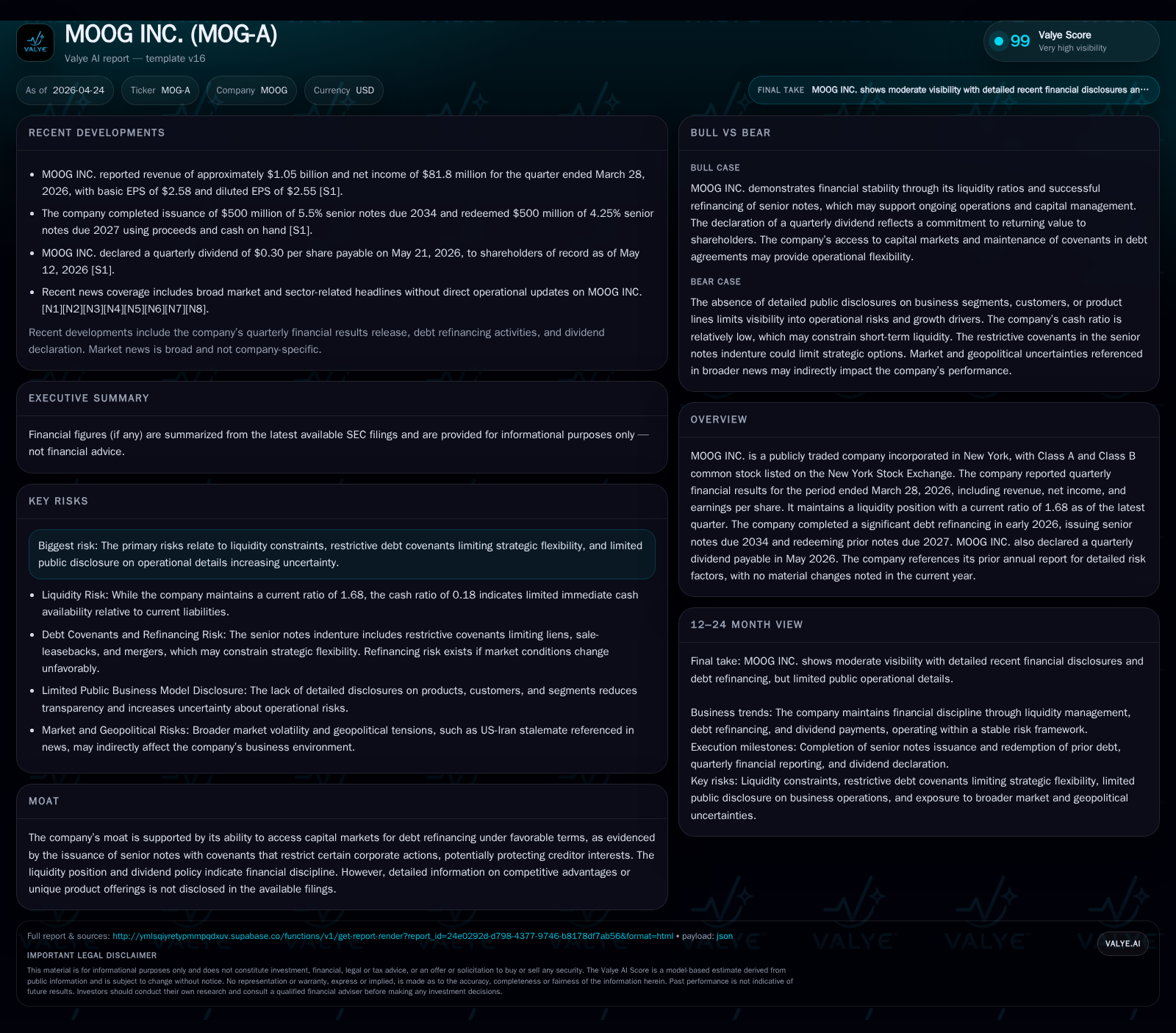
Moog Inc.'s Q2 2026 10-Q reveals a significant refinancing event: issuance of $500 million senior notes due 2034 replacing prior notes due in 2027, extending debt maturity and strengthening liquidity. The company operates in the specialized aerospace controls segment, with durable customer relationships and differentiated product complexity underpinning pricing power. While growth is fueled by aerospace recovery and defense spending, restrictive debt covenants and limited disclosure add some strategic constraints. Financial discipline remains central, as reflected in a stable dividend policy and solid liquidity metrics.
Recent Quarterly Operating Results and Capital Structure Update
Moog Inc.’s latest quarterly filing for the period ended March 28, 2026 [S2] anchors this analysis with a key capital restructuring development. Financially, Moog maintains a solid liquidity position characterized by a current ratio of approximately 1.68 (current assets of $2.79 billion vs current liabilities of $1.67 billion) as of quarter-end [F1], supported by $308 million in cash equivalents and manageable leverage with net debt around $943 million [F1]. There were no material changes to risk factors disclosed [S5], suggesting continuity in business environment expectations.
In parallel with these financing activities, the company declared a quarterly dividend payable in May 2026, reaffirming disciplined capital allocation amid operational steadiness [S20].
Moog’s Business Model: Precision Aerospace Controls and Aftermarket Services
Moog operates predominantly in the niche market of precision motion control solutions for aerospace applications—primarily actuation systems that control flight surfaces and engine components integral to aircraft performance [F1],[S2]. This specialization requires engineering depth given the critical safety standards and reliability demands inherent to aerospace OEMs and defense clients.
Revenue generation is balanced between new aircraft production contracts and aftermarket services including maintenance, repair, and upgrades—aftermarket segments contributing to recurring revenues through ongoing customer engagement. This dual revenue stream supports pricing power driven by product complexity and switching costs associated with system integration and certification processes.
However, public filings provide limited granularity on product mix or customer segmentation beyond broad aerospace focus areas [S2], which constrains detailed evaluation of competitive strengths within specific program footprints or geographies.
Competitive Position and Industry Dynamics in Aerospace Actuation
The aerospace actuation market features a concentrated competitive set marked by a few specialized suppliers capable of meeting stringent regulatory and quality requirements typical of the industry. Moog’s technological expertise combined with established contractual relationships facilitates a defensible moat enhanced by high barriers to entry for new competitors lacking similar certifications or legacy ties.
Post-pandemic supply chain normalization combined with sustained commercial aircraft production recovery align with Moog’s end markets . The company’s ability to secure capital access evidenced by recent bond issuance further segments it favorably from peers that may face tighter funding costs or shorter debt maturities.
Nevertheless, restrictive covenants embedded in the recent note indenture constrain operational flexibility regarding asset management or transformative transactions such as mergers or divestitures that could reorient competitive posture [S7].
Growth Drivers: Aerospace Sector Recovery and Technological Advancements
Demand for Moog’s products is fundamentally tied to global aerospace production cycles; an uptick in aircraft deliveries alongside rising defense budgets fuels volume growth prospects. Additionally, the increasing complexity and electrification trends within aircraft systems elevate content per aircraft, favoring suppliers like Moog that offer sophisticated electronic actuation technologies.
The aftermarket segment also presents structural growth opportunities as operators prioritize fleet modernization and component longevity—areas where Moog's engineering capabilities support higher-margin service revenues.
Operating income growth outpacing revenue expansion (~13.7% YoY) indicates efficiency gains or improved product mix possibly resulting from favorable program wins or cost management initiatives [F1].
Constraints: Debt Covenants, Market Cyclicality, and Transparency Limitations
Furthermore, aerospace manufacturing inherently involves cyclical exposure tied to macroeconomic conditions affecting airline ordering patterns—a dynamic somewhat mitigated by defense contracts but still relevant.
Operational transparency also remains limited as the company provides minimal breakdowns of contract wins, geographic exposures, or customer concentration beyond high-level disclosures [S2],[F1], increasing external uncertainty regarding incremental growth sources or margin sustainability.
Anticipated Developments: Guidance, Operational Milestones, and Risk Monitoring
Investors should track subsequent SEC filings for any updated management guidance capturing shifts in capacity utilization rates or order backlog volumes particularly tied to commercial aerospace rebounds or defense allocations.
Execution on cost efficiencies embodied in recent margin expansion will be critical amidst potential raw material price volatility common in industrial manufacturing sectors.
Additionally, monitoring compliance with bond covenants over upcoming reporting periods is essential given their restrictive nature which could trigger default risks if breached—particularly if external shocks impair cash flow generation.
Awareness of broader industry signals—such as supplier delivery timelines from major OEMs or regulatory developments impacting aerospace certification—will likewise inform Moog’s growth sustainability assessment.
Financial Review: Liquidity, Debt Profile, Capital Allocation, and Dividend Policy
Historical performance (annual)
| FY | Rev ($bn) | Net ($mm) | CFO ($mm) | OpInc ($mm) | Rev YoY | Net YoY |
|---|---|---|---|---|---|---|
| 2025 | 3.9 | 235 | 273 | 450 | +7.0% | +13.4% |
| 2024 | 3.6 | 207 | 202 | 395 | +8.7% | +21.2% |
| 2023 | 3.3 | 171 | 136 | 343 | +9.3% | +10.2% |
| 2022 | 3.0 | 155 | 247 | 283 |
Source: SEC companyfacts cache [F1].
Capital returns and efficiency (annual)
| FY | Div ($mm) | Buybacks ($mm) | FCF ($mm) |
|---|---|---|---|
| 2025 | 36 | 143 | 128 |
| 2024 | 35 | 37 | 46 |
| 2023 | 34 | 29 | -37 |
| 2022 | 33 | 49 | 107 |
Source: SEC companyfacts cache [F1].
Moog's financial positioning is characterized by prudent capital allocation evidenced by consistent dividends and increased share repurchases [F1],[S10],[S19]. Operating cash flow comfortably covers capex needs supporting free cash flow generation. Continued focus on managing balance sheet flexibility amidst covenant restrictions will be paramount for sustaining financial health going forward.
This analysis synthesizes information derived from Moog Inc.’s latest SEC filings up to April 24, 2026 [S2],[S3],[S5],[S7],[S11],[S20] complemented by financial data snapshots [F1]. Perspectives offered reflect grounded interpretation based solely on documented disclosures without extrapolative speculation.
Disclaimer: This is research-only, informational analysis and not investment advice. It may include AI-generated interpretation and general industry context. Always verify important details using primary sources.

Comments