
Selective Insurance Group’s Q1 2026 Performance and Strategic Momentum at Centennial
Selective Insurance delivers strong operational results in Q1 2026 while advancing its franchise-value model amid evolving market challenges.
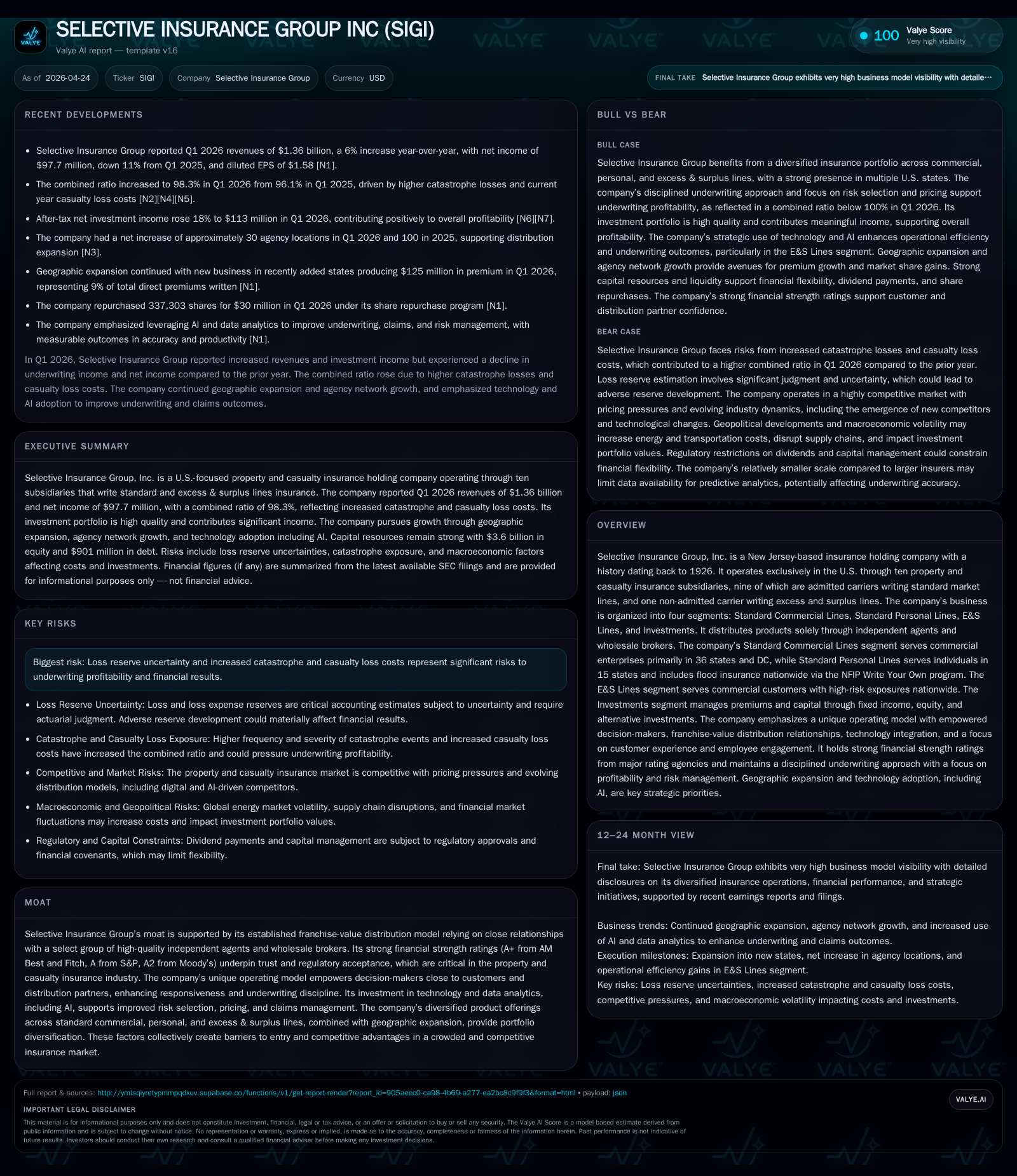
In the first quarter of 2026, Selective Insurance Group achieved a double-digit operating return on equity of 12.0%, returning $56 million to shareholders through dividends and share repurchases. The company continues to reinforce its distinctive decentralized underwriting and franchise-driven distribution strategy, leveraging technology investments including AI to enhance risk selection and claims management. While facing rising catastrophe losses and social inflation pressures, Selective's disciplined underwriting and capital management, supported by strong financial strength ratings, position it well for measured growth and profitability. Investors should monitor geographic expansion efforts, underwriting margin trends, and ongoing technology deployments as key execution milestones.
Q1 2026 Results Highlight Operational Strength
Selective Insurance Group kicked off its centennial year with a solid operational performance in the first quarter ending March 31, 2026 [S2]. The company reported a double-digit operating return on equity (ROE) of 12.0%, demonstrating resilience despite pressure from higher catastrophe losses and elevated current year casualty loss costs. Underlying GAAP ROE was slightly lower at 11.2%, reflecting net realized and unrealized investment losses driven by rising interest rates.
The combined ratio rose by 2.2 points year-over-year to 98.3%, primarily due to a notable increase in net catastrophe losses (up 74%) attributable mainly to more frequent winter storms and severe thunderstorm events within Selective’s footprint [S16], [S19]. Casualty loss costs also increased by 8%, driven by the incorporation of elevated social inflation assumptions recognized during 2025 [S19]. Despite these headwinds, Selective maintained underwriting profitability supported by diligent risk selection.
Capital returned to shareholders via $26 million in common dividends ($0.43 per share declared) plus $30 million in opportunistic share repurchases during Q1 reinforces commitment to shareholder value creation [S6]. The board's discretion over dividend policy is balanced against capital requirements and regulatory constraints [S7].
Effective tax expense was slightly lower than prior year ($26.5M vs $29M), keeping the effective tax rate steady around 21.8% [S2]. Portfolio investment income remained a positive contributor with net investment income up modestly to $113 million after tax [S14].
Selective’s Unique Business Model and Distribution Ecosystem
Selective’s business model is rooted in a decentralized underwriting approach complemented by a franchise-value driven distribution system consisting exclusively of high-quality independent agents and wholesale brokers [S1], . Nine of its ten property & casualty subsidiaries operate as admitted carriers focusing on standard markets while one non-admitted carrier writes excess & surplus (E&S) lines nationally.
A hallmark strategic advantage is empowering front-line underwriters placed near customers and distribution partners who exercise authority on key decisions, enhancing responsiveness and maintaining rigorous underwriting discipline at a granular level [S1], [S15]. This localized authority fosters accurate risk assessment closely aligned with evolving market conditions.
Distribution is carefully curated — the independent agencies constitute long-standing relationships that realize "franchise value", enabling Selective to compete effectively against large national insurers which often employ direct or captive agent channels. This relationship-driven model supports customer retention, premium renewal pricing power (renewal pure price increases around ~9-10%), and mitigates attrition risks even during competitive soft markets [S16], .
The company invests meaningfully in advanced technology platforms including AI-enabled analytics covering claims automation, risk evaluation, pricing, and fraud detection — early deployments have shown measurable improvements in accuracy and operational efficiency especially within E&S lines where underwriting complexity benefits from data-driven tools [S15]. This technological edge bolsters Selective's ability to refine underwriting margins amid challenging external cost inflation.
Competitive Positioning Within Property & Casualty Insurance
Selective holds a middling yet respected position among top U.S. property/casualty writers — ranked #34 by AM Best based on net premiums written in 2024 — supported by consistently strong financial strength ratings (AM Best A+, Fitch A+, S&P A, Moody’s A2) that enhance trust among policyholders and regulators alike [S1], . These ratings facilitate favorable reinsurance contract terms critical for managing catastrophe exposures.
Operating predominately in the eastern half of the United States—the company's commercial footprint spans approximately 36 states plus DC—Selective benefits from focused geographic expertise enabling tailored risk appetite calibration versus national multi-line insurers with broader but less nimble presence [S10], [S23]. Its personal lines reach fewer states (~15), though flood insurance is written nationwide through NFIP’s Write Your Own program.
Mesa Underwriters Specialty Insurance Company acts as the platform for E&S business which addresses clients with higher-risk profiles underserved by standard carriers; this segment has seen significant premium growth supported by system modernization delivering greater operational leverage with limited headcount expansion [S15].
Regulatory nuances shape product offerings between admitted vs non-admitted markets; selective participation allows nimbleness while preserving compliance integrity across multiple jurisdictions influencing profitability dynamics differently within segments.
Key Growth Drivers and Market Challenges
Growth avenues for Selective include:
- Geographic expansion: Since 2017 adding fourteen states in Standard Commercial Lines including recent entry into Kansas (2025). Planned entries into Montana and Wyoming slated for late 2026 subject to regulatory approvals aim at achieving near-national coverage [S15], [S23]. First quarter expansions contributed roughly 9% of total direct premiums.
- Segment diversification: Enhanced penetration of E&S lines leveraging distinctive expertise combined with expanded retail access offers above-market returns potential amid rising demand for specialty coverage.
- Technology enablement: Scaling AI applications across underwriting / claims stages promises sustained improvements in precision pricing, loss control effectiveness, productivity gains offsetting inflationary pressures [S15].
- Agency network growth: Net increase of approx. thirty agency locations during Q1 demonstrates steady franchise augmentation supporting organic premium growth.
However, Selective confronts significant market challenges:
- Catastrophe exposure volatility: Escalating frequency/severity of climate change-related weather events such as hurricanes, wildfires, winter storms creates unpredictable claims spikes increasing loss variability beyond traditional models’ estimates; impacted first quarter results materially [S19].
- Social inflation: Structural upward trends in casualty claim severities driven by expanding litigation scope, longer settlement periods, higher jury awards especially in general liability lines require sophisticated loss trend modeling; influences pricing adequacy necessities [S19], [S16].
- Inflationary environment: Higher labor/material costs delay claims settlements increasing ultimate payouts; supply chain disruptions elevate repair costs further complicating reserving accuracy.
- Competitive environment: Pursuit of premium growth is balanced against selective tightening in underperforming sectors/regions where risk-adjusted returns do not meet benchmarks leading to deliberate exposure reductions ensuring margin protection [S25].
Despite these headwinds, management emphasizes relentless focus on fundamentals — granular risk selection improvements, individual policy pricing accuracy enhancements, prompt equitable claims outcomes remain top priorities underscoring franchise resilience moving forward.
Capital Strategy and Financial Health
Historical performance (annual)
| FY | Rev ($bn) | Net ($mm) | CFO ($mm) | Capex ($mm) | Rev YoY | Net YoY |
|---|---|---|---|---|---|---|
| 2025 | 5.3 | 466 | 1233 | 39 | +9.8% | +125.3% |
| 2024 | 4.9 | 207 | 1100 | 31 | +14.9% | -43.3% |
| 2023 | 4.2 | 365 | 759 | 23 | +18.9% | +62.4% |
| 2022 | 3.6 | 225 | 802 | 26 |
Source: SEC companyfacts cache [F1].
Capital returns and efficiency (annual)
| FY | Div ($mm) | Buybacks ($mm) | FCF ($mm) |
|---|---|---|---|
| 2025 | 93 | 93 | 1194 |
| 2024 | 85 | 16 | 1069 |
| 2023 | 74 | 8 | 736 |
| 2022 | 67 | 18 | 776 |
Source: SEC companyfacts cache [F1].
Selective’s capital position remains robust as of March 31, 2026 with stockholders’ equity totaling approximately $3.6 billion alongside manageable long-term debt approximating $901 million yielding a conservative debt-to-capital ratio of roughly 20.1% consistent with historical prudent leverage standards for rated insurers [S4], [F1]. High-grade fixed-income portfolio holdings underpin liquidity needs while supporting an effective duration around 4.3 years balancing yield pursuit versus interest rate risk exposure [S22].
Insurance subsidiaries generated $75 million in dividends flowing up to the Parent during Q1 reinforcing internal capital recycling efficiency; the allowable ordinary maximum dividends remain substantial enabling flexible capital allocation frameworks pending regulator approvals [S9], [S10].
Capital allocation reflects a balanced approach prioritizing solvency maintenance alongside disciplined shareholder returns evidenced by dividend declarations at $0.43 per common share planned for June payment plus ongoing opportunistic repurchases ($30 million executed in Q1 with ~$140 million remaining authorization) providing incremental EPS accretion potential [S6], [S12], [F1]. The Parent maintains access to liquidity facilities unused this quarter but providing additional financial flexibility if needed through credit lines maturing in mid-2028 under variable interest rate regimes tied to credit ratings collateralized by subsidiary investments [S7].
Operating cash flow generation remains healthy albeit slightly lower than prior-year quarter primarily due to narrowed underwriting gains but supported positively by investment income stability; capital expenditures remain modest reflecting investments largely focused on technology platform modernization projects enhancing future operating leverage capacity rather than traditional physical capex deployments [F1], [S14], [S23].
Forward-Looking Considerations: What Investors Should Monitor
Key execution benchmarks shaping near-term Selective performance include:
- Combined ratio trajectory: Management targets full-year GAAP combined ratio guidance range narrowing between approximately 96.5%–97.5%, balancing ongoing market losses with underwriting discipline initiatives reflecting margin improvement ambitions post-Q1 volatility impact [S15], [N3]. Monitoring quarterly updates will clarify trajectory execution fidelity.
- Geographic Expansion Progress: Entry into Montana/Wyoming later this year provides test cases for incremental commercial premium growth; regional market reception plus regulatory hurdles remain key gating factors.
- Agency Network Development: Sustained agency count increases bolster distribution depth sustaining renewal volumes; watch for any shifts accelerating or decelerating recruitment pace reflective of competitive positioning.
- Reinsurance Pricing & Cat Modeling: Shifts in reinsurance costs stemming from updated catastrophe models or hardened pricing cycles may influence ultimate loss cost assumptions integral to underwriting profitability analysis.
- Technology Implementation Outcomes: Measuring realized benefits from scaling AI tools across claims triage/risk management functions essential for validating investments delivering improved speed/accuracy/profit gain economics at line-of-business granularity.
- Regulatory Environment Developments: Emerging state-level insurance regulatory changes potentially affecting product filings/dividend restrictions particularly given lingering inflationary cost pressures warrant vigilance.
These factors collectively form the operational roadmap navigating present industry headwinds while leveraging core strengths honed through Selective’s century-long heritage.
Disclaimer: This report is an objective analysis based on publicly available SEC filings and credible news sources as of April 24, 2026. It does not constitute investment advice or recommendations concerning securities transactions.
Disclaimer: This is research-only, informational analysis and not investment advice. It may include AI-generated interpretation and general industry context. Always verify important details using primary sources.

Comments