
Norfolk Southern’s Q1 2026 Update Reflects Merger Progress Amid Legal and Operational Challenges
Latest quarter highlights merger integration steps, operational resilience, and ongoing legal exposures.
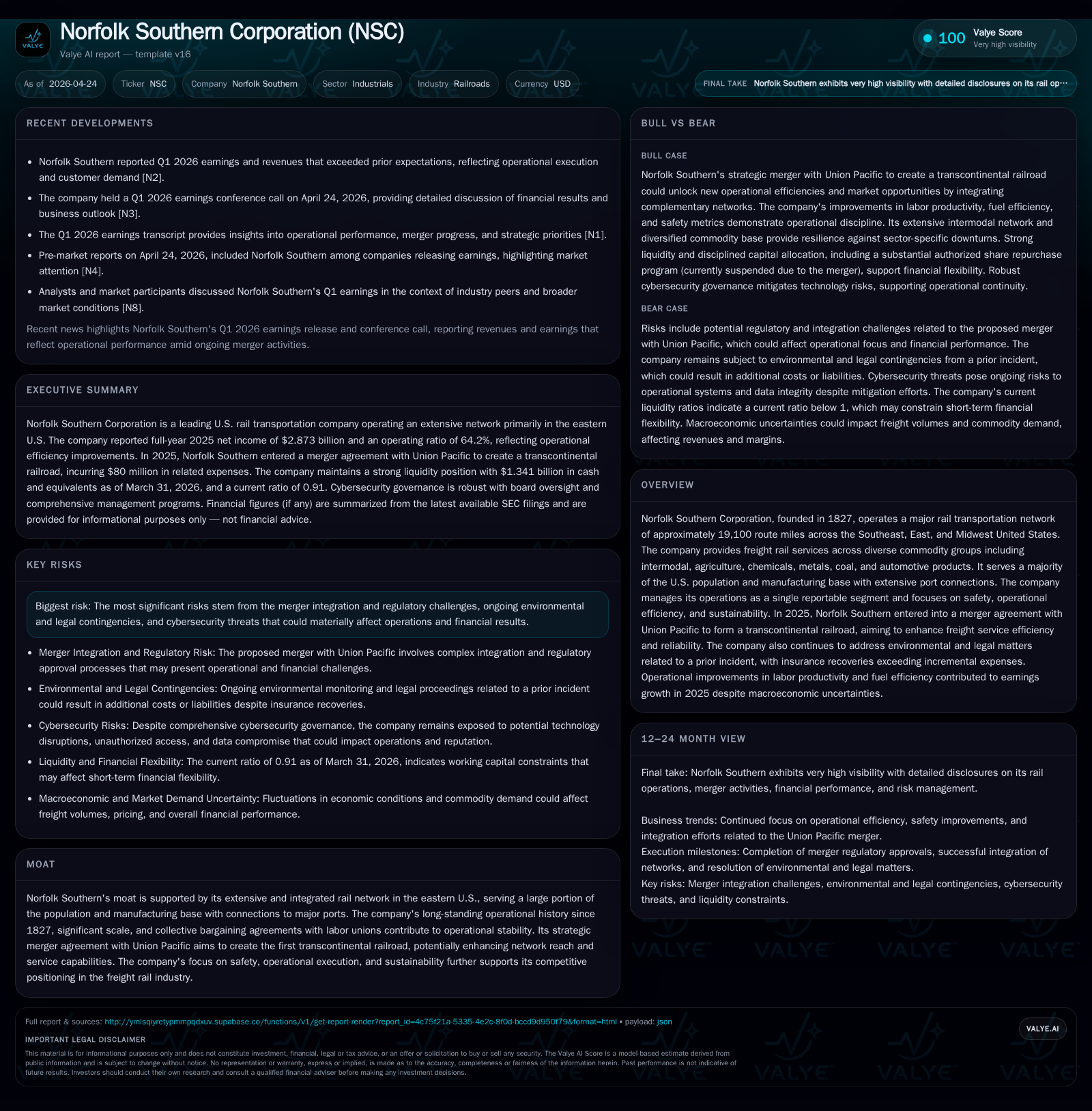
In its latest 10-Q filing for Q1 2026, Norfolk Southern Corporation reported continued operational focus while advancing its transformative merger with Union Pacific. The company remains exposed to legal contingencies stemming from the 2023 Eastern Ohio derailment, though insurance recoveries have mitigated expense impacts. Norfolk Southern’s extensive rail network and diversified freight portfolio underpin its competitive moat. Growth is both supported and constrained by regulatory scrutiny and evolving demand in key commodity segments. Financially, the company maintains robust cash flows alongside significant debt aligned with capital investments and merger-related obligations.
Recent Operating Update: Q1 2026 Highlights
Norfolk Southern Corporation’s most recent quarterly filing (10-Q dated April 24, 2026) outlines continued progress toward its strategic merger with Union Pacific [S2]. This integration represents a transformative step positioned to establish America’s first true transcontinental railroad network combining complementary eastern and western U.S. rail routes [S1]. The company's management continues to balance merger execution with core operational imperatives such as safety enhancement and service reliability.
Operationally in Q1 2026, Norfolk Southern navigated pressures from macroeconomic cycles impacting freight volumes while focusing on labor productivity improvements and fuel efficiency [N1], reaffirming its long-standing emphasis on operational discipline. The event filing concurrently confirmed that insurance recoveries related to the February 2023 East Palestine derailment now exceed incremental remediation costs incurred through the recent period [S3]. This is critical given the substantial contingent liabilities noted since the incident.
Business Model Overview
Norfolk Southern operates an integrated freight railway system covering approximately 19,100 route miles primarily across the Southeast, East Coast, and Midwest of the United States [S1]. The model revolves around transporting raw materials, intermediate goods, and finished products for a diversified customer base spanning sectors such as intermodal transport (containerized goods), agriculture & forest products, chemicals (including natural gas liquids), metals & construction materials, coal shipments, and automotive manufacturing components [S7][S17].
Revenue generation relies heavily on negotiated contracts that include fuel surcharges—approximately 95% of revenue originates under these agreements—providing a mechanism to partially offset volatile fuel costs [S26]. Pricing power varies by commodity mix; favorable pricing offsets adverse volume trends in several groups such as coal and intermodal segments [S9][S25].
Norfolk Southern manages all operations primarily through a single reportable segment centered on railway operations encompassing all geographic service areas and product lines [S7]. Decision-making consolidates financial performance for optimal resource allocation across the network.
Industry Structure and Competitive Position
The Class I freight rail industry in North America is oligopolistic with few large players controlling vast rail networks integrating into supply chains supporting manufacturing hubs and port gateways. Norfolk Southern’s moat is driven by its entrenched eastern U.S. infrastructure connecting key metropolitan areas—including ports along the Atlantic seaboard—and serving a broad industrial footprint [S17].
The merger agreement with Union Pacific aims to complement this network by adding expansive western routes that would enable seamless coast-to-coast freight transportation—offering customers more efficient transit times and reduced inter-modal switching costs [S1]. This consolidation should bolster pricing leverage via enhanced service quality but faces scrutiny from regulators concerned about potential service monopolization or antitrust implications [S14].
Labor relations are another dimension of stability; nearly 80% of Norfolk Southern’s employees are unionized under collective bargaining agreements contributing to operational continuity but also imposing structured cost frameworks [S7].
Growth Drivers and Constraints
Growth drivers for Norfolk Southern include:
- Merger Synergies: Expected cross-network efficiencies could stimulate new business flows and optimize asset utilization post-integration.
- Commodity Demand: Expansion in automotive production cycles and chemical shipments supports volume growth.[S25]
- Intermodal Potential: Leveraging container traffic linked to expanding international trade flows; however recent declines linked to reduced West Coast-origin traffic signal vulnerabilities.[S26]
- Operational Enhancements: Improvements in safety metrics foster regulatory goodwill and reduce disruption risks; productivity gains improve cost competitiveness.
Constraints include:
- Regulatory Oversight: Merger approvals remain uncertain amid antitrust reviews.[S14]
- Legal Exposure: Environmental remediation liabilities following the Eastern Ohio derailment carry ongoing litigation risk despite insurance mitigating net impact.[S14][S21]
- Market Cyclicality: Volumes in coal shipments face structural headwinds from transitioning energy markets; intermodal demand sensitive to trade tariffs and logistics competition.[S26]
- Cybersecurity Risks: Persistent threats to operational technology systems present potential for disruptive incidents that can impair service reliability.[S1]
What to Watch Next
Key upcoming developments include:
- Regulatory decisions concerning the merger with Union Pacific — any delays or conditions could materially affect long-term strategy execution.
- Resolution milestones around legal cases stemming from the East Palestine incident — outcomes could influence financial provisions or reputational standing.
- Quarterly volume trends in intermodal freight serving international trade corridors — pivotal for sustaining non-commodity revenue streams.
- Safety performance metrics released periodically — provide insight into operational risk management effectiveness.
- Capital expenditure allocations post-merger announcement — indications of fleet modernization or digital infrastructure investments assure competitiveness.
Financial Profile Summary
Historical performance (annual)
| FY | Net ($bn) | CFO ($bn) | OpInc ($bn) | Capex ($bn) | Net YoY |
|---|---|---|---|---|---|
| 2025 | 2.9 | 4.4 | 4.4 | 2.2 | +9.6% |
| 2024 | 2.6 | 4.1 | 4.1 | 2.4 | +43.5% |
| 2023 | 1.8 | 3.2 | 2.9 | 2.3 | -44.1% |
| 2022 | 3.3 | 4.2 | 4.8 | 1.9 |
Source: SEC companyfacts cache [F1].
Capital returns and efficiency (annual)
| FY | Buybacks ($bn) | FCF ($bn) | ROE% |
|---|---|---|---|
| 2025 | 0.5 | 2.2 | 18.5 |
| 2024 | 0.0 | 1.7 | 18.3 |
| 2023 | 0.6 | 0.8 | 14.3 |
| 2022 | 3.1 | 2.3 | 25.7 |
Source: SEC companyfacts cache [F1].
As of March 31, 2026, Norfolk Southern held approximately $1.34 billion in cash and equivalents against total debt near $16.5 billion yielding a net debt position around $15.15 billion [F1]. The current ratio stands at 0.91 reflecting typical working capital dynamics within capital-intensive rail operations [F1].
Financial performance trends demonstrate steady improvement: annual operating income grew by roughly 7% year-over-year reaching $4.36 billion in FY2025; net income gained nearly 10% over prior year levels totaling $2.87 billion; operating cash flow expanded similarly indicating robust internal liquidity generation capacity [F1]. Capital expenditures approached $2.2 billion in FY2025—a scale consistent with ongoing network maintenance plus investments oriented toward digital transformation and capacity enhancements [F1].
Dividend policy remains stable delivering meaningful returns to shareholders alongside share repurchases paused due to merger-related restrictions but historically part of capital deployment strategy [F1][S23].
Lease financing structures for corporate headquarters were refreshed in April ’26 indicating active balance sheet management [S29].
Conclusion
Norfolk Southern Corporation’s Q1 2026 disclosures paint a picture of a railroad balancing legacy operational rigor with transformative ambitions via its pending merger with Union Pacific. While legal contingencies from past incidents remain an overhang, effective insurance coverage coupled with disciplined safety programs help mitigate material risks. The company’s scale, strategic geographic footprint in the eastern U.S., extensive port connections, diverse commodity exposure, and ongoing investment in modernization underpin its durable industry position.
However, growth will hinge on successfully navigating regulatory scrutiny of the merger deal alongside adapting to evolving market demands especially in intermodal freight where competition intensifies. Monitoring execution milestones related to integration progress, legal litigations resolution timelines, volume recovery trajectories in key segments, and cybersecurity robustness will be critical indicators of sustained operational strength going forward.
This analysis synthesizes publicly available SEC filings as of April 24, 2026 ([S1],[S2],[S3]) alongside supporting financial data ([F1]) without providing investment advice or recommendations.
Disclaimer: This is research-only, informational analysis and not investment advice. It may include AI-generated interpretation and general industry context. Always verify important details using primary sources.

Comments